
Twenty years have passed since Lázaro Saavedra presented his exhibition La imagen del pensamiento, el pensamiento de la imagen in 1993. From that entry based on comic strips, drawings, and installations, we recall El Sagrado Corazón, Saavedra’s version of the iconic image seen in so many homes throughout the country, and La isla del tesoro. In the former, the Cuban flag was visible against the chest of Jesus, and while his words outlined the hammer and sickle, a bubble with the U.S. flag referred to what was in his mind. In the latter, we saw a hyperbolic Cuba, grown continent-like well beyond its place in the Gulf. The symbolism in these two works was a succinct expression of the paradox of Cuba’s circumstance and established Saavedra as a chronicler of his society.
In his work, Lázaro Saavedra has built an ethical discourse that is heuristic in its condition, where the element of the installation, drawing, and painting meet and connect with objects, performances, animation, video art, photography, and web art. It is important to highlight in this combination of methods the deployment of tools taken from graphic humor, comic books, and graffiti. All of which renders Saavedra a singular conceptualist, amalgamating philosophical explorations with humor and vernacular elements.
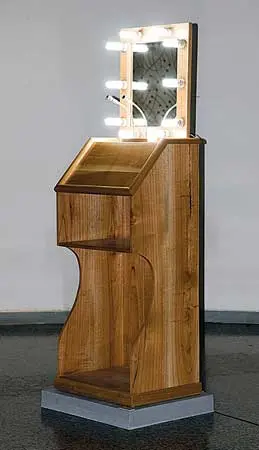
Invited to once again present his work at Havana Gallery, Saavedra conceived Sin concepto. It displayed clearly his condition as a satirist, noted early by Osvaldo Sánchez. The playful title underscored this, and entertained us with its jocularity. But the real opening was the statement made by a drawing on the wall, reflecting Saavedra’s questioning rationality: “We are all marionettes, I just draw the strings,” the text from Artista contemplativo1 that we discovered right before entering and was now part of Trastorno bipolar (with a small-format English-language duplicate included), emphasizing the absurdity of the two legal tenders that define Cuba’s economy. After that graphic, the podium titled Narcigogia appeared in its full theatricality. Its title, a neologism that combines narcissism and demagoguery, was as clever and surprising as its fusion of a podium with the mirror usually found in a dressing room, surrounded by economy light bulbs of the kind used daily by Cuba’s citizens. This contraption embodied the rhetoric and complacency of power. A power that likes itself and enjoys its own language, its effects, and its vacuums. Works like these revealed Lázaro Saavedra as the scourge of social ills he has consistently been, a sharp protagonist of critical art in Cuba and a leading member of New Cuban Art.2
For this exhibition, which established a more sensorial connection with its audience (without fully setting aside Saavedra’s verbalizations), the artist selected more than twenty works including drawings, sculpture objects, paintings, and installations, mostly created in recent years, as well as variations of previous editions of his work. In the latter set, the protagonist was Detector de ideologías (electronic). It didn’t work due to the lack of parts, a comment on a circumstance of material deprivation. On the other hand, a chess set made in 1987—now presented in wood—and the plaster bust of Saavedra’s well-known portrait of Karl Marx, was included in the series titled Del Siglo XX al XXI.
Special mention must be made of Se va conmigo a la tumba, a series of drawings on the wall clearly concerned with aesthetic considerations, and Software cubano, an algorithm that summarized the society’s cybernetic behavior. Other standouts, although in a different sense, were Palimpsesto, Naturaleza muerta, and Expresionismo, alongside a small aside of small-format drawings. The installation Mima, which closed the exhibition, was, more than a portrait of the artist’s mother, the condensed expression of many lives given to society. The biography suggested by specific photographs and numerous diplomas of recognition—pieces of paper that do not express the everyday sacrifices of several generations of Cubans—was a historical projection of the individuals upon whom utopia was built.
The work of Lázaro Saavedra constitutes an analytic space that subjects art, politics, and society, as well as human nature, to profound revision. In a general sense, he moves from the contextual to the universal, from the analytical to the gestural, without having his cultivated spirit shirk from popular elements and his art cease to interrogate reality.
NOTES
1. Artista contemplativo was shown for the first time in Cuba as part of Arte Rupestre, Lázaro Saavedra’s exhibition at the Museo de Arte de Pinar del Río (MAPRI). There, it was a stand-alone drawing within the graphic expression that used the museum walls as its support.
2. Nuevo Arte Cubano, a concept used by critic Gerardo Mosquera to define the
movement of artistic renewal that began in the early 1980s.
CARIDAD BLANCO DE LA CRUZ