
With Leandro Katz: arrebatos, diagonales y rupturas at Espacio Fundación Telefónica and Leandro Katz: rincones y refugios at Galería 11 x 7—the former an anthology exhibition curated by Bérénice Reynaud; the latter, a selection of recent works—the presence of this artist is strongly felt these days in his native Buenos Aires (Katz lived and worked in New York City between 1965 and 2006).
The protagonist of Katz’s anthology show at Telefónica—the first of this kind for the artist—is a technological organism comprised of photography, digital art, and works in film and video, all made between 1965 and 2013. One of the central revelations of this exhibition is the balance between Katz’s great mastery of the technology of the image and the tangible potency of his contents, which are, among others, political in character. Both ingredients come together into a vigorous unit. Each work featured in this show expresses such forcefulness. Moreover, they seem to have been projected for unavoidable receptors. The images and concepts possess an uncommon magnetism.
Katz’s complete mastery of the medium, evident in all the works on exhibit, begins by the revelation of the primitive state of cinematographic technique and of video in Siete Luces, 1968-2013, which consists of a harmonium of lights built by the artist for a shadow theater in 1968, with its corresponding screen. It renders the shadows produced by the motion of hands or bodies visible. In an extensive gesture of historical memory, Katz goes 5,000 years into the past—when this technique to produce images in motion was invented in Java, and later in China—to show the germinal stage of the future technologies of the image.
The works on exhibit in Espacio’s great first-floor gallery—including Siete Luces—are preceded y a photograph of Karl Marx, as the key to the background that will haunt the entire experience. This gives the show undertones of a 1960s-like utopia, signaling the era when Katz’s career was launched. Yet, beyond this opening gambit, the themes of a large portion of the exhibition are focused on Argentinean and Latin American issues, bringing forth a yearning for a constructed identity.
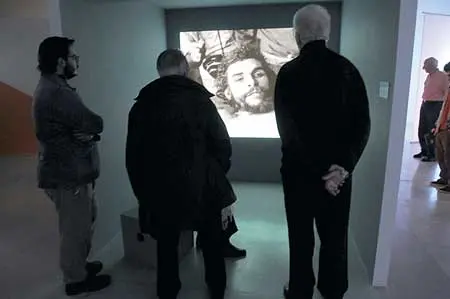
With its Gardel-inspired title, El día que me quieras (1997) is a documentary video centered around the world-famous photographs of Che Guevara’s corpse by Bolivian photographer Freddy Alborta, taken in the laundry room of Valle Grande Hospital Bolivia, in 1967. The video’s thirty-minute length goes by in a flash due to the poignancy of the narrative. Alborta’s images and words, the revisiting of the famous photograph, and its myriad details told by the author himself, among others. The analogies with Rembrandt and Mantegna came later. That image and others were captured barely hours after Guevara’s death, which also transformed our perception of the photograph over time.
The themes explored by the videos are many, yet all of them process experimental and documentary elements, a readily accessible hypersensitivity on the part of their creator, to the point that visitors are able to pulsate with the work as if the experience were their own.
La escisión, a 1978 video, refers to Emma Zunz, the title character in a Jorge Luis Borges’ short story about revenge and justice. Even in the face of family and personal disgrace, Emma chose to act justly: yet another example of a utopia that also includes, among elements, a morality.
Exhumación, 2007; La visita, 1986; Mucho ha cambiado París, 1977; Estación Los Angeles, 1972-1976; Paradox, 2001. The latter alternates images of a stone altarpiece dating from the Classical Maya period with others of present-day banana exploitation. Parallelisms and contradictions. Cultural decadence and injustice are axial themes for Katz, on display here.
In parallel, a variegated corner takes over half a dozen films from Charles Ludlam’s Play-House of the Ridiculous made between 1969 and 1973, one of the few documentary records of the company’s work.
Finally, two works can be seen as the closure of the exhibition, from among other possible candidates: Horizonte perdido, 2010-2013, and the series of the Moons. The former is a projection on a long, narrow screen. The image is a marine landscape featuring the beach, sky, and horizon. A red flag flaps incessantly over the shore, seeming to envelop the sea and part of the horizon.
This work and Las Lunas can be clearly deemed romantic, a beautiful undertow that sustains all the works in the exhibition, accompanying them with the possibility of dreaming a different reality.
MERCEDES CASANEGRA