
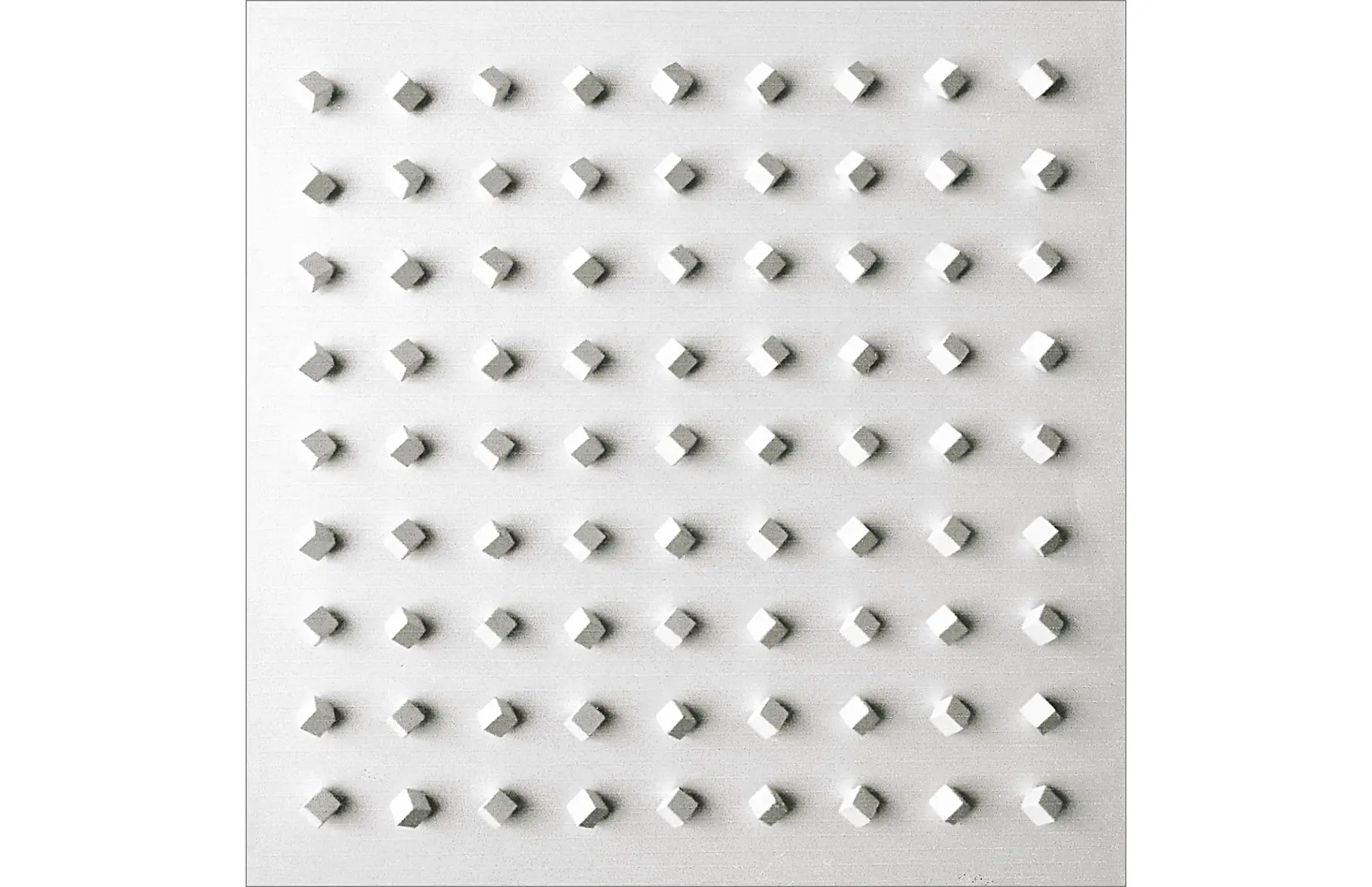
An internationally recognized representative of Op Art, Tomasello decided to follow an independent path. In order to establish a concise language based on the economy of means, he needed a maximum of controlled expressiveness.
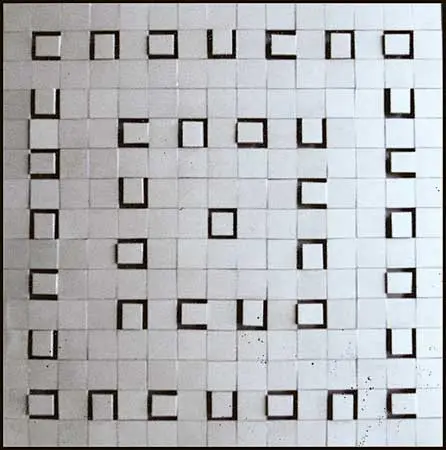
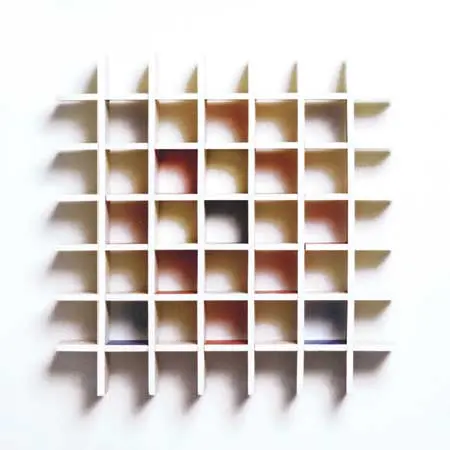
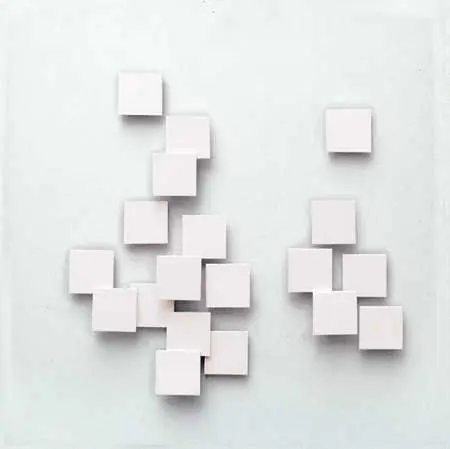
In Tomasello’s work, each cube acquires a particular meaning. It contains the infinite points of his planes, and also the verticals and horizontals formed by aligned borders that loop, converge, and diverge, all part of the work. On the one hand, we encounter here reliefs in the strictest sense of the term; on the other, we notice the color white and the expressive potency of the monochrome. But light does exist, ever-present in its capacity for reflection upon the surface. Light is not represented as it was throughout the history of art, and neither is it “installed” as in kinetic art. In Tomasello’s Atmósferas cromoplásticas, light is manifest as such: it rounds the cubes, traverses them, and there appears something that is basically a deviation of the directionality of light rays. It gives us back a reflected image, and with it, we seem to be reading a visual poem. Our memory goes back to certain laws of physics and their visual derivations. All of it, wisely summarized.
Until approximately 1950, Tomasello painted in oil, in a figurative manner. After a European sojourn in 1951, he discovered original works by Mondrian and Malevich. Starting then, he engaged in an investigation that systematically followed the very evolution of art history. Post-Cubist landscaped, a study of rhythm based on Mondrian, and concrete-art exercises marked the next half-decade.
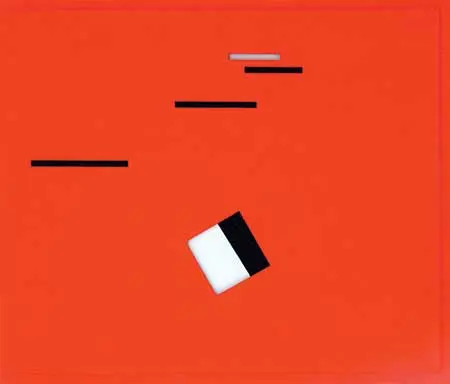
Mondrian’s famous Broadway Boogie-Woogie is a source of inspiration for concrete art in Latin America, and also for kinetic art. A repeating rhythm and a concern for the surface, as well as the regularity of the construction, the sobriety of the execution, and the use of three primary colors, made neo-plasticism one of the most important veneers for South American artists.
It is important to note that Concrete artists in Argentina limited themselves to the exclusive use of geometric shapes, combining them with each other. They didn’t allow themselves the slightest intervention of individual sensibility in the application of color on the canvas. Concrete artists rejected all sensation of perspective, and they did not see the painting as a “window.”
Tomasello’s Relieves Negros, created in 1982 and brought to full fruition in the mid-1990s, implies the complete repositioning of the artist with respect to his previous work. We notice that Tomasello replaced the use of light with the use of shadows, color with the absence of color, high-relief with bas-relief.
It was in this way that Tomasello, a follower of Mondrian, educated in the rigors of concrete art, builds volumes and relieves based on a systematic and geometric organization. In the last decade, the Argentinean artist has introduced vivid colors into his work.
Light manifests itself in indirect ways: it gives us a reflected image, and, with it, we seem to be reading a visual poem. In his Atmósferas Cromoplásticas, this reading happens from any angle. Viewers observe the reflected light from different points of view and discover that there is no beginning or end. The whole is atomized. And, as in the game of hopscotch, it perhaps moves towards the sky.
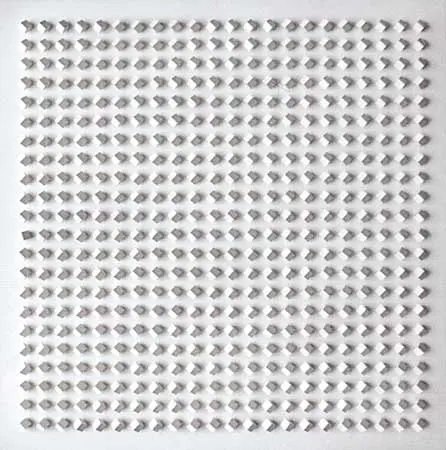
Susana Sulic: The chromoplastic atmosphere Belloli speaks of, consists of a will to dissolve at once the volume of his reliefs and color itself into a vibration that takes the observer away from the geometric rigor with which he or she is confronted, his or her knowledge if you will.
Luis Tomasello: I first perceived the vibrations on the basis of the atomization of square shapes in Mondrian’s last-period work. And this happened thanks to the disappearance of the characteristic black strip that was used to separate the colors.
S.S.: You moved away from flat surfaces then and towards relief…
L.T.: With reliefs, I proceeded towards the use of light that created kinetic effects: a sensation of motion due to optic instability.
S.S.: You limit yourself to a valorization of reflected color, which is to say, you do not paint the squares that receive environmental light, in order not to confuse different issues.
L.T.: I don’t paint the external faces because then I would be getting color-vision and color-reflection at the same time.
S.S.: Tomasello, are you essentially a painter?
L.T.: I carry on with my effort as a painter because I am essentially working with surfaces.
S.S.: You express a will to go beyond the plane.
L.T.: Colors move forward and back.
S.S.: What was your education?
L.T.: In Buenos Aires, I wanted to do Fine Arts. I started with a private instructor. Then I was accepted into the Academy at the time it was known as the Alsina School because it was on the street of that name. In 1938 I received my diploma as a teacher. For four years, started in 1940, I attended the Escuela Superior de Pintura Ernesto de la Cárcova. At the Escuela I had a professor whose teachings helped me a great deal.
S.S.: It was the experience at the Escuela Superior that initiated you in the life of an artist…
L.T.: In truth, I think one must be an autodidact. Diplomas aren’t necessary to be an artist.
S.S.: But you were also educated as an architect.
L.T.: One of my brothers was an architect and the other one was an engineer. I worked with them for twenty years. And I built my own studio in a lot that belonged to my father. That was my first studio. I told my father that I wanted to be an artist.
S.S.: You were still doing figuration at the time. Both your landscape and your nude studies reflect the influence of Cézanne.
L.T.: I like Cézanne’s sense of composition. In my figurative works, the weight of form mass, and volume is felt.
S.S.: One notices the beginnings of an abstract structure.
L.T.: In the 1950s I worked on figurative paintings with reminiscences of cubism and expressionism.
S.S.: But, how did the intuition of color-light come about?
L.T.: It was in front of the stained-glass windows at the Chartres Cathedral that I had the intuition of the color-light. I felt a vivid emotion as I discovered that colors were realized through light. What we experience with stained glass s color-light… a sensation of color.
S.S.: All of that has poetic content…
L.T.: It is possible that the Moon has always been the object of poetic rituals in literature because its light is a reflected light.
S.S.: It is not only a matter of direct or indirect light.
L.T.: On the white surface, the reflection of color has an effect that is more poetic than pure color.
S.S.: You focus on reflected color
L.T.: I don’t paint the surface that receives light in order to avoid any confusion, and in that way to preserve the entire spectrum of gray hues.
S.S.: You have chosen wood as the noble support from which geometry was launched.
L.T.: In general I use wood, which allows for the construction of prisms and painted volumes. Forms are composed of pieces of woodcut in regular shapes. The base hue is white. In general, acrylic paint or lacquer.
S.S.: The elements are extremely simple in appearance.
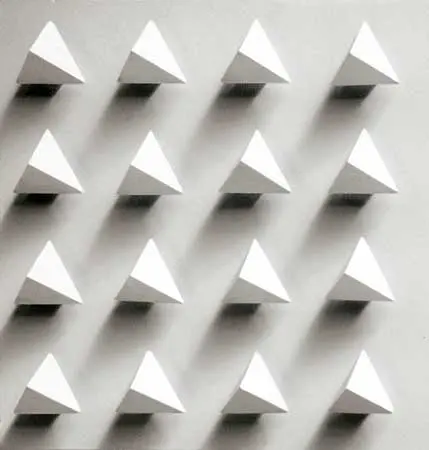
L.T.: The volumes of polyhedrons in relief create vibrations and passages of lights and colored shadows on the white plane. In this way, we move from pure color to reflected color.
S.S.: This would imply an abandonment of the narrative.
L.T.: This large painting, as an example, with its rhomboid shape, doesn’t narrate anything.
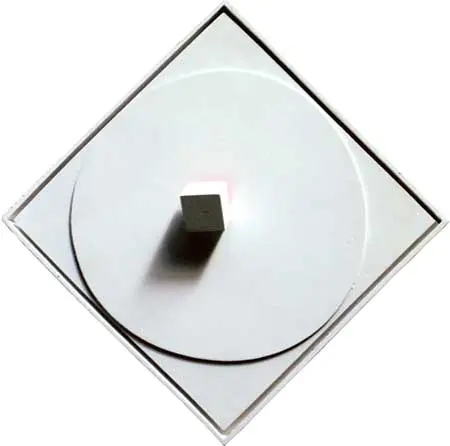
S.S.: In that way, then, you approach concrete invention.
L.T.: I decided to break with an illusory perspective and move into the three-dimensional.
S.S.: But a phenomenon of repetition also takes place.
L.T.: What produces the optical effect is the incidence of light through the repetition of the elements.
S.S.: How were your first contacts with the new trends in painting?
L.T.: I traveled to Paris in 1951 and stayed for about six months. There I became acquainted with abstraction. In Argentina, abstraction wasn’t well known. We were aware of the theoretical proposition. Back home, I met Pettoruti, and with a group of artists, we founded the Arte Nuevo group and the Arte Nuevo Salon. Aldo Pellegrini played an essential role with the publication of Artistas abstractos argentinos in 1956.
S.S.: But you didn’t stay in Europe in the end.
L.T.: I returned to Argentina with the idea of going back to Europe. I wanted to go back to Paris immediately, but it took me four or five years.
S.S.: How were your beginnings there?
L.T.: When I arrived, I didn’t do much. Some five or six paintings on the plane. In Argentina, abstraction hadn’t become widespread.
S.S.: But when did you opt definitively for geometric abstraction?
L.T.: I saw a Mondrian exhibition at the Denise René gallery. And I was dazzled. Influenced by Mondrian’s Broadway Boogie Woogie, I continued on my path.
S.S.: When did you move from the plane to reliefs?
L.T.: Looking at a painted rod leaning on a blank paper, I noticed how color was reflected. At the time, I was in search of transparent color, and in that way, I found what I was after.
S.S.: The role played by Denise René was key.
L.T.: In 1958, after settling in Paris, I became a member of Denise René’s group. And in that way, I joined the group formed by Jean Arp and Michel Seuphor. Kinetic artists like Vasarely, Soto, Schöffer, were also there.
S.S.: Which were your first exhibitions?
L.T.: My first solo exhibitions were at the Museo de Bellas Artes de Buenos Aires and the Denise René Gallery in Paris, in 1959.
S.S.: And why did you choose Paris?
L.T.: At that time, Paris was the world capital of culture. All the significant artists had settled there: Kandinsky, Mondrian, among others. When I returned to Paris, I immediately set to work. At first, I lived in an attic, on the 7th floor. Thanks to the Coltejer Medellín Biennial prize, in 1970, and the Menton a year later, I was able to buy a lot in this popular, lively area near Plaza de Gambetta. And I designed what is still my home and my studio.
S.S.: Your work is connected to architecture.
L.T.: Incorporation into architecture allows me to take over space in its totality. On a painting, space is limited. In 1971, in Guadalajara, at the Conference Room of the Puerta Maillot Congress Palace, and then at the Grenoble police station in 1981, I used reflected color.
S.S.: But sometimes you use water.
L.T.: At the Justice Hall in Meaux, the murmur and action of water are added to the relief of granite cubes.
S.S.: All of that is also inspired by classical elements.
L.T.: Starting with the Parthenon, I could continue marveling at the skyscrapers of New York, pre-Columbian abstraction, the Inca civilization of Peru, and even the intricate Istanbul.
S.S.: Your titles speak of atmospheres.
L.T.: When I moved into reliefs, I discovered the problem of light.
S.S.: But you make white reliefs in “positive” and sometimes black ones in “negative.”
L.T.: The Relieves Negros, which came about in 1982, do not imply an opposition necessarily, they signal a complementary aspect of the investigation.
S.S.: The topic of light is endless.
L.T.: The more I work on it, the more facets I discover. At first, it was the overhangs, and later it was depth. Because with the question of light, one is never done. It unfolds into infinity.
S.S.: And even when exploring reliefs, is it a question of painting?
L.T.: Both with the canvases and with the reliefs it is a question of painting.
S.S.: Which is the most important figure?
L.T.: The square. The rotation of the square is what originates the cube. I immediately began working with fluorescent colors. On a white surface. At first, I called them reliefs.
S.S.: Can you tell us more about that period?
L.T.: Once I discovered that the color of one of the painted rods reflected on the paper, I moved from flat color to polyhedral color. It was 1959. I called them Reflexión cromática. But Belloli, the Italian writer, gave them the title of Atmósfera Cromoplástica in 1960.
S.S.: But some of the paintings are flat…
L.T.: Yes, some of those where reflection doesn’t play a role I title Objeto Plástico.
S.S.: And what about the series of reliefs in black?
L.T.: I got to black on black by carving grooves on the wood. The section with the groove is blacker than the black of the surface.
S.S.: All of that is a consequence of light.
L.T.: Yes, it is reflected color.
S.S.: What kind of paint do you use?
L.T.: For the most part, acrylic, and for more than twenty years I have been using fluorescent colors. And in general, primary colors. Yellow, because it is closest to light. Red symbolizes pain, and blue symbolizes evanescence.
S.S.: Do they have other meanings?
L.T.: Femininity, masculinity, and procreation.
S.S.: And what is your position with regards to kinetic art?
L.T.: I tried to differentiate myself from kinetic art. My issue is, rather, optics.
S.S.: There is also an aspect of the economy of means. It was Malevich who introduced those issues in the arts.
L.T.: I want to achieve the maximum using the minimum.
S.S.: How long does it take you to finish one of your paintings?
L.T.: In general, between two and three weeks, and it also depends on the dimensions.
S.S.: Do you do it all yourself?
L.T.: Yes, I do every little part of my work.
S.S.: And in connection with the viewer?
L.T.: Even though viewers discover the optical variations as they move, I focus on perception.
S.S.: Somewhere you mentioned your greatest friends.
L.T.: I was very close with Jesús Soto. I also frequented Emilio Pettoruti in Argentina, and also when he lived in Paris.
S.S.: You worked with Julio Cortázar. The writer on more than one occasion gambled for Tomasello’s work as a literary game and also in reality?
L.T.: I met him when I first arrived in Paris. And that is how Negro el 10 was born, work in collaboration with my friend. We did several books together. At a certain point, a publisher told me he wanted to work on a book with me, but it had to be a collaboration with a writer. So I asked Julio and he immediately agreed. So, first, we worked on Un elogio del tres, in 1980. I had already created my black reliefs. Cortázar, seeing the number 10 in roulette, decided to title it Negro el 10. Four years later we did another book, featuring 10 silkscreens by me and poems by Julio Cortázar.

S.S.: Do you trace any analogies between your work and those literary productions?
L.T.: Rayuela was revolutionary in the 1960s. It refers to that game children draw in chalk on the floor.
S.S.: It is said that this book inaugurates hypertext or a non-linear reading.
L.T.: That book is analogous to my art.
S.S.: A reader can start in the middle and continue that way.
L.T.: There doesn’t seem to be a starting point or an end.
S.S.: Were the two of you close?
L.T.: Julio Cortázar was my dearest friend, I was with him until the moment of his death. I designed his tomb at Montparnasse. His long-term companion died two years before him. This is how I came up with the idea of a book with two open pages. Julio Silva, another Argentinean artist created a symbolic sculpture for it. Rock holds a metro ticket. Like a character, a messenger, who visits the tomb and brings in his hand a ticket for the subway.
S.S.: Negro en 10 is a series of brief poems in which death is ever-present. He wrote it for you.
L.T.: It begins: “Begin by not being, By being no. Chaos is black. Like nothingness is black.” And it ends: “Your shadow awaits behind all light.” These are considered his last verses.
S.S.: Artists of that period were far from expressing color-light by means of reflection.
L.T.: chromo-plastic atmospheres are my invention, and it is for them that I am recognized today.
S.S.: A phrase by Cézanne comes to mind: “I love rules, which guide emotion, and emotions, which correct rules.”
L.T.: Yes, and in that way, I think I have made a small contribution to the history of art.
SUSANA SULIC
Doctor in Aesthetics and New Technologies of the Image by Paris VIII, Sorbonne; professor of Fine Arts in Buenos Aires, History of Contemporary Art at Paris IV Sorbonne, and Graphic Arts at Dusseldorf’s Kunst Akademie.