
It is already common practice for the dominant discourses to substantiate the fantasy perspective or the exaltation of the marvelous-reality category when it comes to promoting in the European context Latin American cultural productions and aesthetic discourses. In most instances, such representations are preceded by reductionist analyses or by falsifications that turn the culture of the other into the fetish that feeds the hunger for otherness. Nonetheless, sometimes the artists themselves are the ones that appeal—in their eagerness to affirm cultural characteristics that respond to a teleological and heuristic vision of the reference culture—to those values, with the intention of rewriting their own stories independently from the prevailing anthropological opinion or from the outline offered by Western sociology. When the subject is unusual or when the “subjectivity” deviates from the norm and the ideology behind it must be restored time and time again through the field of power relations, such approach almost always results in a “positioning exercise” in which the voice acquires character beyond the prescriptions that shape it.
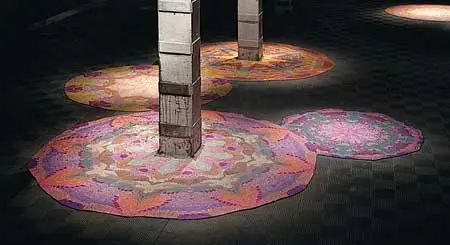
The intervention titled Cenotes by Chilean artist Magdalena Atria at the former cold storage building of the Matadero de Madrid revives a series of inquiries associated with the aforementioned themes. The installation is a beautiful montage that reclaims the value and pertinence of a Mayan legend or mythology, according to which, these magical sinkholes not solely would provide water to farming communities, but also represented a bridge between the worlds of reality and fiction. They were the doorway to the wonders of another world within the order of a tangible reality while, at the same time, their animistic and poetic idealization offered an excellent way of communicating with the gods. In Atria’s own words, “Cenote is a term used in Mexico that comes from the Mayan word dzonot, which means abyss or sinkhole. They are freshwater wells naturally created by the erosion of the soft and porous limestone. In the Maya world, they were a source of life that provided the vital liquid (…) Cenotes originate in collapsed caverns and they are often interconnected through a vast system of underground tunnels and cavities well into the depths of the earth. Both from a geological and mythic standpoint, they are thresholds that connect two planes of reality: the everyday world that expands under open skies, bath by sunlight and inhabited by familiar life forms; and that other world is hidden under the surface, dark and mysterious, populated by unknown phenomena and creatures and also by fantasy and myths associated with the supernatural and the marvelous.”
Thus, the piece serves as a great allegory for the unfortunate lack of poetic in the life of Western and globalized societies, where the blind prevalence of rabid skepticism and essentialism has exiled the value of utopias. The verticalism of Western models and their tendency to the excessive ideology of the utilitarian and the pragmatic has resulted in the erosion of the narratives that recover for their own consumption the value of local imaginaries and oral traditions. The piece by Magdalena Atria is undoubtedly an ode to beauty amid a horrendous media circus that transforms death into an abject and meaningless act through repetition and by turning it into a spectacle. Atria’s visual essay at the former cold storage space—once used to store the cadaver of the beast—now pays tribute to the local traditions and to the expanded paradigm of art. What are actually these psychedelic rugs that use beauty as an excuse, as an end, and a means? What other aspects of the evolution of the art practice and of its narratives is she submitting to the discussion?
Cenotes reinvigorate the debate surrounding the languages, grammar, and ontology of painting. It restitutes the value of the medium and offers an expanded vision of the pictorial occurrence through a modality that blurs the lines between painting, installation, performance art, and kinetic art. Her drawings with multicolor plasticine become free from the constraining walls of history as they activate their visual and narrative possibilities. Every one of Atria’s interventions tells a story, combines the history of the space with her personal narrative and the aesthetic overtures allowed by the medium, to the extent that its malleable nature can conform to the narrative and aesthetic desires of its author. The darkness in the chamber and the spectral quality of the space are activated as visual metaphors that turn this new proposal by Atria into an erotic narrative that combines the power of all the senses. With the eyes closed, the most absent-minded viewer can hear the reverberation of those cases in which freedom becomes the object of emancipation from the yoke of the times. Thus, what prevails is an alphabet that can be organized and reconstituted through the flow of new words. The verb becomes part of the material in these pieces. There, in the place that worships the stridency of contemporary neon, Atria writes a measured story based on other times; one that no longer exists and another that has not arrived yet.
ANDRÉS ISAAC SANTANA