
In his first solo exhibition in the country, titled SIN, artist Mario de Vega (Mexico, 1979) puts on display the process of a conceptual investigation that wavers between terror and the sacred. Here, the Berlin-based artist confronts the boundaries of the cultural institution and emphasizes the vulnerability of the viewer.
The project presented at Laboratorio de Arte Alameda between June and September has divided into two moments: a direct intervention on the space with six site-specific works, and a sample of his work of the past ten years. The latter, curated by Michel Blancsubé, brings together in a freeway and with a conceptual discourse parts of de Vega’s archive, documentations of Situationist processes that have characterized his art and where it is possible to observe his evolution towards a more rigorous and more radical oeuvre.
The six interventions, specifically commissioned by Laboratorio and curated by Carsten Seiffarth, were conceived around the notion of emptiness. The artist intervenes the exhibition space with well-aimed conceptual gestures that have only a slight physical or visual presence, yet confounds the viewer with intense acoustic pressures and tensions of damaging potency. Visitors are warned as they enter the space that their safety could be at risk, and are asked to sign a form releasing de Vega and the institution of any liability.
The first item on exhibit is more an absence than a presence. The gesture that produces it was to take down the glass wall from the main entrance, with highlighted the space and returned it to its original state, dislocating the site and emphasizing its origin as a church; the building dates from the Sixteenth Century and was part of the old San Diego convent.
Located in the central nave is Nodo, a sound installation featuring an electromechanical feedback system hidden from view, in which only vibrations coming from the walls and the floor tiles are perceptible, loped through the system that was created specifically for this show. Oscillations and resonances make the building and its visitors vibrate to levels that can even affect their internal organs.
Another work on exhibit is a 7,000-volt electrified chain-link fence that blocks access to the mural in the Capilla de las Ánimas chapel. Such high voltage also generates vibrations and sounds that reinforce the expectant tension created by the risk of receiving a potentially lethal shock if one comes to close. In another gallery, a wall with industrial-size lamps, 12,000 watts in total, threatens to blind visitors who look at it too long.
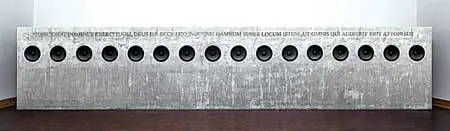
The final gallery contains Credo, the show’s most outstanding work. It features a 15-meter long concrete wall with 16 subwoofers on its front and a Latin inscription from the Book of Jeremiah that speaks of God’s wrath. This work confronts viewers with infrasound (a powerful 17-Hertz harmony) capable of disorienting individuals and even inducing visual hallucinations. The simplicity and forcefulness of the wall with the Latin inscription contribute to the whole experience a tone of sacredness and of encounters with the unknowable, which added to the sound effect generates an overwhelming sensation of vulnerability that, despite being the product of technology, bring the sacred close to sublime terror.
The exhibition ends with Absentia and action that could not be completed as planned due to the bureaucratic limitations of the institutional context. A large bell, molded by artisans especially for this project, is presented without its clapper: the impossibility of sound. Inscribed in Latin on the bell are the words: “I call upon the living, I cry for the dead, I unmake tempests”, a slogan often inscribed in Catholic church bells that summarizes their task. De Vega’s bell was intended to be buried in what was the church’s atrium, which is now the entrance to Laboratorio, once the exhibition closed, there to remain forever in silence. But the required permits for this action were denied for reasons of the building’s safety and its historical value. In the end, the bell’s final destiny will be destruction.
The works in this exhibition are populated by concepts of catastrophe, violence, and legality, echoing the meanings of the political elements present in exchanges between institutions and individuals. Through an experience of vulnerability and disturbed perception, through the idea of the sacred and the boundary-pushing possibility of damage, Mario de Vega suspends the structure of the symbolic and confronts us with forces that exceed our human capacities.
OSWALDO RUIZ