
Volver a Girar (To Spin Again) is the title of the colossal intervention by Argentinean artist Mauro Giaconi (Buenos Aires, 1977)—who moved to Mexico two years ago—that shook the foundations of the Museo del Palacio de Bellas Artes in Mexico City. Consisting of an imposing mural and an animation of a more intimate nature, the intervention was part of the group exhibition entitled Panoramic. Landscapes 2013-1969, which opened to the public from April 25 to July 7 of this year at the prestigious institution.
Volver a Girar consists of two fundamental elements that are closely connected. The first, more intimate in nature, is a video that also serves as the material memory of the project and represents a challenge to time. The second, and clearly the central element of the work, is a mural that contains the notion of cycles. It is marked by the fate of that unfailing rhythm of Cronus that imposes a beginning and an end—determined here by the temporal duration of the exhibition.
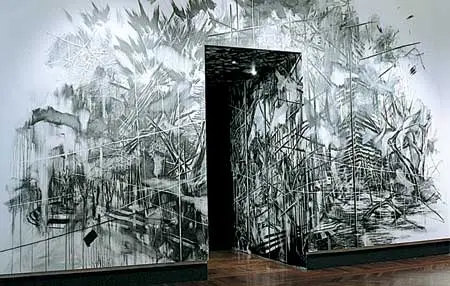
Loyal to his continuous inquiry for the intricate labyrinths of memory and oblivion—that in this proposal translates into an exquisite work of construction and deconstruction created with graphite and an eraser—Giaconi was inspired by a historic photograph of the dome of the famous Mexican institution he intervened. The picture in question was taken at a time when, because of the sinking of the ground, and then as a result of the Mexican Revolution, the architectural project that was originally commissioned by Porfirio Díaz was suspended for several years.
Based on that image from the museum’s archives—which the artist saw as a historic record and premonition of the building's future—Giaconi began to incorporate architectural and decorative elements from the place, along with urban and landscape elements from the surroundings. The result is an intricate psychological landscape that, halfway between dream and reality, grows everywhere like ivy, invading ceilings, doors, and walls in a swarm that—when are not too unsettling—coerces and interrogates us.
More than a mere approximation to typology, the incursion into the architectural space is animated by a socio-cultural interest that allows the artist to inquire and to demystify the historical meaning. Indeed, the resumption of the imposing architectural project implied changes to an original plan marked by an eclectic style dominated by Art Nouveau and Art Deco. Later on, with the revamping of the main hall at the beginning of the new century, many of these elements were destroyed. Another point of interest is the contrast between foreign architectural styles and the incorporation of national materials and symbologies. Standing out among these are, of course, the inclusion of murals by Siqueiros, Orozco, Rivera, and Tamayo. All these changes integrated into Giaconi’s proposal attest to the accidents and complexities of the national history, the indelible mark of several historic moments, and power groups that, in sum, build our collective memory.
A title based on the etymological meaning of the Spanish world “revolución,” Volver a Girar implies this relational notion that animates the work in its dialogue with the institution and the various works that are part of its collection.
The compelling landscape is charged with the high electric force derived from the frenetic use of graphite and eraser that generates high tensions accentuated by the same chaotic nature portrayed. There, the achieved depth of field is dismembered by innumerable beams into defying angles, falling buildings and interposed vegetable clutters. The result is an organic immersive experience, a corollary of the effective disarticulation of the support—it is important to read the architectural structure of the museum that symbolically becomes an allegory of our material memory. The recurrence of motifs located in the exterior of the museum, responds to the task of switching the interior space with the exterior, thus generating a dialogical relationship between the entity and the public space that surrounds it.
The visceral drawing is monochromatic, an aspect that characterizes the entirety of the very personal proposal by Giaconi. The highly intense areas of blacks that contrast the flashes of white are amalgamated in the middle of the effective depth generated by the masterful handling of the sfumato. Nonetheless, from time to time anguishing orange ulcers surface that, like capricious tunnels, promise a journey through the museum’s past. These touches of color are indeed the result of an avid deconstructive inquiry motivated by the examination of the museum’s history, one that motivates Giaconi to remove up to ten layers of paint, to emerge at the end onto the surface with a sui generis dialogue with the space and with time.
The action, which only a shortsighted observation could interpret as a journey to the past, also imposes an inescapable parallel with the installation that, ephemeral in nature—the magnanimous drawing was directly rendered on the museum’s wall—is condemned to disappear under new layers of paint. Nonetheless, it will always be a latent part of the material history of the building.
This reflection about the perennial and the transitory, the visible and the invisible, the remembered and the forgotten, is the main focus of the exploration of this proposal by Giaconi. To him, the space after all becomes a tool to immerse in time. The artist himself has said about Volver a Girar that his intention is not the representation of an image, but the creation of a state, and adds: “the gaseous state of the space.” This explains his interest, formally speaking, in the fracture of the original physical space to create an organic experience that dilutes the architectural structure of the place, in favor of that omnipresent and overwhelming sensation of the passage of time that dominates Volver a Girar. It is ultimately, the concretion of this transit to the “gaseous state of the space” where the fluid experience in the history of the building is used as a bridge toward a much deeper reflection about the processes of construction of history and of our collective memory.
Energized by a vital relational sense, Volver a Girar maintains a close relationship with the intent of revising the landscape that animates the exhibition Panoramic. Landscapes, 2013-1969, a show that used the date of the first moon landing—a historical event that represented a substantial transformation of our perception of space and that was also a crucial sign and symptom of the relationships of power and the construction of history—as the day of departure.
JANET BATET