
Argentina’s Del Infinito Gallery celebrated the first anniversary of its Bogotá location with Castles in the Sky, an exhibition of works by the young Bucaramanga artist Máximo Flórez. The show, featuring more than ten sculptures, was open to the public from July 25 – September 5, 2013.
Given Flórez’s trajectory in architecture, the idea of construction is at the base of a creative process that originates in his interest in capturing space in terms of a containing frame, of a geometric dimensionality with linear projections.
In his formal explorations, Flórez uses tools from the field of design such as drawing, modeling, computer models, and planimetric. From the latter, he takes the process of transferring the features of terrain into the two-dimensional plane using grids. Almost all the works in this exhibition are created in the manner of “boxes” in which the lines constitute grids that generate angles, movement trajectories, and fine rectilinear volumes inserted in the geometric rigidity of the constructions.
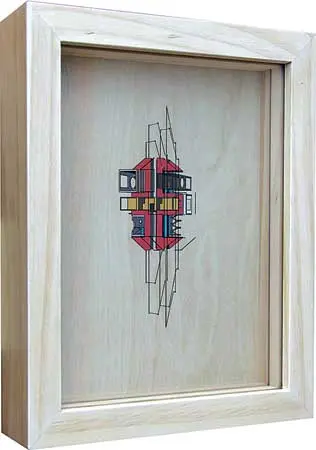
The vacuums and walls of Flórez’s sculptures play with the perception of the viewer as they subtly bring forth the duality between the two- and the three-dimensional. One must come close to the works, especially those in small formats, to enjoy the detail of the tension in the lines, the calculatedly tiny orifices they penetrate, the colors of the planes, and the formal effects achieved by light and shadows.
In the words of the artist: “The process of creation for these works is connected to the development of the MURA project (Museo Rodante Audiovisual), which consists of small buildings in scale, itinerant and able to be taken apart, installed temporarily in a variety of contexts. The design materials for these devices were also the raw materials for the development of Castillos en el aire. The works in the show were presented, in one way or another, as moments in the constructive (or destructive) process of these architectures. And they combined sculpture with the drafting and photographic print of the 3D models.”
Máximo Flórez’s works can be described as special conceptions in different material and thought dimensions, from technical drawing to geometric sculpture. Despite the unmovable discipline of an absolutely controlled and “perfect” production, we perceive the intention of transgressing the rational need to define space. With this, I am referring to the fact that Flórez’s Castillos en el aire challenge our notions of weight and weightlessness, up and down; trace and imaginary lines, horizontality and verticality, etc.
The scaled models of some of the works in the show are notable for the way in which, besides reflecting Flórez’s training as an architecture student, they verify this process of conceptual transference of space into a mental projection and then into the matter. They bring forth the rational transit of the idea of spatial volume and vacuum into a palpable object with comparative correspondence.
Asked whether he conceives an idea after exploring space, or adapts it to works he has developed prior to reconnoitering the space they will inhabit, the artist answers that his dialog with the exhibition space is essential. He requires a prior reading of that space because “its characteristics (circulation, lighting, textures, etc.) are what begin to shape the idea of the body of the show.”
The step that follows Flórez’s reconnaissance of the space is its mental abstraction to generate a preliminary representation, based on its documentation by means of plans, images, and models. In what the artist defines as a “mise-en-scene,” Flórez simultaneously reflects on ways to adapt the space to the specific space, modifying the models and formats through the repetition of forms extensions, additions, and subtractions, as well as the modification of the spatial surroundings by means of light and color.
Regarding color, Flórez notes: “I lean towards textures and colors that come from the materials, in this case, wood. However, when I saw the first renderings, I thought it’d be interesting to treat some of the works as the materialization of virtual volumes and to give them that aspect with flat, lively colors. Some of the works were painted on colors that corresponded to those assigned them (by default) by the computer modeling program.”
At a more sensible level, Flórez perceives space by experiencing and establishing it as a memory. His previous work in other Bogotá spaces has fed into this experience, reinforcing a predilection for certain materials. In that sense, the nobility of elements such as wood and thread also implies a physical relationship, and in consequence, the enjoyment that the artist refers to when he says that manual labor is the essence of his work. While other media are involved in his creative processes, such as video or photography, the constant to emphasize is that he always seeks to have them be connected to the processes of sculpture.
MARÍA JOSÉ RAMÍREZ