
The vibrant lines in the work of Natalia Cacchiarelli (Argentina, 1971) exude the simultaneous appearance of instability and perfection. The worlds they create are capable of revitalizing our gaze and liberating our mind, with a simplicity that is more than it seems. Twelve new works by the artist were on exhibit at Palatina Gallery, in parallel to the group show Geometrías: desvíos y desmesuras (OSDE Foundation), which highlighted the 100th anniversary of the emergence of essential geometric shapes in the Suprematist movement after Kazimir Malevich’s theories.
In the Argentinean cultural context, abstract art emerged from the original assimilation and transmutation of the early-Twentieth Century European avant-garde and was expressed around the 1920s with Emilio Pettoruti and Xul Solar, who frequented the cubist and futurist scenes in Europe. After the Concrete Art proposals of the 1930s, with Juan del Prete and Yente (Eugenia Crenovich), other constructive artists created the Arte Concreto Invención Association and the Madí group in the 1940s, intent on breaking with the representation of reality and with all traces of subjectivity. In that sense, constructive Argentinean artists of the 1940s have aesthetic and even political concerns; they believed that the end of representation had the power to change the course of history (for example, combatting capitalism and operating positive changes in society). Contemporary local artists who work in geometric abstraction, certain features of constructivist sculpture, variants of neo-abstraction, a kind of post-minimalism (in the manner of Frank Stella, who once said, in reference to his early line-based paintings, that “what you see is what you see”), do not seem to want to take the issues of the world in their hands.
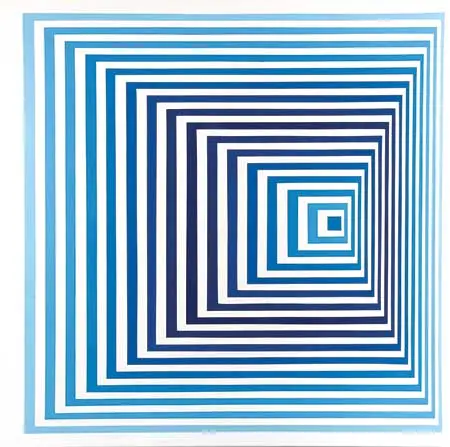
Unconcerned with any attempt at representation, Cacchiarelli investigates the very nature of painting. “I work hard in the exploration of chromatic variations and of lines, without wanting to mean anything,” she says. In her search for synthesis and experimentation, the artist persists in painting on the plane, which grows the sensation of volume and/or false perspectives that result in optical effects. Cacchiarelli’s works in acrylic, on canvas or paper, move between seriality and a reduction of formal elements, perhaps as a way of expressing her quest for the essential. Besides her paintings, Palatina Gallery exhibits three digital prints on cotton paper, with shapes that seem suspended on a single plane but are independent of each other.
Earthen, blue, gray, turquoise, yellow colors alternate with varying cadence and intensity in each one of Cacchiarelli’s works, populated by dozens of dashes and lines, points, profiles and strips, bars. Once again, the works in this series reveal an aesthetic of the minimal and interpellate observers with their colorful displays, as vivacious as they are sensible. “Two constants are expressed n my work: obsession and repetition, which become order accumulation, and association of basic elements,” notes Cacchiarelli, who began to exhibit her art in the 1990s, first in her native Bahía Blanca and later in unconventional Buenos Aires spaces as part of the young group ø (cero barrado).
Cacchiarelli’s geometric compositions generate a presumptive sensation of regularity, with lines that converge towards the back of the plane to simulate depth and, at the same time, deliberately distort the center. The serial repetition of a single visual motif, the subtle variations in size, form, or backgrounds, the vibrant colors, establish an optical illusion, a retinal dialog between the work and the viewer’s mind that reconstructs it, conditioned by emotional ad cultural factors. The austere, impeccable lines, points, planes, grids, plots, produce an illusion of serene agitation with great sensorial impact. Cacchiarelli perfects the simulacrum sharpens the contours and recreates vibrations, the result of an inexplicable enthusiasm.
If we take Cacchiarelli’s production as a whole, which includes printmaking, works in tempera, and in hard acrylic surfaces, we see it as inscribed in the thesis sketched by Marta Traba more than 40 years ago with regards to the division of countries into “open” and “closed” areas (to immigration, among other things). Especially artists from port cities in Venezuela, Brazil, Argentina, and Uruguay were and are sensitive to abstraction and concrete art, and produce excellent works.
But what is it that Natalia Cacchiarelli paints? It is impossible to know. To be noted, the artist participated in another exhibition at the Ricardo Rojas Cultural Center (Buenos Aires)—in parallel to the show at Palatina—with a well-executed installation of abstract paintings arranged on the wall in the manner of a puzzle; each canvas presented four pulsating full-monochrome sectors. Are they signs of a new path in her oeuvre?
VICTORIA VERLICHAK