
When entering Henrique Faria Fine Art for Oswaldo Maciá: a Laboratory of Cynical Perception, a wave of powerful scent and the screech of animals wash over you. The initial impression is both startling and confusing. The smell is not unpleasant, but very potent. Coupled with the sounds emanating from the first gallery, it is at first hard to focus on the objects in the space. How does this ramped-up environment relate to an aquarium filled with bubbling black liquid (Cynic, 2013) or to the large, black cube standing under a pendulum of speaker-like bells (Empty Smoke, 2013)? In fact, the second impression may well be one of cynicism: there is a lot of information here, but where is the reason, the confidence we have grown used to when looking at works of art?
This collection of some thirty objects sits comfortably in the elegant, clean space of the gallery. Collected here are works on paper, sculptures in wax, metal, and glass, as well as drawings collaged with silver leaf. The show flows nicely out into the evolving legacy of the minimalism and abstraction that have been mounted here since the space opened. Visually we get what we expect; sensually, we get much more. And, in this regard, some of these conceptually “large” pieces might profit from more floor space. However, the other looming media featured in this work, sound, and smell, add dimensions usually intentionally excluded from more conventional exhibitions. Sorting this out requires the viewer to spend time with each object, and all of its parts, but also to begin to understand the past work of the artist and the primary concepts that run through his work.
In the informative text by Jim Drobnick that accompanies the exhibit, Maciá states that he is “particularly concerned with how external stimuli we receive from the world are translated into images and information through our senses, often mediated by what-we-think-we know.” The artist recognizes that what we know as a “thing” is the product of many combined perceptions—touch, sound, smell—and that the complete image of an object is formed by all of these, as well as sight. All of these sensations are part of a whole object as we (each of us) know it. And, that same object may be perceived differently by another individual.
At the same time, a single quality, such as a scent or a sound, can represent an object, or recall its absence. The animal sounds in the gallery are collected from the British Library Sound Archive and present species that are near or at extinction. These sounds, then, represent these creatures as accurately, perhaps more accurately, as a photograph and, within the lifecycle of the animal, allowed it to exist, reproduce and sustain itself. The smells represented here, collected and preserved by International Flavors and Fragrances, Inc., form another building block in perception.
Consider Empty Smoke. The strong smell of wood near and around this object causes us to consider the idea of smoke while at the same time understanding what wood is, what it feels like, and what happens when it burns. If smoke were “empty” it would be invisible, however, here in this piece, it is present in our perception. From the sound loop of Cynic we know of these species that are disappearing, or gone, but we “know” them.
Of course, the intellectual and philosophical substance of this exhibit is much deeper and more complex than the above simplification, these works being the result of study and consideration throughout the artist’s career. However, for the more casual viewer, arriving at an understanding of the elements used in Maciá’s work and attaching to these elements or perceptions—sound and smell—the same weight we ascribe to vision, forces the viewer to think in a broader manner. This thought process ultimately leads to a more profound conception of how we form knowledge, or construct a vocabulary for what composes and describes reality.
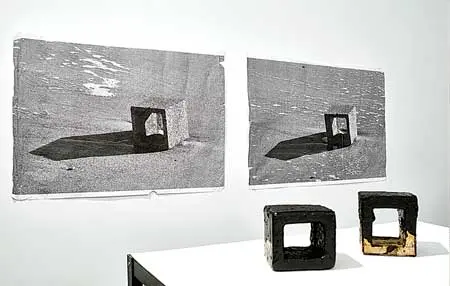
For me, the exhibition fell into order when I returned to view again Pre-Construction/Post-Construction, 2013. This piece is comprised of photographs of a concrete block on a beach and wax recreations of the block. Looking at these photographs, while considering the sound of the surf, the changing landscape of the sand itself, and the smell of the sea, the cement block seemed at one time more real and more abstract than any simple photograph of a cement block. In this moment of enhanced perception, the block has not been transformed by these elements, but our sense of it has been formed by them.
CLAYTON KIRKING