
From the autobiographical to the scenographic. With a pornographic touch. If we were to erase the hand-painted watercolor, then black and white photographs would appear. If the camera were to be eliminated, then the staging would remain. If we were to discard the curtains, dolls, rugs, and toys, then she would be revealed. Zaida González (Chile, 1977) stands out for an anachronistic style in the form of hand-painted photographs. González exhibits anxiety for the exotic, the aesthetic sacralized by icons like Frida Kahlo and emulated by Brian Walker (with his alienated women), Daniela Rosell (the excessive luxury), and Marcos López (with his allegorical carnivals). And to showcase the current social, political, economic, and religious context.
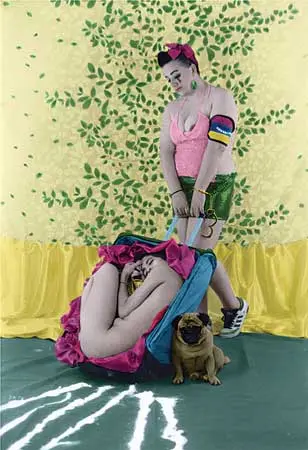
The exhibition consisted of 43 photographs created during the last two years, some in Chile and others in Venezuela and France. The images depict heavily ornamented and colored characters that strike dramatic poses about specific facts: the elections in Venezuela, sex, religious hypocrisy, economic power, and consumerist culture. The three graphologies referenced lead to a polysemic polemic. The autobiographical: she translates her states of mind and philosophical reflections through her work. Even the title offers clues that place us on the trail of a personal experience. The Punishment addresses a contradiction. González received the Rodrigo Rojas Award in 2012. The result of that work was exhibited at the Museo de Arte Contemporáneo (MAC). Nonetheless, because of several problems, changes of exhibition spaces and dates, the show only remained open for 15 days, and thus the award became a punishment. In González’s own words: “The museum is a marvelous place but is poorly managed. Artists are not treated seriously or with respect. This lack of commitment causes many problems to the artists.” On the other hand, the punishment can be understood as the resulting fatal consequences, and the subjugation to the political, religious, and economic powers. Here, the scenographic is understood as a society that stimulates, hides, feigns, and poses in order to transform artificiality into the natural. While the pornographic element is literally presented as homosexual sexual scenes, it is also metaphorically present as a crude, unedited demonstration of that which is usually hidden. All these elements and interpretations stem from Zaida González’s conceptual work. By (analogically) manipulating the narrative, she infuses criticism through exaggeration and absurdity.
Sensationalism, distortion, and reiteration are elements in the imagery of many contemporary artists. Parallelisms are eloquent. Baroque was widely introduced in Latin America through European colonialism. The buildings—most of them religious—that have withstood revolutions and earthquakes, are in a continuous state of decay. It is similar to what occurred with the term baroque: it underwent an evolution with the passing of time. During the eighteenth and nineteenth Centuries, the adjective “baroque” represented something negative, in the sense that it was perceived as deceiving. In part, all of that degradation originated with the use of the baroque term in the theater. It stood for something popular, sinful, and vulgar. The goal was to get people to laugh. In the works by González we see echoes of that complex assimilation of baroque, both in her thematic and in the final resolution of the work. Punishment finds an added meaning. The people are punished for their excesses and sins.
The exhibition includes a series dedicated to Venezuela. Zaida González was in Caracas during the elections. Her critical vision about those elections is conveyed in the portraits that she created during those days. There are inverted bracelets in support of Chávez, wives, drugs, and money, as the political and social corruption converges with the absurd and the hyperboles in her works. All of these are presented through fiction in which theatrical stages are built for each photograph. In the final montage, one of these stagings was made available to viewers so anyone who wanted could be part of the picture, alongside a frog toy and a child landscape. Online entertainment with some of the snapshots that are displayed. But we cannot be solely left with the sarcastic side. Behind the laughter, there is criticism and accusation.
JUAN JOSÉ SANTOS MATEO