Candidates
present an exhibition project for Bogotá galleries. In this seventh edition of
the event, eight proposals were selected, with the additional challenge of
establishing a dialog with a variety of spaces in the city. The projects were
exhibited simultaneously during the month of October 2013.
First, the Prize winner: Ejercicios espirituales, by José Alejandro Restrepo, an artist with a long and established career, who has expanded the field of the visual arts in Colombia with multiple sounds, visual, and drama references. And also an art theoretician whose books seek, for example, to explore the body as a battlefield, with echoes of Foucault, between a colonizing culture, exclusionary to the point of extermination, catholic and violent, and subjects who attempt to inscribe their difference in that context.
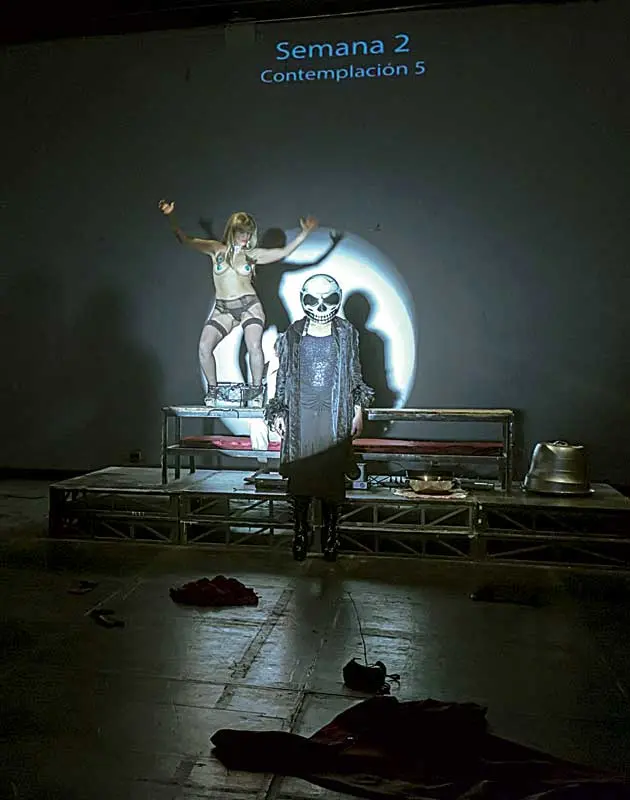
Ejercicios espirituales invited its audience to go to the theater every eight days. It was a date with meditation. For “spiritual exercises,” Ignacio de Loyola said, one must understand “any means of examining one’s conscience, of meditating, of reasoning, of contemplating…” And the audience encountered a happening, performance, sage drama that combined the presentation of speeches with videos and “live bodies” of an actor or of an “I am not me” simulator, on an open stage.
What happened at first was that the usual voyeurs of the visual arts were no longer in a safe position but found themselves deprived of a center, estranged, and required to reinvent their role. And were invited, for example, to celebrate the fact that simulacrum overcomes death, and to gradually understand that these spiritual exercises were a gamble for consideration of violence in Colombian culture.
The opaquest of situations of violence in Colombia has been the massacres carried out by paramilitary groups. In defense of private property, these groups have been denounced by many, but their actions have been rarefied by a complex system of censorship. In Restrepo’s work, suddenly on that open stage, participants were able to share their space with a patriarchal figure dressed in elegant evening attire and fieldwork boots, who sharpened a machete in the middle of the scene.
Estanislao Zuleta wonders why Colombians build a democratic imagination while social contradictions persist and deepen. This is the persistence of idealization and opacity, fostered by discourses of power that are removed from actual experience. What is left outside official discourse is any thought of the circumstances, of exclusion and violence, of the contingency of irresolvable paradoxes.
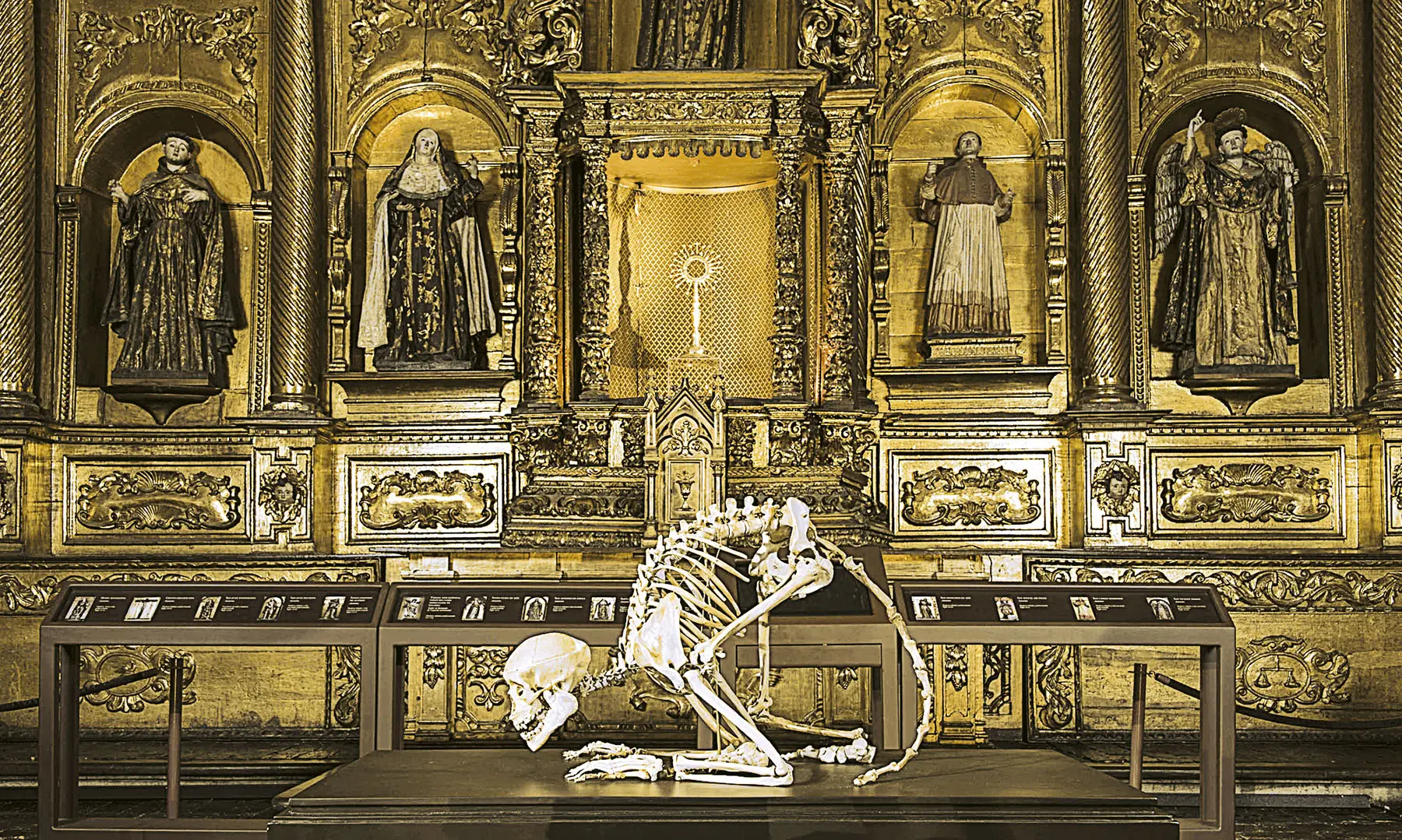
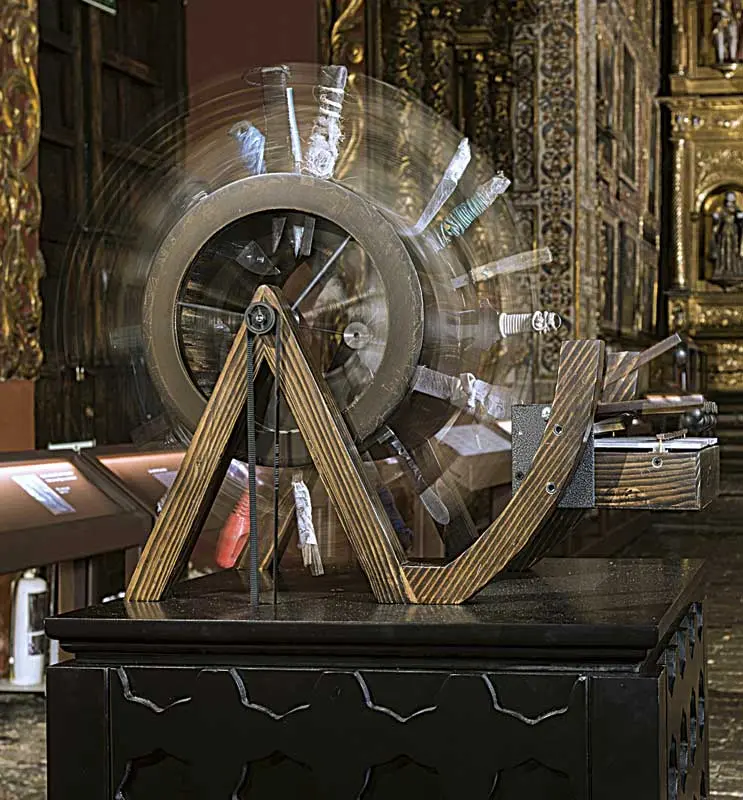
This view of Colombian culture has been incorporated by artists like Carlos Castro, intent, it seems to me, on de-idealizing our gaze by means of a series of intelligent and perverse objects. Belleza accidental contributes to that idealization. On this occasion, Carlos Castro intervened Santa Clara church in Bogotá, a Seventeenth-Century building. It brought to my mind a previous intervention, by María Teresa Hincapié in 2006, who installed two large trees as a space for reconciliation. Castro’s intervention was relentless. In the midst of the church’s Baroque splendor, we find other furnishings: a police patrol and columns with music boxes built using deformed knives, like tools made by hand with discarded materials, wrapped in rags, knives made with urgency, confiscated by the police.
These knives situated the viewer already in an invisible landscape that, paradoxically, is close to the church: Bogotá’s so-called “Bronx street,” a street of “other” lives, garbage and homelessness, drugs and other arts for doing and using the system of power that renders them invisible, as Michel de Certeau would say. Castro also built a skeleton and commented:
“Hijos de Dios, the title of this work, is located where previously the church’s altarpiece was found, at the feet of the Christ. The work is put together and arranged in the way the remains of extinct or contemporary animals are displayed in educational and scientific institutions. We see the traces of an imposed transformation, in a subtle yet violent way: a flattened skull, more prominent upper and lower jawbones, and a tail made by phalanges from many different bodies, among other modifications. The arrangement of the body, which can be of submission or of aggression towards the viewer. In the Catholic tradition, we as human beings are created in the image of God, and this is a deeply rooted principle in many people’s minds; however, other theories assert that we evolved from primates. These contradictions represent in a symbolic way a key dichotomy about our origins as human beings.”
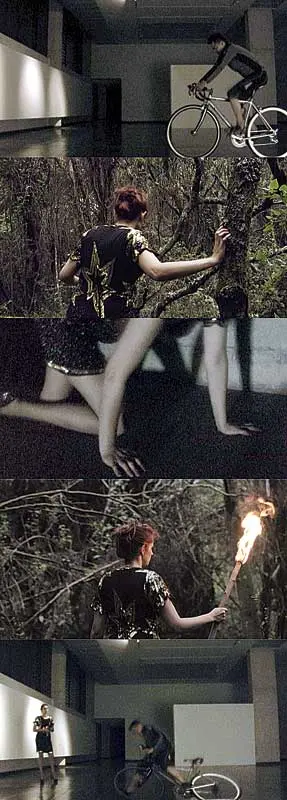
Manuel Quintero presented a surprising installation, unexpected in its topic and staging; a seldom seen topic, at least, it seems to me, in contemporary art, which has nevertheless been an obsession for him. And I say that the topic is seldom seen because women in the arts have expressed their desire to be seen or not seen, but men, at least today, almost never raise their voices to express their fascination with women, lest they be accused of being chauvinistic or potential serial killers. Men, I believe, have increasingly fewer voices to express their emotions. In Dromos, viewers entered onto a stage assembled with pieces of wood that appropriated the space in effective ways, revisiting the history of installation in Colombia, for example, the work of Danilo Dueñas.
Quintero’s giant model suggested a cycle track and set the stage for a video projection. In it, the camera looks at a woman with the entire range of gazes, from delicateness to perversion, in a place that is surprising in that it shows many possible ways of looking at a woman without reaching any extremes, neither idealization nor pornography. It is simply a state of pleasure in looking at a woman who has apparently stopped so that she can be seen, while a man pedals on a stationary bicycle. When she finally decides to look back at him, frontally, the man falls, and from that point on she counts his falls. It reminded me of some works by Sophie Calle, those that seem like conversations between female friends, but here, in a male version, the narrative was delicious and I enjoyed it greatly.
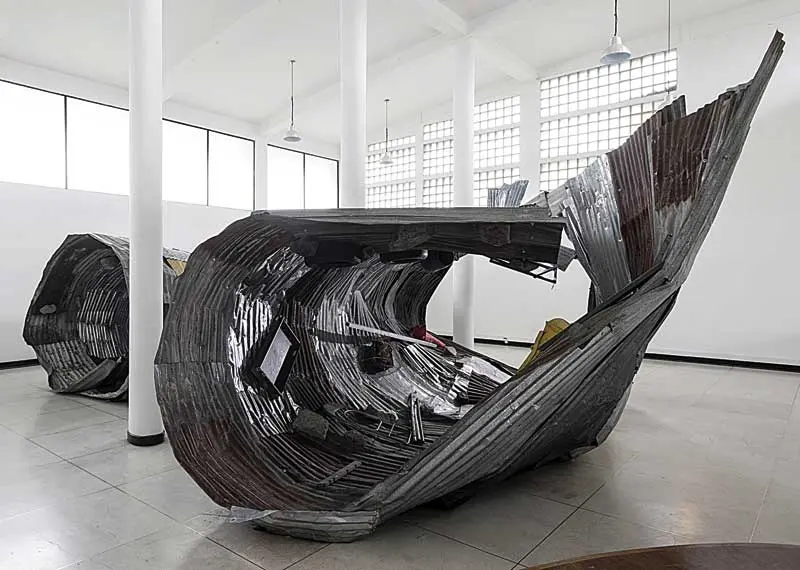
Fredy Alzate proposed Quinta fachada, a work that, as its title indicates, attempts to give greater visibility to a city’s subterranean life. His rolled-up brass sheets, inhabited by objects, were powerful. Yet, it must be said that they appeared somewhat passive. This is to say, they did not dialog with the Architecture Museum at Universidad Nacional, didn’t interrogate, nor did they invite viewers to traverse them.
I would say that a line needs to be traced at this point to speak of the remaining projects, all excessively confident in the object’s ability to say it all. Excessively trapped in an unquestioning kind of representation. Yet, they register well: all are excellent photographic subjects. these works felt like proposals brought in from an isolated studio, with their own referents, to be placed in the site without their circumstances altering them in the least, which would not be a bad thing had they had the necessary force to critically engage the viewer.
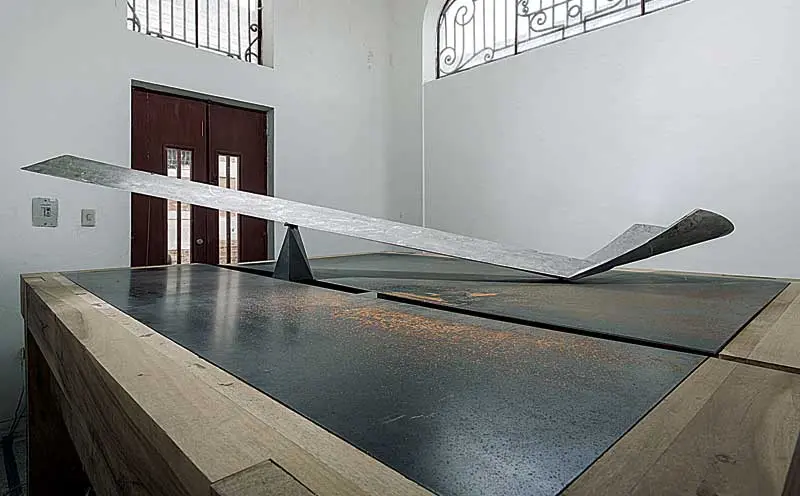
This was the case of Mesa franca, by Consuelo Gómez, a well-established sculptor in Colombia. It was a table with a mechanical arm that, perhaps because of its title, suggested a spoon as it forcefully hit the table. It was installed in a market square in Las Cruces, a historic Bogotá neighborhood. As architects say, a prêt-à-porter square: it came to Bogotá on a ship from Delaware in 1924. The metal structure brings to mind the Crystal Palace; it was later finished in an eclectic style. The site fulfills all formal and narrative requirements to be named a historic landmark. It features numerous suggestive details, such as a stone turkey on its portal, perhaps a symbol of plenty or a Thanksgiving Day reference, set in the tropics. And, of course, all of this as a stage for Bogotá peddlers of all kinds of products. One had to traverse this habitat in order to find, inside a small room, the table. The mechanical arm’s strikes and the title were the most significant aspect for me. I read them as the call of an empty spoon. But, in truth, the surroundings were the most eloquent element.
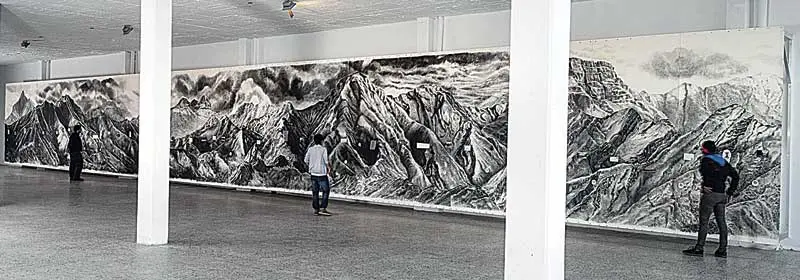
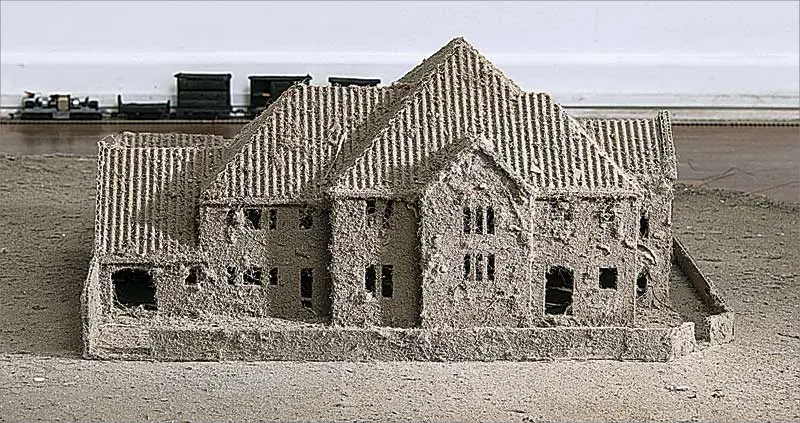
Something similar happens with María Adelaida López’s La casa de los reyes: retrato de un vecindario, which in fact was a neighborhood (“vecindario”) in small scale, with houses covered in vacuum-cleaner dust; covered by the repetition of domestic tasks and also by nostalgia. Mariana Varela’s Fracturas was a large drawing of Colombia’s mountains, with photos and texts like small traces of emotions and of life in those mountains always subjected to neglect and the crossfire of different armies. The complete drawing was made with papers on which the artist had drawn in her studio, or so was my impression, and later brought to the site and mounted on a large wall. This precluded the possibility of experimenting with the line, with shadows and light, and with the exhibition space. The fact is that the Colombian mountains possess an infinite range of grays that the study turned repetitive, which brings up a question: representation takes life away, reduces it. Representation is an impossible task; I believe, nevertheless, that this premise—which is the artist’s premise—needs to be visible in the work.
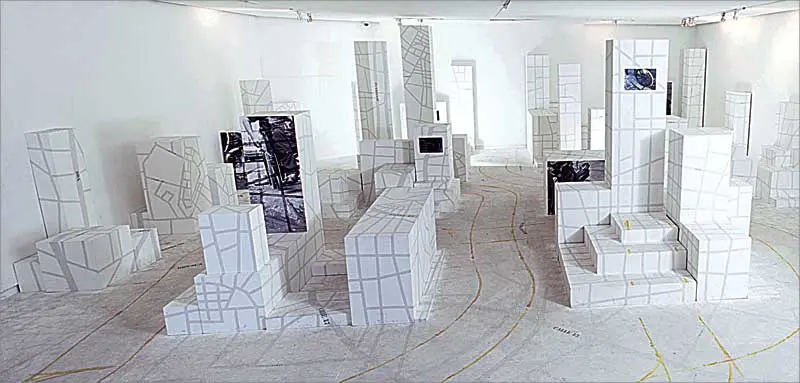
Finally, Sergio Giraldo presented Espacios imperceptibles, the most artistically uninformed project here: a wheelchair-bound city dweller is an extremely pertinent topic, but it wasn’t really presented or represented by Giraldo’s raised solids crossed by yellow lines.
This magazine has a Latin American reach, and more. I feel that this article is rather local, and I have at times been accused of being too local-centered; I see that as a virtue and accept the criticism gladly. But, to conclude and in an attempt to include other “localities”, I’ll say that I continue to support art that lets itself be thematically and formally filled with its own circumstances, which remain unexplored. Even if it is to dig up a mirror on which we are yet to look at ourselves.
NATALIA GUTIÉRREZ
Professor at Universidad Nacional de Colombia.