“Painters see the world through color. I am a sculptor. I see the world through lines.” It was on the basis of this statement by Amilcar de Castro (1920-2002) that gallerist Silvia Cintra organized Amilcar de Castro, an exhibition at Silvia Cintra + Box 4 in Rio de Janeiro. De Castro’s dealer for more than thirty years and the executor of his estate, Silva heard those words from the artist himself and used them to weave the relationships between the diverse supports De Castro employed in his five-decade career.
The show, which brings together thirteen works (eight sculptures in wood and two in weathering steel, as well as three drawings) seeks to emphasize De Castro’s sculptural thinking, even in the two-dimensional items. This is what the drawings from the series Lineas and Sobre, created in the 1990s as a proposal for revisiting the Neo-concrete period of the 1950s, express. On the other hand, while the drawings reveal their sculptural character by means of lines that dialog with space, the sculptures have their point of origin in draftsmanship. In this way, they bring forth the infinite potential of the plane, a key concern throughout the artist’s career.
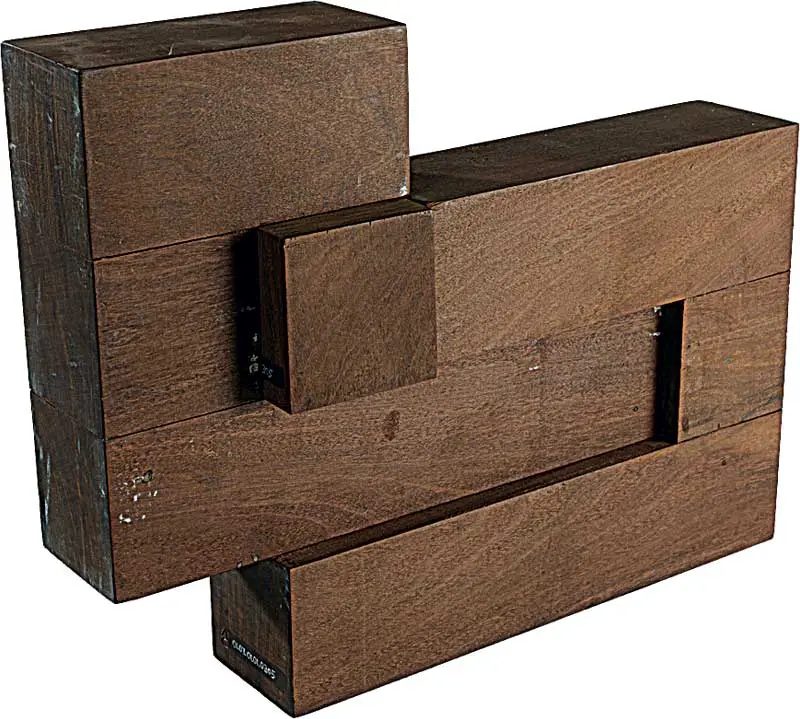
Amilcar de Castro never created a sculpture without a project on paper, which was also folded to simulate the future sculpture. Like other figures in the constructive tradition, he was a graphic artist and draftsman, with projects inscribed in the graphic-design tradition of historical Modernism, like the Bauhaus and Ulm Schools in Germany.
Both in his sculptures and in his paintings and drawings, Amilcar de Castro amassed a unique body of work based on concrete principles: the option for geometric shapes, the direct expression, the structured lines. Yet, the artist clearly abandoned the rationalist orthodoxy and made room for non-rational drives in his work. Alongside other artists, he signed the Neo-Concrete Manifest in 1959, incorporating freer elements in his art in an increasingly more emphatic way. De Castro created sensible geometries that acted as expressions in space.
Instead of adding or subtracting matter, de Castro began his sculptures from a plane (circular, rectangular, square, etc.) that was trimmed and/or folded to form a three-dimensional object. In that motion, the artist articulated cuts and folds of the material with the empty areas of the space, giving the sculpture an intense internal unity. The use of single sheets, the absence of any welding, and the oxidized surface caused by the passage of time, all emphasized the uniqueness of his work: instead of starting with the established ideas of Concrete art regarding an emphasis on matter, De Castro created his works on the basis of a relationship with the natural world.
In his drawings, the artist also experimented with a variety of positions and configurations, even signing his works in different places. The possibility of hanging the drawing in any position was another indication of the relationship of the two-dimensional plane with his proposal in sculpture. The drawings were built on the basis of gestural tracings and simple elements that evoked drama. His studies with Alberto da Vega Guignard (1896-1962) in the 1940s, in the “School of the Park” in Belo Horizonte, were essential to moving De Castro in that direction. The Minas Gerais artist taught him to draw with hard-tipped pencils, without erasure, and with a firm hand. Barred from fixing the line, the hand trained in precision. And Amilcar de Castro developed a textured, three-dimensional line.
An interesting element in this exhibition is the presence of sculptures in weathering steel (an iron and carbon alloy). The artist used this material mainly from the 1970s onwards, concerned with the durability of his works. He achieved similar effects even without iron’s typical oxidation; he had used the material before for its ancestral character, typical of the state of Minas Gerais. The artist used to say that in Minas Gerais, everyone knew how to forge iron. Even with the new, more malleable material, De Castro retained the idea of living energy infused into the work by the conflict between filled and empty spaces. Towards the end of his career, he even created monumental-sized works, extended horizontally on the ground in dialog with the landscape. As the poet and artist Ferreira Gullar said in Modulo magazine in 1961: “His shapes are monumental without being rhetorical, heavy without having mass, dramatic without recourse to any conventional figuration of drama.”
This succinct and coherent exhibition proves that all of Amilcar de Castro’s sculptures originated in drawings. It can be seen as a small, intimate ode to the artist. As the gallerist Silvia Cintra, one of the most knowledgeable students of his work, puts it: “I decided to bring together Amilcar’s greatest passions. Works which he finished and then called me to celebrate.” With Rio’s Museu de Arte Moderna, Cintra is organizing a large-scale retrospective of the artist’s work for the second half of 2014.
ALESSANDRA SIMÕES