
After several years of an absence felt in the local scene, Juan
Ruiz Gallery, located in the Wynwood District, presents a well-calibrated
selection of recent work by Betsabée Romero under the stimulating title Urban Ouroboros.
Derived from the Greek words oura (tail) and boros (to eat), Ouroboros means “tail eater.” The presence of the enigmatic and recurring image of the snake or dragon biting its tail is present in human culture since ancient times and points to the precepts of cycle and renewal, perfection and conservation, energy, and continuous movement.
The work by Betsabée Romero (Mexico City, 1963) is a revisitation of this journey that is the human condition. Using the wheel and the car as a leitmotiv of this journey that History ultimately is, Betsabée opens a number of questions about traditional and contemporary culture, high and low culture, gender issues, globalization, immigration status, and geographical boundaries. Although it has also been around since the beginning of the development of civilization, in Romero’s work the wheel refers to the wheel of the car and, hence, to that urban entity identified with modernity and the idea of progress associated with the Industrial Revolution.
The first work in which Romero used the car as a cultural icon of contemporary society was in the piece Ayate Car (1997), an in-situ installation created for the binational biennial inSITE 97, in Tijuana. Attracted by the many junkyards of the area that become raw material for the construction of affordable housing on the outskirts of the city, the wheel renounced its wandering status to become an expression of an emerging sedentary culture, one where the car became a sort of totem or altar. The installation in turn referred to the widespread cultural phenomenon known as lowriding, whose origin is directly associated with the Pachucos and the Mexican-American culture of the 1940s.
Romero decorates trucks, tires, mirrors, and fenders with elements from Mexican popular culture, motifs from Aztec glyphs, indigenous textiles, paper cutouts, and festivals. This appropriation leads to a revision of the linear and upward progress precepts contained in the Western notion of history, as the artist erects the wheel as a symbol of a nomadic race that is not going anywhere. The use of the car also underlies an important comment about the gender divide. Male par excellence, the car is intervened, decorated to satiety and, during the process, Romero appropriates a vast Mexican popular tradition that has historically excluded women.
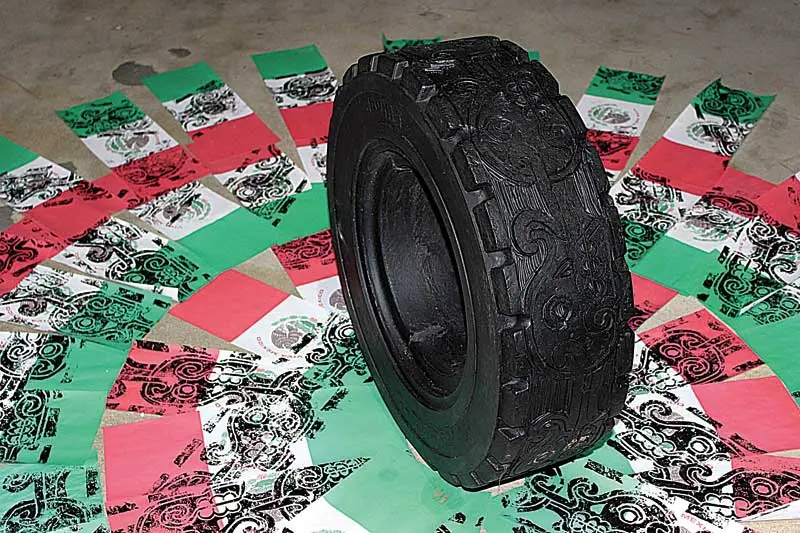
Banderas Atropelladas (Trampled Flags, 2010), is one of the central installations at Urban Ouroboros. Several Mexican flags are radially displayed across the floor as an industrial tire decorated with pre-Columbian motifs rests on top of them. Printed time after time on the flags, the footprint of the tire addresses questions around our notions of nation, cultural spaces, and global culture.
Romero’s wheels are turned into circular dies that, in their wild and often erratic trajectory, leave along their path traces of identity that are like justified claims. Amid the signs of mobility and speed that seem to obsess the contemporary world, memory appears as a single pillar. Hence the compulsive need of endlessly personalizing the industrial object, making it a sort of amulet of the self.
Her series Códices Masticados (Chewed Codices, 2008) consists of carved wheels with incisions covered with colorful chewing gum that recreate pre-Columbian tails. Used in both (tire and chewing gum), rubber—identified with a vast range of products from modern industry—has been one of the most exploited resources by Mesoamerican peoples long before the arrival of European settlers. Its original name in Quechua (Kauchuk) means “weeping tree.” With the discovery of the vulcanization of rubber in the late Nineteenth Century, a new chapter opened in the unequal exchange between north and south through what has been called the “white gold rush.” The Códices Masticados by Bathsheba refers to exacerbated consumerism, pollution, and unequal exchange.
To Romero the car is the embodiment and extension of the individual. In her most recent series Reflection of a Stone Gaze I and Reflection of a Stone Gaze 2 (both from 2012), as well as Mirrors of Malinalco (2013), the artist appropriates concave mirrors and forces viewers to approach the mirror in order to discover themselves amid the pre-Hispanic motifs.
In Ojivas de la Memoria (Ogives of Memory, 2010) and Homenaje a Chucho Reyes (Tribute to Chucho Reyes, 2013), Romero reflects on identity and cultural crossings. Supported by the widespread tradition of Mexican paper cutting capriciously made in China—the artist creates an interesting counterpoint between the original, culture of origin, and tradition.
JANET BATET