
David Palacios (1967) is part of the last wave that arrived in the
Cuban art scene during the late 80s—completing the mythical 1980s
Generation—which was characterized by an aesthetic discourse that placed great
emphasis on commenting on socio-political themes from a conceptual approach
that appealed to diverse formal vehicles, ranging from easel painting to the
use of Dada inspired objects, and through performance—which left a collective
answer in a body of work that is already anthological: Young Visual Art is Devoted to Baseball, staged in September of
1989 at the Estadio José Antonio Echeverría, in Havana. Since then, Palacios’s
work has been characterized by a cogitative passion and a sharp and ironic look
at social and aesthetic themes, as he uses the symbols from both fields as
expressive vehicles, for his social criticism also extends to the art
institution, in a sort of short circuit or Ouroboros snake biting its tail.
In Breaking News, his most recent solo show, Palacios continues his exploration of the raw social and economic realities of our planet through inter-textual games between artistic discourses and the tools and methods from the economics and sociology fields, in particular, statistical technics that are so relied upon when turning raw social phenomena into cold figures with the intention of trying to understand a specific situation on the ground and to outline appropriate strategies that lead to the best possible solution. It is the magical-technocratic way in which power operates in a contemporary civilization that has elevated statistics as the new Delphic Oracle.
But the work of David Palacios carefully dismantles this modus operandi, it turns it upside down and reconfigures it in a way that exposes its seams and lace lines, showing precisely that which the dominant political discourses and their corresponding media outlets usually hide in plain sight with the confident certainty that people are too busy working overtime, drinking beer and watching football to pay attention. Palacios invents a mechanism that—unlike the rather gray, murky, and convoluted media—is a transparent device that produces crisp semiotic metaphors that use found (or searched) objects. These are re-semanticized in their new context and function—his art supply store becomes an office supply store. In this specific project, Palacios creates more than literary, artistic, the fiction of a visual news agency “that explains and illustrates to the public problems associated with our social reality ( ... ) in different categories that include the global economy, international investment, oil prices, military spending, and poverty.” 1
Most of the parts are supported by an element that has been recurrent in his work: the clipboards used for reports in the corporate world. These automatically convert the showroom into a sort of boardroom and spectators into hypothetical members of a board of directors, shareholders, etc. But the presentation of statistics implies a code that represents percentages with different colors, in a graph that is always accompanied by a digitally printed artistic image, retouched with acrylic layers—which appear to underscore with a cynical wink the artistry of the object and its function in the circuit of the art institution—an image that contains the same amount of colors than the graphic and that is not always directly connected to the topic of each statistical table: Forced Labor in Numbers (2013), bears the image of a young female nude, Military Expenditure (2013), a Sports Swimmer and Asylum Seekers in the United States (2013), or a detail of the portrait of Francisco de Miranda in jail, painted by Arturo Michelena in the Nineteenth Century. In another group of pieces connected to oil prices and oil production in Latin America and the world, Palacios resorted to an abstract expressionist illustration, a dense dripping of two, three, or four colors where paint has been applied with a thickness that evokes the density of oil.
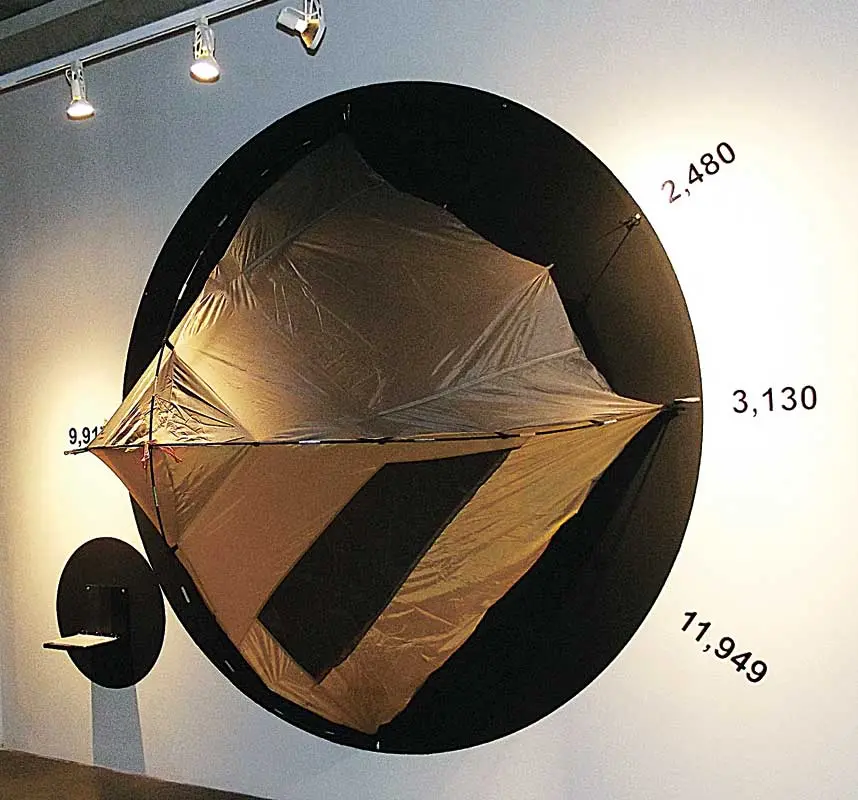
The most striking piece in the exhibition, not only for its size but for the dramatic theme it analyzes, is Distribution of Homeless Veterans Across the U.S. in 2012. A tent mounted on the wall in a black circle edged with vinyl numerals at first seems abstract and incoherent, but then makes sense when you see the tablet with the printed report which can make a copy for viewers to take home to digest at their leisure. This lists the thousands of homeless veterans across the Union and in the most critical states: California, Florida, and Texas. It is at once the piece that most literally illustrates the title of the exhibition because of its highly direct and urgent nature, like a newsflash.
NOTE
1. David Palacios, artistic declaration, in the exhibition catalog, p. 2.
RAFAEL LÓPEZ-RAMOS