
Several years ago Malba-Collección Costantini showcased the work of Elba Bairon and the curatorship considered acquiring some of her work in order to enhance the collection’s contemporary Argentinean art section, within the production of a select and diverse group of artists.
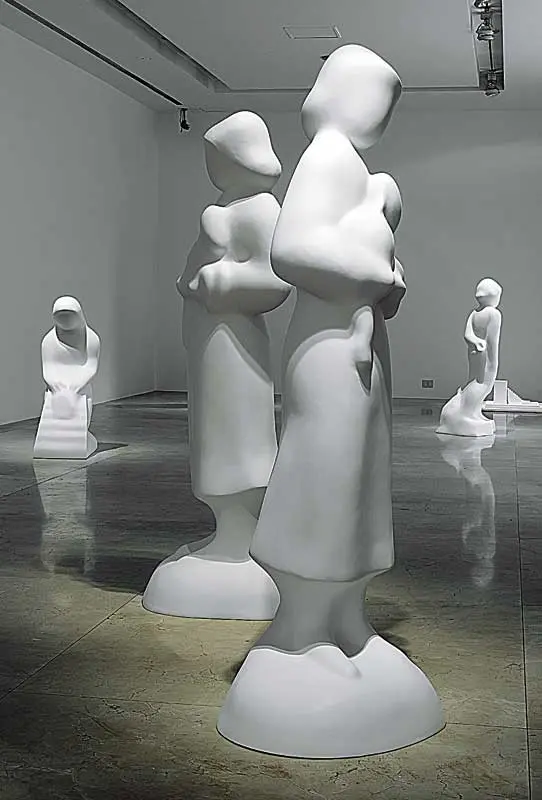
Just over a year ago, Bairon was invited by Malba to submit a solo project for the exhibition room devoted to contemporary art on the ground floor of the building. As explained by Victoria Giraudo during the institution’s catalog presentation event, this is the first exhibition of the artist in a museum. The uniqueness of the invitation was to give Bairon full control to formulate an original proposal for the occasion. Both sides agreed to the challenge because it was an artistic idea that would gradually develop and the museum would accompany the creative process until the inauguration. The first steps took place on paper and gradually gave birth to the protagonists, the buildings, and spaces. Bairon spent nearly a year working on the installation that launched last October and which will remain on display until March 10 at the aforementioned exhibition room and during the 30th edition of the institution’s program. The show consists of eight human figures, three constructions, and a bench, all of which were designed specifically for that space.
With respect to the formation of her imagination, Bairon has commented that during her artistic and intellectual development she found some references in the international sculptural tradition, in modern representatives like Wilhelm Lehmbruck or Alberto Giacometti; and among national contemporary expressions, she has referenced installations by Argentine Liliana Maresca, Magdalena Jitrik and León Ferrari, among several others. Thus, based on three-dimensional shapes, objects, broad concepts, and installations, her work belongs to the territory of contemporary languages.
There are constants that have led Bairon to the tight expression of her work. To the viewers’ gaze, the initial appeal is the sensitivity in the appearance of surfaces, textures, as if the appearance of the material emanated from a somewhat enigmatic, subtle, and powerful aura. It consists of white or faintly colored—and some touches, not many, of flashy or saturated colors—plaster and paper. Once the abstract, human, or animal form has been rendered, the sanding of the material becomes an essential action because its achieved effect results in an almost undefinable, eloquent aspect that characterizes Bairon’s work. In 2009 we included her work Estados de la Materia (States of Matter) in a group exhibition at the Fundación Klemm. The show included works that conveyed with their materiality the condition of the landscape, the liquid or solid nature or its opposite, according to the various elements and variants, and in varying degrees, based on a metaphor of transformation. It is this quality that gives a strong identity to the work of the artist. It became an element that attained a high degree of refinement in the installation at Malba.
A usual modality of Bairon’s poetic, the installation crystallizes the final idea. In this untitled exhibition the figures, which share the same space, in addition to the constructions, do not necessarily interact with each other, as they, instead, evidence the act of being centered on themselves. Although the representation of four of their five senses—eyes, nose, mouth, and ears—is absent, nonetheless the figures exude a marked sensorial and emotional element. Nonetheless, it is the element of the sense of touch that perseveres and connects some of the figures to small animals—rabbits, small sheep, other—or to an old-fashioned washboard. It is through the touch that each entity merges into a single unit with its pristine corresponding figure. And thus they have become presences that manifest a primal, archetypal quality. The constructions on a different scale to the rest of the scene appeared as empty ancient temples. These figures attest to the passing of time, they are immersed in a temporal stream, but they are also outside of it. The viewer transits in reference to them, in the scene or, like in a landscape, the manner in which the artist suggests is should be interpreted. And this transit is like a return home, a new meeting, a return from a reconquered cosmos.
The text in the accompanying catalog was written by Wainfred Teo. It is a long poem that after having read it in full we can agree that the word “poetic” is perhaps the best term to rely on when approaching Elba Bairon’ work. Memory, invention, transfiguration, and prophecy are some of the other terms used to address the work by Bairon.
MERCEDES CASANEGRA