
Enrique
Metinides Tsironadis was born in Mexico City in 1934, the son of Greek
immigrants who had a photography business right next to the Regis Hotel and had to
leave the location in the 1940s because large buildings were being built in the
area: “That is when my dad gave me a bag of film rolls and a small camera…”.1
This, and his frequent visits to the movie theaters of San Juan de Letrán to
see gangster movies filled with shootouts, chases, and killings, are the roots
of his interest in seeing and recording violent episodes.
“I took my little camera and took pictures of the screen; I also started visiting Police stations in the city’s first quadrant and the Seventh, which was near where my dad had set up a restaurant, to take pictures of cars that had been in accidents, which were parked there; that’s how my collection of photographs of totaled cars began,” he says. “One day when I was photographing one of those cars, Antonio ‘El Indio’ Velázquez, a graphic reporter at La Prensa who was considered one of the best in the country, came to do the same thing and was surprised to see a ten-year-old boy having the same interest and invited me to work with him as an apprentice. The next day I went early to La Prensa with my camera, and from then on I had to carry a reflector for El Indio, who didn’t like to use a flashbulb. We went out every morning in a taxicab rented for 50 pesos through 2 pm. The route began in Lecumberri, and from there to Juárez Hospital, then to the police and the fire department, and finally the Red Cross.”
“We also went to the scene of crimes, accidents, or fires. In Lecumberri, pictures were taken of individuals who had killed someone the previous night; later, at the police, objects related to the event were also photographed. The wounded were at the Red Cross, the Green Cross, or Juárez Hospital because they could not receive private care. I was ten years old and saw how corpses were washed at Juárez Hospital, the only forensic hospital we had; I slipped on the blood and, because there weren’t enough concrete tables, the cadavers were placed on the floor, which was covered in internal organs.
“At the police, we visited the secret service, and at the fire department, when there was an alarm, I was taken to the place of the fire and there were standing orders for a fireman to carry me on his shoulders into places where the photographer couldn’t get so that I could take photographs; these were published in the front page, and became famous.
“Through El Indio, the director of La Prensa invited me to cover the Red Cross beat, although without payment. By then I was thirteen and had a special permit, renewable every thirty days, to climb on ambulances despite not being of age. At thirteen I took a paramedic course so that I had credentials not only to take photographs but also to help the wounded…”
Boundless Energy
Metinides’ energy was boundless: he got into everything and was absorbed by it all. So much so, that his parents, already angry at him, used to send his 23-year-old brother to get him back. The brother would take him back home and swear never to have anything to do with the Red Cross, but in the end, Enrique’s energy proved contagious: he ended up working as a volunteer driver and an instructor of paramedics.
The family’s attempts at controlling Enrique petered out as they realized that, far from outgrowing his vocation, he was more and more involved in it, to the point that an ambulance parked overnight in front of his house so that he could be driven at any time to the scene of an accident or a crime; he always had his clothes at the ready and tells us that he would only lie down in order to rest for a bit. “I became so well-known that the Road Police would call the Red Cross and ask for me on loan for their service. I invented the radio keys that the Red Cross still uses across the country; a corpse was a ‘fourteen’.”
Metinides collaborated as a photographer with the Crimen magazine, later renamed Guerra del Crimen. He was paid 100 pesos a month, in one-peso notes. “Although they paid me nothing,” he says, “I also worked for crime publications like Nota Roja, Prensa Roja, and Policía.” Metinides was officially hired by La Prensa in 1960, but his work life didn’t change: he received a low salary and produced an abundant output, but on many occasions throughout his career he had his photographs damaged, hidden, or published under a different credit line. “There was much envy,” he says, adding that “if I had to do it all over again, I wouldn’t be a photographer.”
Metinides, now a widely recognized artist, tells us about the visitors he receives: “people from all over the world, famous photographers, and representatives of international publications.” He complains that a book about his work, with reproductions of his photographs, has been published, yet he hasn’t even received a copy. Now, he says, “I am looking into copyright issues, and it is all in the hands of lawyers.”
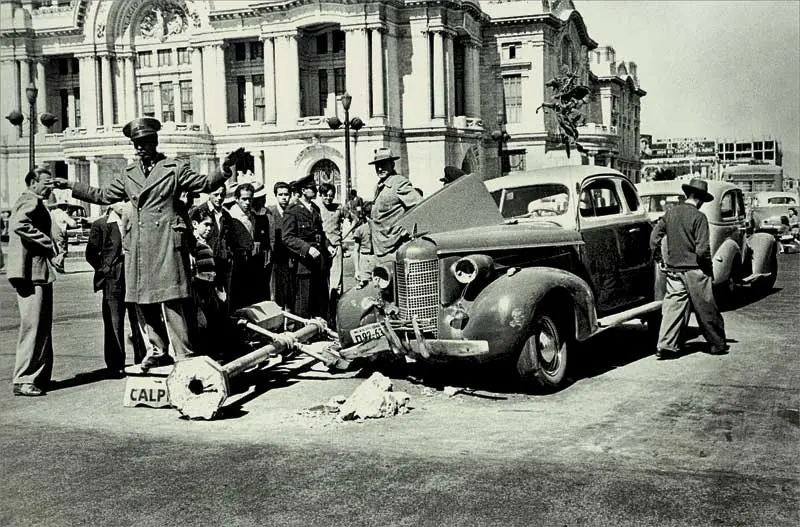
Metinides has been compared with Weegee, the famous New York crime reporter of the first half of the Twentieth Century, in particular, because of his aptitude to capture small details in a scene: “not only the object of the crime but, above all, the curious crowds around it,” whom he calls the “peeping toms.” This even proved useful in a crime involving a female victim: the suspect came up with two witnesses who swore he was out of town at the time, but Metinides’ photographs demonstrated he had been in the crowd of “peeping toms,” and he and his witnesses ended up in jail.
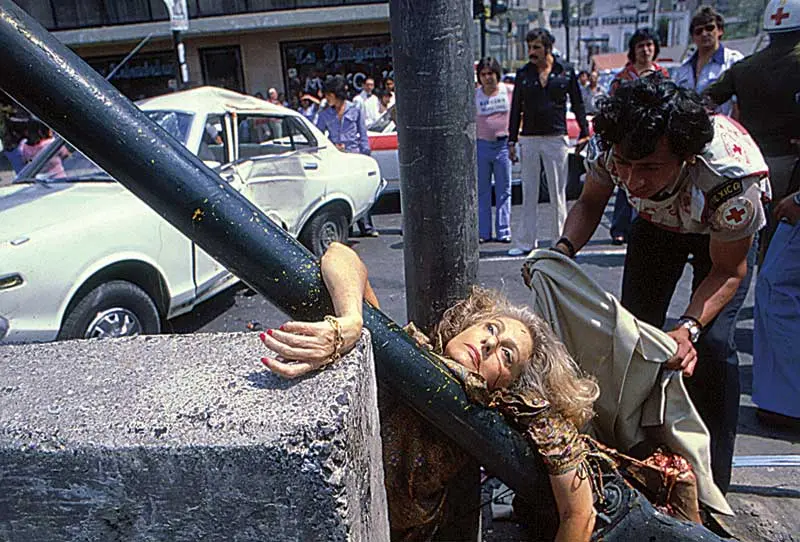
A master of the urgent, of the pressures of time, Metinides was careful with his framing, focus, and the psychological context of events. He kept everything under control, and his photographs were always of great quality, more like montages than the mere record of events. He has even been asked for the size of his stage, especially concerning one of his most famous photographs: the image of a woman hit by a car and driven into a lamppost on Chapultepec Avenue in 1979. The foreground shows the woman’s bloodied face and blond mane, resembling a carefully positioned movie extra more than the victim of an actual accident.
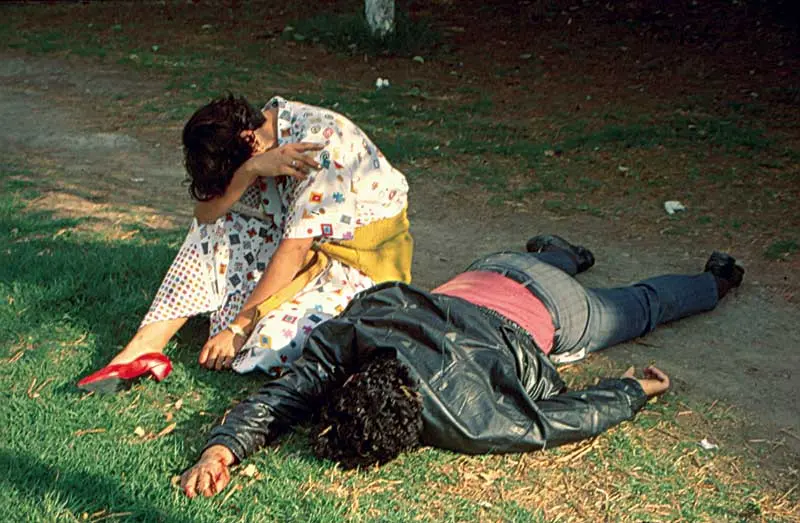
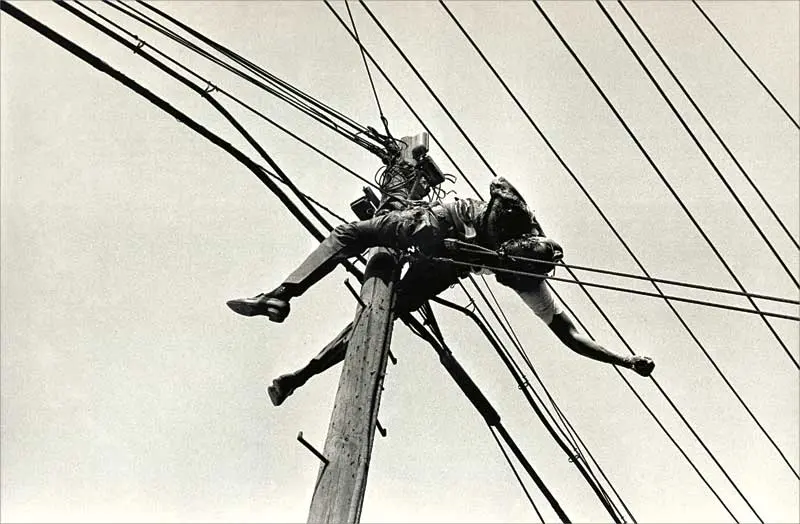
Another famous image by Metinides depicts a woman crying inconsolably next to the lifeless body of her fiancée, moments after the latter was knifed in Chapultepec for trying to impede a robbery; their wedding was to take place a month later. This photograph appeared at full bleed, front page, in a famous London daily, but the newspaper for which Metinides actually worked chose not to publish it. Another celebrated picture of his presents, tied in cables, the charred remains of an employee of Teléfonos de México, who died while installing a new line at the 13th km of the Mexico-Toluca highway in 1958.
Another one shows us the body of a teenage boy at the bottom of a public pool; diving, he had broken his neck. The photograph captures the dirty water in impressive detail. Another scene that confirms Metinides’ skill at photographing water depicts a corpse floating in the Xochimilco canal: there, the water clearly reflects the crowd watching the body from the sides of the canal.
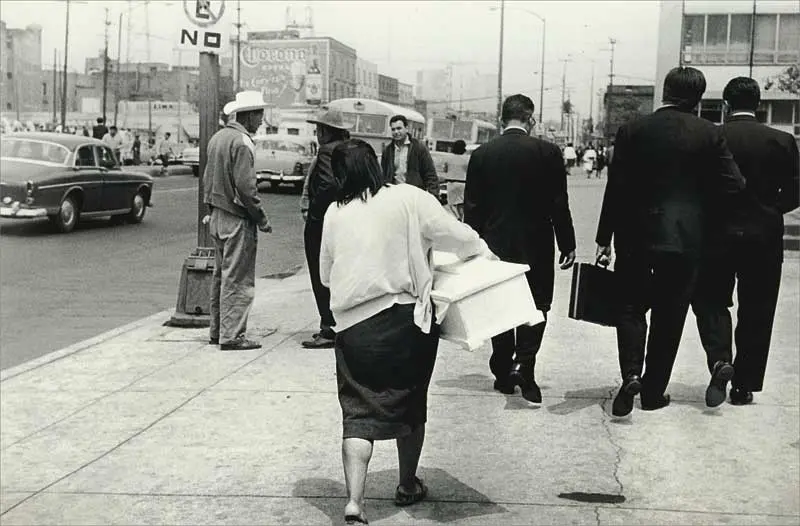
In another harrowing scene, a poverty-stricken woman comes to collect the remains of her daughter, who had been hit by a bus. She was walking with the girl by the hand; the girl’s hand slipped and she was killed by the vehicle. As she was given back the body, the woman told the M.E.: “she was all I had,” and the M.E. replied that she had to take the corpse with her anyway. She walked to a place where coffins were sold, kneeled down in prayer, and people came together to help her with the cost. Once she had bought the casket, she placed there the small, lifeless body of her daughter… the story is narrated with tremendous tragic gravity in a sequence that follows the mother from the moment she places the body in the casket to the moment she leaves the hospital with the small box in her arms, to be lost in the anonymous multitude.
Metinides also captured brutal fires from which he only came out alive by a hair. One remembers the huge smoke mushroom that formed after yet another one of the many explosions at a stationary gas tank and resupply center of the Santa Clara Gas Plat, in the state of Mexico, on May 6, 1966, a famous photograph Metinides took from the ambulance.
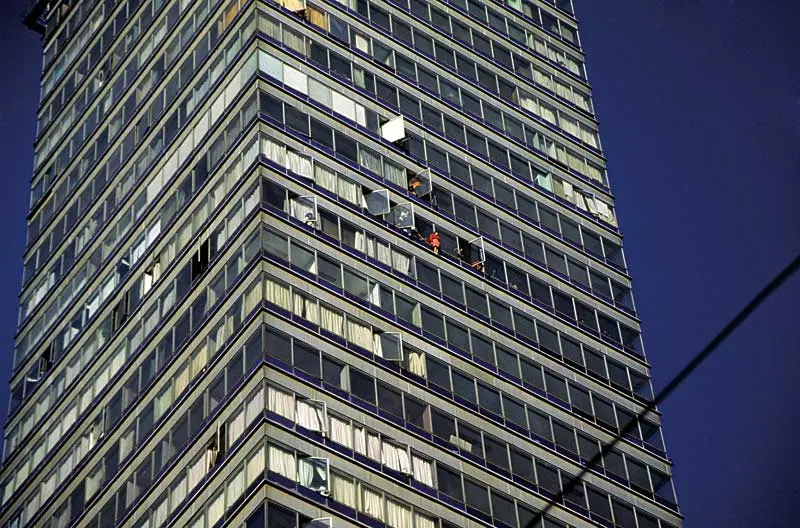
Among the many fires he photographed are also the warehouses of the Jamaica Market and a Textile Manufacturer; he ventured into the flames with no other protection than his drive to get his shot at the closest possible distance. “One day, when I was at the Red Cross in Polanco, I was called and had to leave in a flash: a suicidal lady had climbed to the 27th floor of the Latin America Tower. When I arrived (everything always happened after I got there, it was providential), I took my shot: a man was climbing down to hold her, and the woman is hanging; she screams, one of her shoes falls off, and they are able to rescue her…”
Metinides was able to capture this scene in a sequence of five photographs, but he tells us that the director chewed him out for not using a telephoto lens, which the newspaper hadn’t given him. He used his small camera’s regular lens and the resulting image includes the grid formed by the skyscraper’s windows, a geometry only interrupted by the woman looking up.
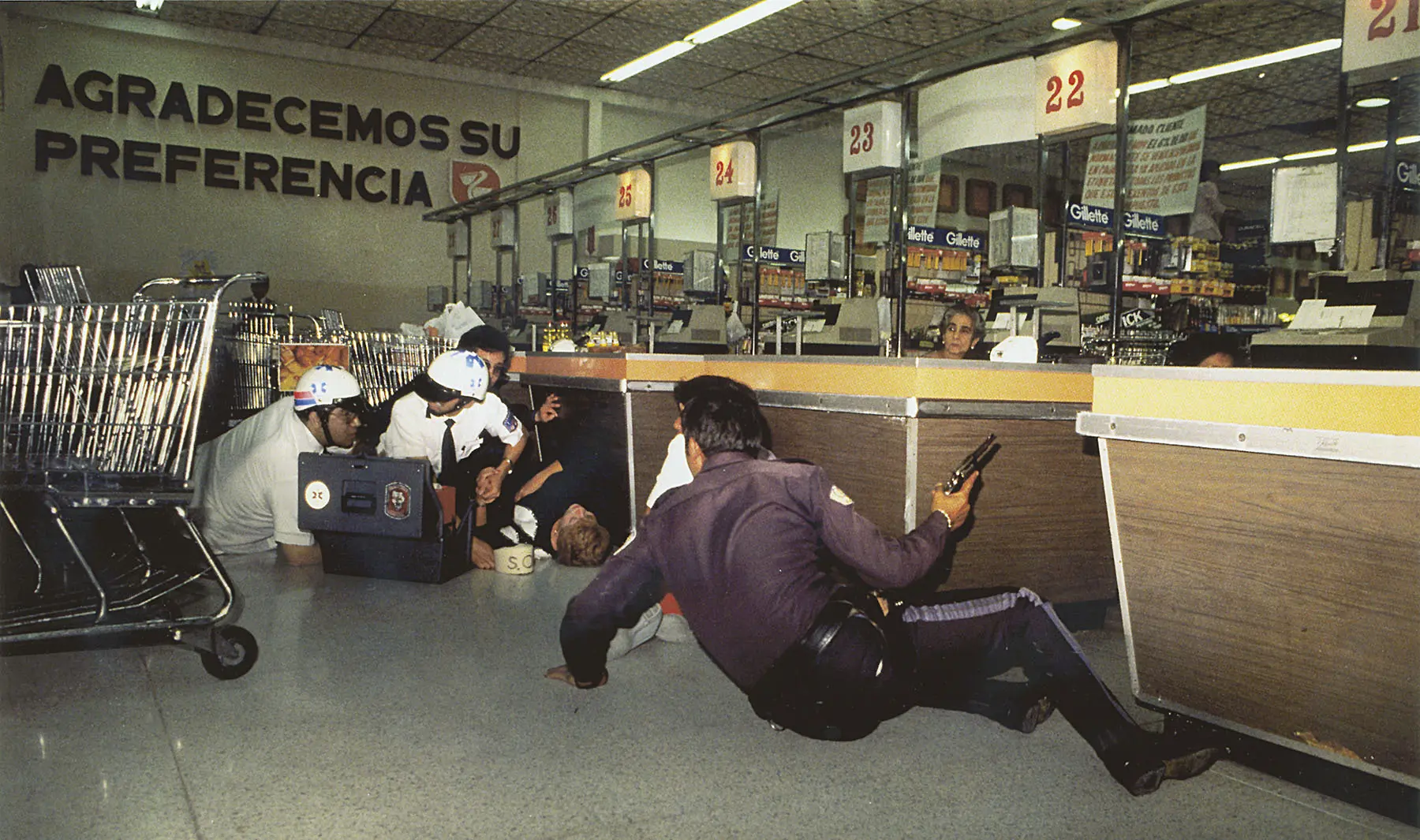
Metinides’ picture of a robbery at a La Comercial Mexicana supermarket in the 1990s has been compared to the photographic work in Dog Day Afternoon, Sidney Lumet’s movie starring Al Pacino. A bank van arrived to collect the day’s money when a commando-like group attacked and killed three policemen. The image shows the policemen and the supermarket staff behind the boxes. The composition retains all the tension and movement of a crime thriller. These photographs weren’t published at the time because La Comercial Mexicana was a big advertiser at La Prensa.
In recent years, Metinides has become one of the international scene’s most recognized and interesting photographers. His works, winners of many prizes (by Kodak, among others) have been exhibited in many countries—not always, he says, with his knowledge. Regarding his own presence in exhibitions outside the country, he warns me with great seriousness: “I would never go anywhere that required me to fly. It has always made me sick. When I was little, a bunch of kids hung me by a foot and a hand for five minutes from a sixth-floor window in the building where we lived, and since then I have never been able to fly.”
Yet he was able to go through 19 car accidents and overturnings, from which he came out alive, he says, thanks to his stamps of the Virgin of Guadalupe and the “lucky frogs” that he always carried with him and that are part of his many collections. Once he had his ribs collapse, but “I always came out and took the shot, and only after that they took me to the hospital with the other victims…”
As a crime reporter for over 50 years, Metinides offers his own interpretation of the many tragic events that take place in the city on a daily basis. In that ocean of competing interests and points of view that are the mass media, Metinides builds his own urban imagination and addresses image consumers to transform them into eyewitnesses, with him as their privileged informer: in recent years, these two ideal types have faded, making way to the emergence of voracious viewers of images that are read-only as sensations.
Color photography and video gave Metinides a new set of valuable tools. The shine of new automotive paints, the various shapes taken by automobiles in a crash thanks to new technological advances, are captured in a scene that shows two unconscious teenagers inside a bright-red car. The scene is photographed like an advertisement, with highly elaborate but never satisfied voyeurism: viewers are denied the faces of the victims and only given access to the perplexed expressions of a “peeping tom” and a police officer, who can see the entire scene.
Metinides adapted to the new rhythms of the city and the new visual environment of colorful design. The 1990s forced him to make an adjustment in his life, recording events that he formerly captured only from very short distances. His proximity to the events today acquires an immaterial character, and in other moments he elaborates what he always experienced in the streets into new images: tragedy and humor, the latter a preferred resource of playwrights which he introduces into his depictions of the crudest realities.
Metinides puts it this way: “It is not that I enjoy taking photographs of crimes and dead people; I’d rather give things a touch of humor, as when I photographed a stiletto-heeled shoe by going to the shoe store and asking the owner to hold it in his hand because the female killer has fled taking with her the shoe she used to hit her victim in the head…” In another crime scene, all that was there were the victim and a parrot in a cage; Metinides photographed the bird as a “witness”. The bullet held between the index finger and thumb is a more conceptual image, referring to the crime since the bullet was found in the victim’s stomach.
With a chair in his home for a set, his current production is based on his photographs of fires and car accidents. He created montages using small plastic toys: ambulances, paramedics, firemen, and police officers that he arranges on top of the actual images. In these compositions, the characters rescue the victims. He introduces humor into scenes of old horror, overcoming them to connect himself and his viewers with reality in a less painful way.
NOTE
1. Interview with Enrique Metinides, June 24, 2011.
CONSUELO ALMADA
Master in Art History.