The sculptures that make up the series titled Bipeds by Venezuelan artist and architect Francisco Pereira
(Caracas, 1959) are based, as the title suggests, on the hybrid representation
of bodies that belong to the animal and human world.
His work falls within the fantasy genre and, paradoxically, takes the truthful observation of anatomical aspects of the bodies of the beings they represent as the point of departure. In addition to mastering his craft as a sculptor, Pereira has a deep understanding of human and animal anatomy and is able to alter the corporal logic to create a new hybrid being through bronze cast sculptures. Pereira does not solely merge bodies from different species but also alters their nature by turning them into bipeds.
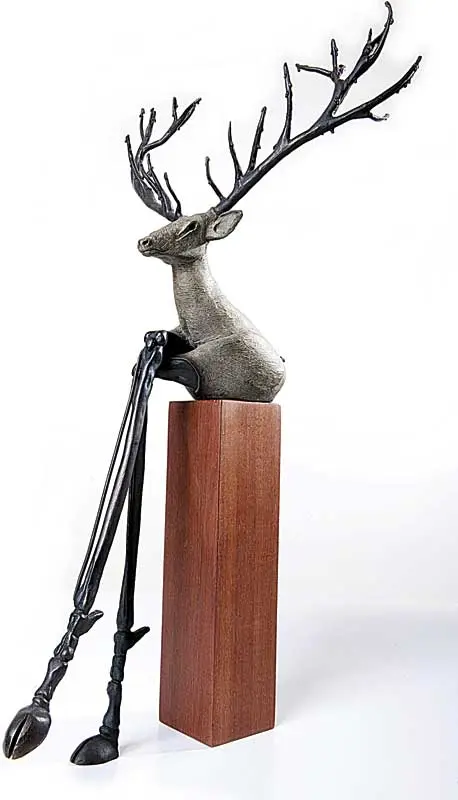
This both fictional and very real “humanized” condition—for that ability to walk on two legs—characterizes the 18 pieces that are part of the Bipeds series exhibited at the Galería D’Museo in October of 2013, in the city of Caracas. Pereira certainly bases his work on the study of the natural world to create these fictional animals. He demonstrates his mastery of the sculptural medium—volume, bronze modeling, and casting techniques, etc.—and power of observation of the natural forms, by rendering his works in a credible and detailed manner. All this leads to a new type of sculptural figuration that is conceptually sound to the point that his work becomes the subject of analysis in the field of symbolism and psychoanalysis.
According to Gerardo Zavarse, curator of the exhibition, the process of evocation and association of ideas that this series raises has an important point of departure: the image of Noah’s Ark in the piece titled El Viaje (The Journey). The reference is explicit because the artist has made a boat manned by the animals themselves—and the boat is arguably also transfigured into an animal. The journey into the origins of the species is based on the biblical story but it is “narrated” in a disrupted manner because, as Carolina Chirinos writes in the accompanying catalog, Pereira “has broken with the established, has been at odds with the natural order of things.” The question is how to preserve the purity of the species without giving into the primitive instincts that are inherent to animals? More than a biological reflection, it reveals a psychic condition that is an underlying part of human beings. The sculptor faces the issue with these pieces —as he has declared—by recognizing that this bestiary is the result of a humanizing process that manifests itself in the standing condition of creatures and it is in such condition that “a tension of opposites coexists: the conscious and the unconscious.” This tension is, at heart, a deep psychic process that is uniquely human.
To transform animals into bipeds has another important signification for Pereira: while the lower extremities are the connection to the earth and, thus, to their primitive condition, the body, as he points, is raised toward the “mysteries of spirituality.” This awareness of duality is embodied by beasts like the Bitoro (Bi-bull), Bicierva (Bi-deer), Bicabra (Bi-goat), Bipardo (Bi-bear) the Bicerda (Bi-pig) Biceronte (Bi-noceros), among others. On the other hand, this bestiary refers, as Pereira points, to some mental processes that are similar to a child whose fantasy world can also generate monsters. Therefore, these are creatures that have been experienced and that elicit a variety of feelings in viewers from the moment they are confronted with the hybrid element, the alterations and transformations of the species, and their own reflection in the biped condition of the creations.
The sketches and artist notes—beautiful in their own right as drawings on paper—reveal Pereira’s ability to analyze forms and their connection to certain ideas. They contain thoughts that complement the symbolic and spiritual meaning of each piece. Many of these associations stem from Pereira’s fascination with referential works in the history of art that he uses as support; works like Bosch’s The Garden of Earthly Delights, The Last Judgment, and The Ship of Fools; paintings by Salvador Dalí, who alters his characters and places them in surreal landscapes; and Gaudí, with his neo-Gothic and organic architecture full of “bony-looking windows,” as Pereira calls them. This selection is not random. There is a clear connection between the sculptor and the artists who indistinctly work with fantasy with reality. Special mention must be given to the bestiaries used in Gothic architecture from the Middle Ages.
In addition to dominating the medium, Pereira has given sculpture conceptual soundness that transforms it into a visual and emotional experience capable of generating in viewers a variety of ideas, associations, and feelings. With Bipeds, Francisco Pereira consolidates an interesting sculptural work and opens a new chapter in the figurative art of Venezuela.
SUSANA BENKO