
Horacio García-Rossi (Buenos Aires, July 24, 1929 - Paris,
September 5, 2012) has devoted his artistic endeavor to investigating
instability as a total experience. The Argentine artist has achieved in his
long artistic trajectory an aura of permanence through his diverse work.
A significant number of lightboxes accompany several paintings and kinetic spheres (1969-1971) in the exhibition titled Homage to García Rossi presented in Paris at the Galerie Lélia Mordoch from September 26 – November 2, 2013.
The exhibition is significant not solely for being a tribute to the artist, but also because of the quality of the works presented.
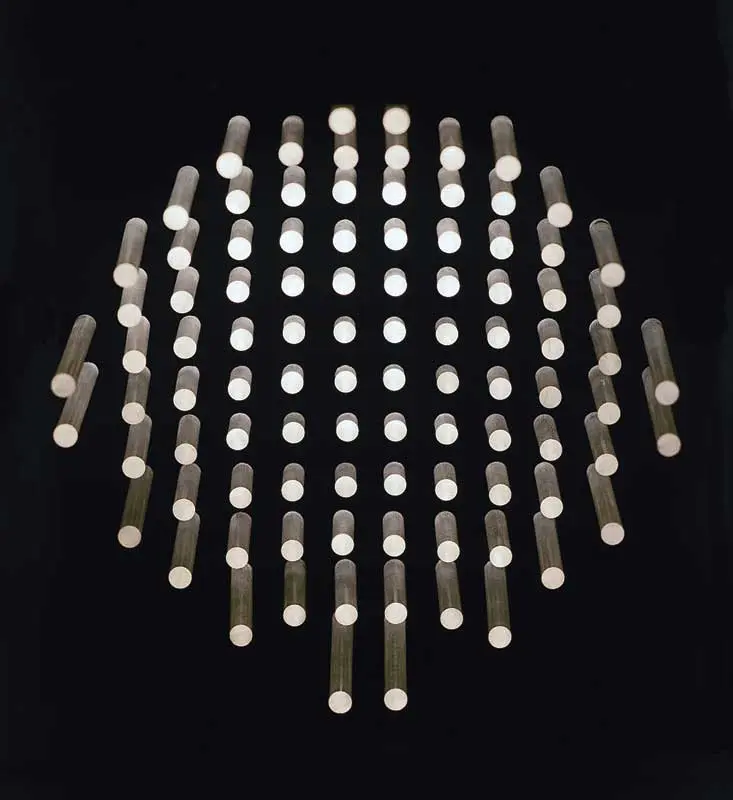
On one hand, they are unusual in their large size. The impression of the observer is significant because it allows for the evaluation of the technique. But there is also the modification of the usual gallery space and how we perceive the work itself as a result of the works selected. The group offers a survey through the themes and expressions that characterize García’s work and also allows us to discern the fundamental inquiries of an artist that has been structuring color and light since 1999. In addition to the pictorial theme, there are the corresponding states of mind and the expressions of the qualities of the medium itself: anger, transparency, progression, positive, negative; including the absorption of colors, namely, of the black on the background. The exhibition allows us to go from one phase to another and to understand the way in which García attempts to materialize the phenomenon and to make it independent from its representative function. In making the objectification of light and its route concrete, his paintings do not only become more abstract but also more intangible. The color theme and dimension of the work leads to the perception of the work as space.
Spheres of Light establish the value of his work as a sculptor, while lightboxes have a historic place. To contemporaries, his work represents a reassessment Fondation Maeght of his artistic trajectory, as these works were in need of being renovated with great skill and put back into circulation. This was also part of the work of García during the last decade.
The two aspects coincide with a change in the general trend towards the geometric taste, and towards the kinetic movement and those works considered historical.
It is interesting to note that the role of Latin American artists continues to be relevant and played a role in renewing this event recognized in the history of art.
A complete catalog helps us to gain insight into Rossi’s work and his steady career since obtaining his degree in Fine Arts, in Buenos Aires, and after settling in Paris in 1959. A year after moving to France, García, along with Le Parc, Morellet, Sobrino, Stein and Yvaral founded GRAV (Groupe de Recherche d’ Art Visuel ) or Visual Arts Research Group, and the following years presented their works for the first time in their studio.
Since 1961 they were represented by the Galerie Denise René. In the 3rd Paris Biennial they presented their first collective creation titled Laberinto (Labyrinth, 1963).
With the theme of instability, they toured the major museums of South America and the Documenta III in Kassel in 1964. Likewise, they presented the exhibitions The Responsive Eye at the Museum of Modern Art in New York, and New Trend at the Venice International Art Exhibition. Both were two key shows during 1965.
García’s personal research on the propagation of the two-dimensional form, compositions in white, black, and gray, and the vibration of colors marks the end of the 1950s. His transitions from real movement and his lightboxes, to the intervention of the works by viewers and to instability (1962-1964), as he works on structuring light and colors until 1966. He incorporated the issue of language and its ramification and other representations with use of concrete - kinetic language that is part of his titles ... Since 1972 HG García has been focusing on two-dimensional proposals. He also explores ways to capture the essence of light and its attributes. Meticulous in the execution of his sculptures, and methodical in principle, his painting also reflects the absence of subjective gesture.
GRAV moves to the street in 1966 with their works in Une Journée dans la Rue (A Day in the Street), a demonstration in Paris: for “entering into contact with a public that is not used to seeing art” and thus “eliminating the traditional relationship between the artwork and the audience.” It is a message aligned with the so-called democratization of art also introduced in Dix ans d’ Art Vivant at the Fondation Maeght, Saint-Paul de Vence, 1967, and Lumière et Mouvement at the Museum of Modern Art in Paris.
With the representation of the Galerie Lélia Mordoch, García has regularly participated in numerous art fairs, including Art Miami, and FIA, Caracas, among others; and in the following main exhibitions: Color–Light in 1999; Garcia-Rossi and GRAV at the Hermitage Museum in St. Petersburg; Garcia Rossi Makes his Film, in 2010; Is Distress Soluble in Art, all during his partnership of twenty years with the gallery.
A replica of the Labyrinth by GRAV and an Unstable LightBox from 1964 by García exposed visitors to the visual and physical effects in Dynamo, the 2013 exhibition at the Grand Palais, in Paris.
Movement (box, steel, motors, lamps, 1964) is part of the new presentation of the collections under Plural Modernities (1905-1970), which just opened at the Pompidou Center, in Paris. It was part of an exhibition room entirely dedicated to the GRAV by the same institution since 2010 and that now continues its existence separately.
SUSANA SULIC