
Between light and glass, we discern a struggle with inescapable
cosmogonic undertones. Ungraspable, colorless, light is essentially what
escapes. The invention of glass was perhaps the initial subjugation of light to
the world of form, the entry of time into history. It is impossible not to hear
in Bertil Vallien’s well-known dictum—“glass devours light”—an echo of
primordial transgressions: Prometheus stealing fire; Tantalus, the nectar of
the gods. Perhaps due to this silent struggle, in the second half of the
Twentieth Century glass sculpture developed a frequent interest in origins: an
essential reflection on the dynamics of light and the nature of time. In particular,
the technique of sand casting, as developed by Vallien, has brought forth a
vocation for the recovery of the past, an “archaeological” salvage that not
only re-imagines the primitive artifact but also the instant of its coming to
light.
Recent works by the Panamanian artist Isabel De Obaldía (Washington D.C., 1957) revisit this micro-archaeological vocation of sand casting in order to recreate pre-Columbian art. The exhibition Metates, at the Upper East Side gallery, brings together a number of sculptures inspired by the famous volcanic-stone metates (a kind of mortar) from Panama’s Chiriquí and Veraguas provinces, whose large dimensions and eminently stylized shapes suggest an ancient ritual set. Like pre-Columbian era metates, De Obaldía’s works display pronounced animal shapes which occasionally refer to the figurative conventions of the Veraguas style but more often express a freer formal exploration in the wake of Modernist primitivism. When her works break with straight horizontality—dictated by the metate’s surface—as in Smiling Crocodiles and Small Anteaters, their curved line brings forth a monumental gesturalism, freighted with pathos, that reminds us of the Mesoamerican modernism of a Rufino Tamayo.
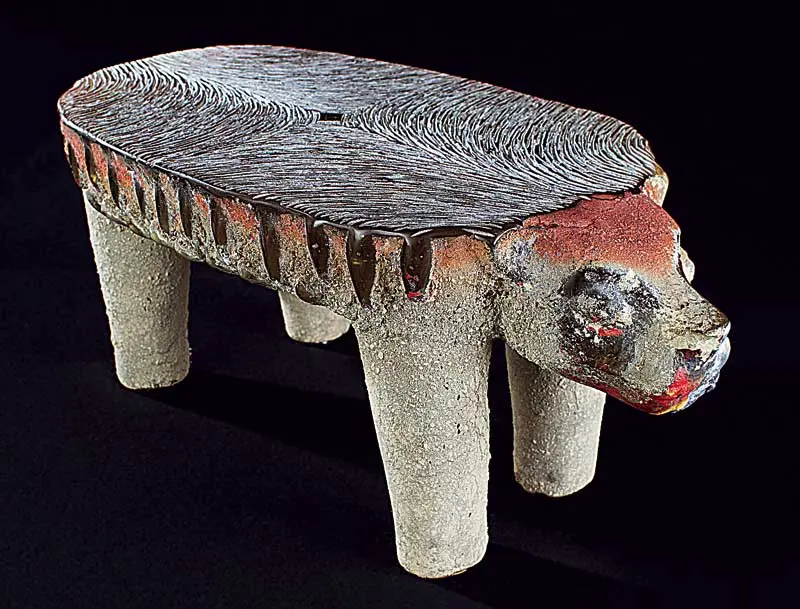
In that sense, Metates partakes of constant concern in De Obaldía’s work, amply illustrated in her 2012 retrospective, to rehabilitate the “primitive moment” of modern art.1 In her work, this rehabilitation is conceived not only as of the political and aesthetic imperative to renegotiate Latin American art’s coexistence with non-Western that share their living space, but also as the moral imperative to integrate the lesson of form into an intimate landscape of childhood: the natural and cultural surroundings that marked the Panamanian artist’s life.2 In Metates, pre-Columbian artifacts and their modernist deconstruction fuse with the colors and textures of the Earth; their coming into light does not take place in the abstract space of a canvas, but from the rocky depths of the soil.
The fact is that De Obaldía’s metates live a double life, or, if you will, hold a surprise for us: they are sculptures to be regarded at a distance, but they are also wells into which one can peer. The back of the metates is a polished surface that allows us to look into the interior of the work. Skillfully using Bertil Vallien’s technical repertoire, De Obaldía inserts into the glass a variety of pigments, sands, and figures of faces and insects, which, along with the glass’ own irregularities, subject light to a rich pictorial and chromatic dynamic. In this way, the soil-rough and irregular surface of the works seen from a distance open into a space of great chromatic richness; what the refulgent back of the metates reveals is a depth that is no longer archaeological but belongs more properly to the sensorial, lyrical order of memory. Because while the outer aspect of her works is always exposed to the pressures of time—and in that way refers us to the vestigial—inside them, the time comes to a halt: a particular arrangement of pigments, the air trapped in bubbles… In the entrails of the vestige, the instant pulses, permanently now, permanently available.
This characteristic tension between sculptural surface and pictorial depth translates an intimate relationship of sand casting with time itself. Many glass sculptors have taken advantage of the technique’s memorializing potential, driving it along with a variety of paths. For example, we have Janus Walentynowicz’s variation on classical sculpture, Clifford Rainey’s African- and indigenous-inspired works, or Bertil Vallien’s Scandinavian motifs. De Obaldía redirects this tension towards the possibility of a non-historicist recovery of pre-Columbian art, not only questioning its vestigial status, deadweight susceptible of museification, but also inserting it into a dynamic that is dictated by imagination and memory.
The metates on exhibit at the Mary-Anne Martin Gallery demonstrate the Panamanian sculptor’s technical mastery and the consistency of her aesthetic investigation over more than two decades and confirm her as one of the most outstanding practitioners of glass sculpture in the Americas.
NOTES
1. Primordial: Painting and Sculpture by Isabel De Obaldía, Sep. 25th – May 27th, 2012. Museum of Art, Fort Lauderdale, Nova Southeastern University.
2. ‘As a child, De Obaldía spent much time in [the painter Guillermo Trujillo’s] studio surrounded by Pre-Columbian ceramics and stonework from Central America, as well as the carved wooden Chiriquí shamanic staffs know as nuchos” (“Emissaries from the Primordial Realms”, Susan L. Aberth, in Obaldía, I. D., Alberth, S. L., & Sullivan, E. J. (2011). Primordial: paintings and sculpture by Isabel De Obaldía. Fort Lauderdale.
DAVID HORACIO COLMENARES