
Titled Jarbas Lopes: A Line, the second solo exhibition by this artist from Rio de Janeiro was presented at the Jack Tilton Gallery. Eclectic without being abundant, the selection of works shows the diversity of mediums used by an artist whose aesthetics are often indebted to the artistic tradition of Concrete Art and certain expressions from Brazilian folk art. Located in the adapted space of an old opulent house in the Upper East Side neighborhood of New York City, the gallery is too similar to the private space of a collector. And indeed, from this encounter between opposing visualities is born the uniqueness of this exhibition: the tension between the Apollonian drive of the shopping arcade and the Dionysian splurge of materials used by the artist.
This tension was manifested from the time viewers entered the exhibition, as they have confronted with the discordant title A Line and the many stripes in the work If Dionysus Drinks Wine, Apollo Drinks Coffee, a large diptych that uses coffee and wine as pigments on a support made with woven elastic. The left section of horizontal lines is rendered with coffee, while the right is vertical and pink in color. The materials used and their scents were evidenced the symbolic complexity of seemingly simple forms, even as the title warned us not to take it too seriously. Lopes had used wine to create a kind of mural in the 11th Lyon Biennale in 2011. On that occasion, the act of squirting wine straight from the bottle on the support involved an exercise of fluid control and movement. This time around, there was only the trace left in all likelihood by a similar act.
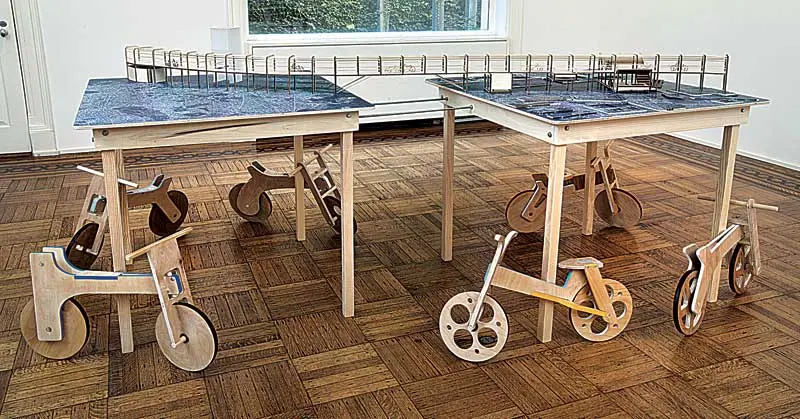
Undoubtedly, the center of attention was Maqueta de Cicloviaérea (Model of Aerial Bikeway), which involves the installation of a fine structure (an elevated bikeway) created with laser-cut wood, which extends diagonally across two tables. These represent two urban areas physically separated from each other but connected through the bike path. Around the tables, leaning their legs, Lopes placed six tiny bikes also neatly made of wood.
Lopes has exploited the aerial bike lane as a sustainable alternative to the tendency of governments around the world to create massive structures such as highways and subways to respond to urban expansion and densification. This process has led him to produce countless objects such as bicycles lined with natural fibers, drawings and monotypes, twenty-five of which accompanied the Maqueta de Cicloviaérea in this exhibition. Placed on a straight line along two walls, these whimsical drawings ranged from severe expressive abstractions to figurative narratives funny in tone.
But back to the installation of the mockup, although the press release explained the presence of small cycles based on an alleged “importance of participation,” this lecture only reflected the obsession of promoters with relying on fashion labels to add value to the artistic proposals. Rather than explaining the piece, this has the effect of encapsulating and limiting the interpretive possibilities. “Participation” is one of the most abused labels today in that it supposes the attribution of a value of use by the community. Although such an adjective was pertinent in many other projects by Lopes, it is not the case for this work. Rather than referring to participation, the children’s bicycles leaning on the table legs served as signs that pointed to the instability and fragility of the utopic model of the bike lane. It also created a sense of lightness and play, very much in keeping with the rest of the works. Namely, rather than a mere presentation of the neatly laser-cut model, Lopes had introduced a discordant strange element: the production of an object that lacks the handmade materiality or the uninhibited attributes of play that characterize his work to a large extent.
On the second floor of the gallery, Lopes presented a series of medium and large paintings of minimalist appearance. Three of them, the largest ones, leaned on the floor and against the wall, while the rest hung conventionally on the wall. As with the bicycles, Lopes sought to create a sense of lightness. This had its counterpart in the works themselves. As with the diptych by the entrance, Lopes used as support easels covered by plastic and elastic bands that, when woven together, produced the effect of a grid that was typical of modernist abstract art. Interestingly, and contrary to expectations, the use of these industrial materials (plastics) did not produce the sensation of cold rigor that characterizes Minimalism. The imprecise handmade characteristic of the grid ensured that the artisanal accent became determinant in the nature of the works.
In these works, Lopes avoids the geometrical rigidity of the grid through several effective resources. In some cases, he places objects under the support, as he tightens and increases it even more and creates suggestive bumps. For example, in Untitled, one of the larger works, the objects in question are two exercise balls located at the bottom corners of the frame so that viewers may see it as a reference to a woman’s breast. In others, Lopes applies color to certain areas of the picture surface, especially on the black squares formed by the woven ribbons, to break the monotony of the grid. Lopes does not seem interested in hiding the industrial origin of these objects but instead enhances them by contrasting them with the texture of familiar artistic materials like ink and graphite.
In the last room of the gallery, Lopes presented three types of works related to printing and drawing materials that were in line with the neo-concrete practice of his country. It consisted of a cloud of pages from a sketchbook on the wall, four boxes that contained rolled up magazines (undoubtedly one of the most successful forms in the group), and a series of artist’s books on a low table painted green without seats to sit and observe the carefully crafted objects (handmade books of the artist) that register dissimilar actions (bites, exposure to the elements, moorings). With this nod to archival nostalgia, the room left a certain flavor of a dead-ended proposition.
ELVIS FUENTES