
Diversity is the principal mark in the career of Swiss-born artist
John Graz (1891-1980), a significant presence in Brazilian modernism. The
exhibition John Graz, Viajante,
presented recently at the Centro Cultural Correios in Rio de Janeiro, featured
150 previously unseen works that attest to the plurality of his work.
Selected from the John Graz Institute, the works are intended to illustrate the artist’s passage through different countries where he lived or spent long periods, such as Brazil, Greece, Spain, Italy, and Morocco. Drawing in gouache, paintings, and other works by an artist who settled in Brazil at the age of 28, underscore his influential role in the renewal of Brazilian art, thanks mainly to the influence of the avant-garde movements he brought with himself from Europe.
While Graz’s painting never reached the levels of recognition of the great figures of Brazilian Modernism, such as Tarsila do Amaral (1886-1973) or Cândido Portinari (1903-1962), his work on many fronts, especially graphic and furniture design, as well as interior decoration, signal his importance in the transformation of the art system of the period.
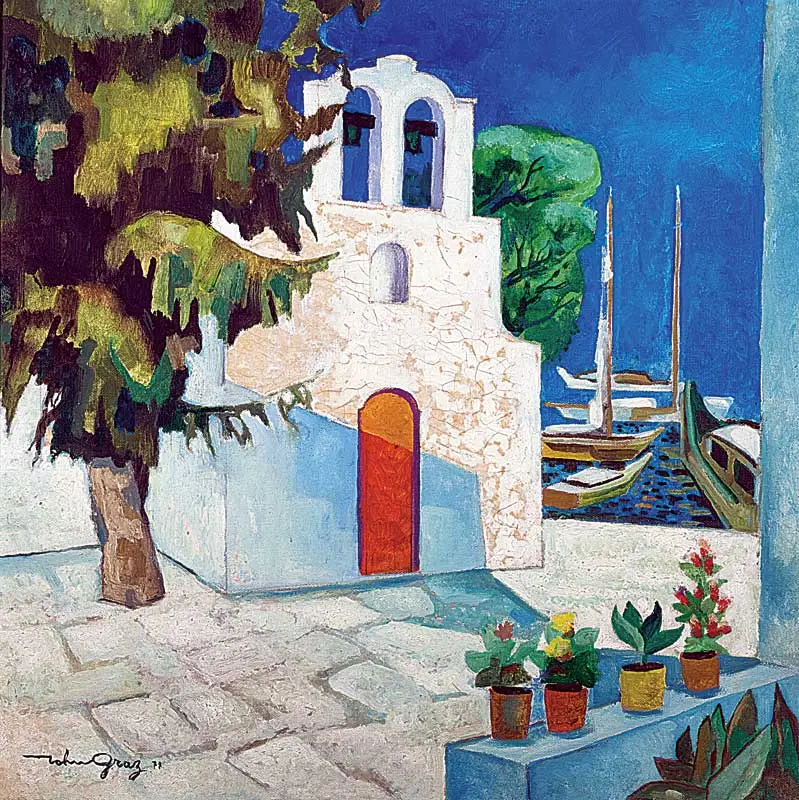
Graz was undoubtedly an emblematic character in the country in the midst of a process of urban and industrial development begun during the second half of the Nineteenth Century, which made possible the professionalization of a new generation of artists through a growing academic system. We cannot forget that the stage for Latin American modernization was paradoxical: half the population was illiterate, and the Tupi language was spoken in downtown São Paulo.
Graz contributed not only to the development of new pictorial languages but also, and especially, to design, as did Regina Gomide (1895-1973), his wife. Along with Regina’s brother, Antonio Gomide (1896-1972), the trio is considered the conduit for the entrance of the Art Deco style in São Paulo. Graz collaborated with Russian-born architect Gregori Warchavchik (1896-1972). He created and executed the interior decoration of São Paulo residences projected by Warchavchik, designing furniture, lamps, frescoes, picture windows, and even doorknobs.
Graz also created landscape projects and was an innovator in the decoration of environments, since in designing furniture he planned for their positioning and their relationship with panels, stained-glass windows, and frescoes. The integration of such elements became a characteristic seal of his work. In 1925, Graz presented in São Paulo his tubular furniture, made using metallic tubes and wood laminates, with geometric shapes. With a vast store of technical and manufacturing expertise, he personally supervised the production of these items at the Arts and Crafts School, with the collaboration of Federico Oppido (1877-1950). In the 1930s Graz also produced many magazine covers.
The term “Traveler” (Viajante) in the exhibition title fits Graz perfectly. He decided to settle in Brazil only after exploring several countries in search of an artist’s education. He studied architecture, decoration, advertising, and design at the Geneva School of Fine Arts and the Munich School of Fine Arts; he spent long periods in Paris, where he was in contact with Cubism, Fauvism, and Futurism. On two occasions, he went to Spain on a scholarship. Two years after moving to Brazil, Graz participated in the Modern Art Week exhibition of 1922, with seven works.
Sergio Pizoli’s curatorial proposal for this show was to go back to the curiosities and expectations that guided traveling artists who arrived in Brazil in the Nineteenth Century. “They worked between the fascination for the exotic and the neutrality of the scientist confronted with the natural world,” the curator explains. Like those artists, Graz began with an ideal landscape to shape his aesthetics. He sketched in small travel notebooks notes and these studies later, back in his studio, were the basis for his drawings and paintings.
It is possible to see in Graz’s canvases how the artist worked with a modernist vision in a country whose beauty and grandeur were ongoing discoveries for him. To represent the immensity of the rain forest, for example, he drew a single tree trunk with giant leaves. In this way, he escaped the pitfalls of the picturesque, in search of an original recreation of the landscape and its themes. With his mastery of line and draftsmanship, Graz produced abstractions and some geometric or purely informal constructions; nevertheless, a large number of his canvases were narrative and figurative, working in subdued tones.
As Pizoli, the curator, explains, John Graz brought in his artistic toolkit a Modernist conception of the landscape, which he admired in the art of Ferdinand Holder (1853-1918), a master of Swiss modernism who reduced his landscapes to a single line on the horizon. At a time when Brazilian artists sought to go to Europe with an enthusiasm for the various “-isms” of the avant-garde, John Graz made the opposite journey: he was a traveler who brought the Modernist vision to Brazil. One of the greatest representatives of Brazilian Modernism, Oswald de Andrade (1890-1954) revered him as “my futurist artist.”
ALESSANDRA SIMÕES