Exhibitions by modern masters are highly educational. Whether or
not the audience is well versed in an artist and his or her environment,
comparisons are established and rich new elements are discovered. Modern Latin
American art is fascinating, and José Gurvich is a part of it. Gurvich was born
in Lithuania in 1927 and emigrated to Uruguay in early childhood. He stood out
as a musician and a visual artist. When the time came to choose one of those
two professions, his encounter with Joaquín Torres García pointed out a path.
Given this, the viewer benefits from noticing the different ways in which
Gurvich incorporates sound into his works, be it abstract or figurative. As a
student in Torres García’s workshop, to which he belonged from 1945 through its
closing, participating also as an author in different disciplines, Gurvich
acquired a structure of basic compositional guidelines and symbolic elements to
expand into many creations. His restless personality, curious about the world,
also prompted him to make several trips to Europe and to live in Israel, where
he reconnected with his Jewish roots and began to work in ceramics, a genre in
which he is a modern-primitive figure still to be fully appreciated. In the
jargon of art criticism, personalities such as Gurvich’s are often said to be
“sponges.” Gurvich absorbed everything around him and turned it into drawings,
paintings, ceramic sculptures.
Besides the abstractions presented here, this internationally renowned artist has worked in a variety of languages, including celebrated versions of figurativism (among them, traditional Jewish evocations, liturgical and festive and infused with autobiographical elements). Of course, Torres García’s constructive universalism and his teachings served as guidelines for Gurvich’s creations, but within those guidelines, he was able to walk other paths, with differentiated approaches. The variety of his series, themes, and concerns, as well as his versatile handling of all materials and his deft navigation of various disciplines and styles, not only make it possible for his prolific oeuvre in areas like the one commented here to be studied and exhibited, but demand that it is. One of such chapters is a landmark in Latin American art and has many significant examples: migration. The mélange of origins and new destinies as part of a forthcoming investigation.
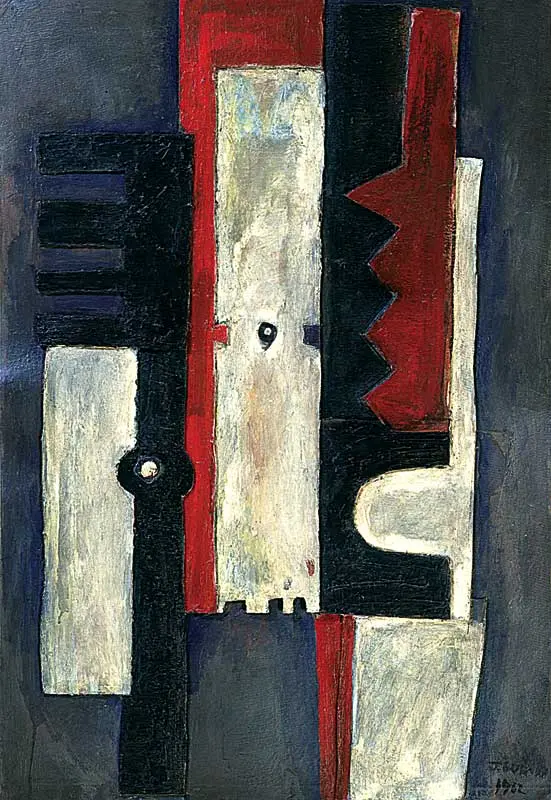
This exhibition at Cecilia de Torres Gallery in New York City features a selection of Gurvich’s abstract works that can be described as intimate and revealing, powerful and diverse. There are 26 works in oil, ink, tempera, and wash, created between 1946 and 1973 (a year before his early demise) on a variety of supports. A music lover, expressionistic, synthetic, surrealistic, somewhat naïve, and narrative, José Gurvich encompasses everything from the saturation of elements, colors, and hues to abbreviated and monochrome organic expressions. While the most cerebral of his works are articulated around monochromes or a subdued palette, as can be seen in Formas geométricas, a 1962 painting included in the show, there are works that explode in dynamic, labyrinthine, playful expressions, like Formas en azul, rojo, negro y blanco, tempera on paper, c. 1973. The 1973 painting presents a dialog of blue, gray, white, red, and black oils, in a composition that is personal, mysterious, and uncomfortable (in the sense of being difficult because of its format and the narrow dimensions of the support); in it, one can find keys and allusions to Gurvich’s years in Torres García’s workshop when he worked in painting, wood, the appreciation of handicrafts, the creation of furniture, and toys. Those essences that Torres García presented as theory and which connected, without being too overt, with the seafront city they inhabited. In the same work, viewers can discover Gurvich’s own pictorial-musical connections.
GRACIELA KARTOFEL