
With arms of water that flood everything, the sea penetrates with the surge. Its white roar hits the coast. The effects of the storm (or hurricane) advance on the limits of the island, dissolve its dynamic nature and ravage the cityscape. Visions of such contingency were collected in the works by Luis Enrique Camejo presented in The Island of the Day After, his most recent exhibition at the Galería Servando. The precedents for this exhibition, in terms of the use of watercolor, were: the exhibition Transparency presented in Cuba at the Galería Pequeño Espacio of the Consejo Nacional de Artes Plásticas, in 2004; and the exhibition Havana at the Havana Galerie in Zurich, in 2006. The former included the distinctive passersby that with their umbrellas turned their backs to the viewer, immersed in traffic and the daily life of a diffuse and humid city recreated from melancholic colors and assembly drawings. Then, at the Swiss event, the views became more open and the watercolors—also part of that exploration of the cityscape, recurrent in Camejo’s painting—became a place of freedom for stains and washes that also validated in this support the monochromatism that has become common in Camejo’s artistic practice.
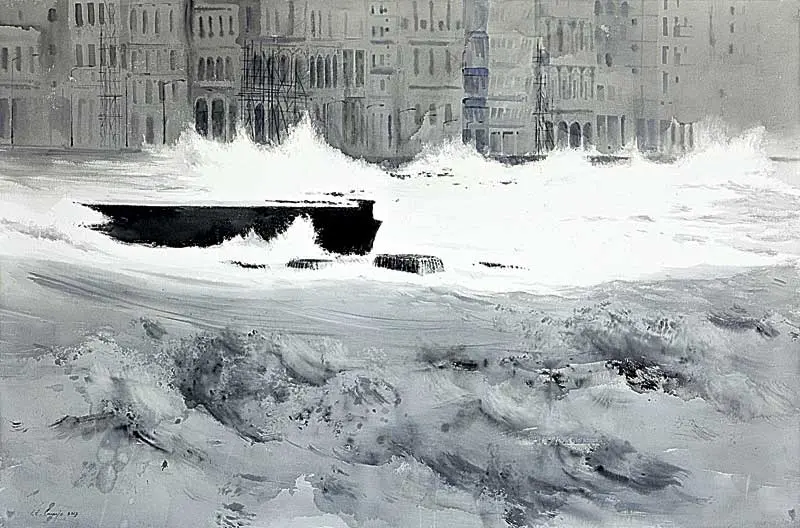
Unlike the earlier works, the current group of watercolors alludes in an unprecedented manner to our insular condition. A romantic vision of the destruction and end of the world accompanied an ocean that flooded the urban landscape erasing all boundaries. It became light as it crashed on Havana’s Malecón. It inundated the streets and avenues that defined part of the outline of the Cuban capital through its buildings and landmarks. An island full of meanings and symbolism, fixed in the past by the meridians and time, was the literary reference for Camejo and, like the castaway from the book The Island of the Day Before (1994) by Umberto Eco, the viewer watched from outside. It is a new point of view in the artistic production by Camejo who assumes the city in a colloquial manner, as he confronts it with its own horizons after observing the multiple voyages taken place in it.
The island city that emerges ghostly and diluted nonetheless describes the identity of an architecture missing in the rest of the symbolic production of Camejo. By the waters overwhelmingly moving pathways, one distinguished a Paseo del Prado which boasted its eclecticism. There was a mystical effect in the way its buildings were painted bearing the poundings of the storm. Although other areas along the boardwalk also stood out, the sea was the main protagonist of those pieces. The narrative character of the exhibition was subjected to the ocean’s will and excesses that illustrated the impact of the waves on the famous breakwater.
Moved freely, the gray penetrated the Arches paper. With his dynamism and through a clever superimposition of layers, the artist managed to create unique atmospheres that served to convey the spirit of the end to the public. Camejo’s technical excellence generated passages of maximum clarity, in which he preserved purely white spaces to distinguish—not without drama—the beauty from the terrible explosion of the surf on the coast. The penetration of the sea as a result of the surge also had a gimmicky effect. In one of the pieces, the sky and the flood water became a bright white. Amid its glow, the architecture survived like a colossus. This work, like other large and medium format pieces, was characterized by the visual exercise as if this consisted of juggling light. The energy of the gesture would take us through routes that opposed the photographic note and envisioned light as a state of mind, but it also evidences the artist’s success in turning moisture into an element that favors the ductility of watercolor.
As a result, the pictorial surface, the core, and soul of Luis Enrique Camejo’s discourse, glows with the explosions and the foam of the waves and, in the same manner, it disappears under the devastating effects of the current and the fluctuations of the rain. Mankind was not a visible part of this bad weather. The clash was exclusively between the forces of nature and that city-island that Camejo (re)created from memory. The symbolism contained in the entire event has different meanings. One yesterday, found in Eco’s Roberto de la Grive—from the Daphne—and his longing to reach the Solomonic insula. Another now, a record of the real moment found in the birth of these landscapes that alludes to the fugacity of the present, in that it addresses the fragility of the environment and projects its elegy through translucencies, superimpositions, splashes, and drips.
CARIDAD BLANCO DE LA CRUZ