
As a result of the continuous observation of the universe around
him, Luis Romero (Caracas, 1967), a visual artist, cultural promoter and
editor, presented from October 6 to November 3, his first solo show at the
Galería Oficina #1, a space—that he co-directs since 2005—aimed at the
dissemination of various artistic practices and contemporary thought developed
in Venezuela.
Overture was the title of this exhibition dedicated to the night, a theme that the artist has repeatedly approached in his work for over a decade, when he initiates a systematic, and yet sensitive, inquiry of those symbols and signs that remit us to the night hours, to the landscape that unfolds under a stellar mantle. That inscrutable aspect of the passing of time and the reiteration of cycles associated with the original myth, are reincorporated by Romero into a reality that he owns to visualize not only the mysteries of darkness and its opposite, light, but also to disrupt and reassign another possible interpretation of the universal precepts associated with mythical thinking. Based on several visual strategies, Romero materializes the ethereal heavenly bodies to conceive a poetic of astral cartographies that, in turn, are inevitably related to the emotional and spiritual.
The exhibition consists of a series of recent works executed with an economy of resources: four different graphic series, a sculptural installation, an object and a poetic sculpture are aptly displayed across the museum space. They are articulated around that which defines the central inquiry of the proposal: “the myth of night.” Series after series, timeless and fictional correspondences give new meaning to the puzzle: constellations of stars, planets, nebulae, and heavenly vaults anchored in that nocturnal landscape: there an imaginary is revealed that comes from the synthesis of these astronomical figures that have troubled the artist has always exhibited. There, a possible narrative is also manifested, a story and also the desire are generated from the artifice of the textual language.
Romero configures a subjective iconography of the night and of the stars by using the synthesis of elementary forms of representation. In the series Overture (2013), which gives the exhibition its name, the group of monotypes created in one ink has a cluster disk and white circles on a dark and deep background, representing more than geometric abstractions, floating structures that move in a game of infinite possibilities looking to radiate light is this horizon dominated by darkness. The series Bóvedas (Vaults, 2013) infers the idea that natural processes are based on a binary system in which the tension of an unavoidable polarity is established. Both phases would appear symmetrical or equivalent and so would cosmic phenomena: day-night, sun-moon, spiritual-corporeal. The mystery of all dualisms stems from its primary contradiction, for no phenomenon constitute a whole reality, only a half one. Each symbolic form must be corresponded by a similar form and its opposite in order to attain an equilibrium. Conversely, the group of monotypes Fase I, II y II (Phase I, II and II), as Tahía Rivero noted in the text that accompanies the exhibition, “differs from the previous series in that it describes a possible fiction within the laws of universal progression, birth and death; two analog images are combined into a third that contains them both, whether or not it is appreciable.”
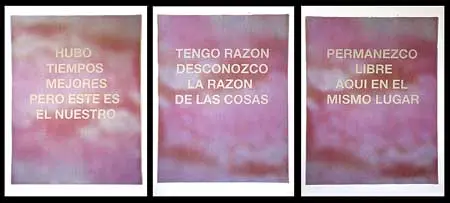
Atardeceres (Sunsets, 2013), which consists of ten unique pieces made in silkscreen, marks a prominent aspect of the exhibition. The nebulous texture and the use of pink and blue inks are associated with various moments that summarize the twilight time, “that which refers to the prelude of the night.” On each of these chromatic backgrounds, Romero incorporates a practice used earlier in which he superimposes a sequence of texts and commentaries that catch the viewer’s attention: “I have reason to not know the reason of things,” for example.
The sculpture group titled Spears displays five iron spears topped with representations such as stars, moons, and suns that were gathered by the artist as cultural testimonies of diverse origins. This work has a precedent in Cielo-Ceú (Sky-CEU, 2010) an installation of 70 national flags over a black background that reveals several symbols of identity and that was presented at the 8th Mercosul Biennial in Porto Alegre, Brazil.
The exhibition closes with a piece that seems alien to the show. Lar (Object / Sandwich), created between 1996 and 2013 and made with plaster and resin, refers to the idealization of a utopian place. According to Romero, “that perfect place that is internalized in me, for this exhibition not only speaks about the night but also about people.” On the floor lies a poetic sculpture that comprises one thousand printed sheets whose content reveals new clues to the viewer: “During the day we do not know how the stars shine in the dark sky.”
RUTH AUERBACH