
If
for Hegel art was to survive as a reflection about art, for Thierry Raspail art
is surviving in our era purely and simply as narrative. This is the thesis that
the artistic director of the Lyon Biennial defends in the catalog essay that
presents the event’s 12th edition, held in 2013. For Raspail, art is
inseparable from the stories it gives rise to, and, even more radically, art is
itself a story, even if it frequently is the kind of story that requires no
words in order to flow. Thus the title that condenses the argument put forth by
this edition of the biennial: Entre
temps… Brusquement, Et ensuite [“Meanwhile… Suddenly, and Then”]. Notions
that refer to a suspension or sudden interruption of the flow and whose
discursive and narrative modalities play, according to Raspail, a crucial role
in determining the current state of art. Citing Jameson’s critique of
postmodernism, Raspail evokes the situation three decades ago or longer, when
there was a “displacement” of the “old language of the work of art and the Masterwork”
by “the language of the text, of texts, and of textuality, a language for which
the achievement of organic or monumental forms is strategically excluded.” This
textuality, which in its way concedes Hegel’s point, has undergone a new
displacement, Raspail assures us, this time in favor of narrative, or more
concretely, of narratives, usually more imaginative and sensual than what any
theoretical discourse can aspire to be.
Raspail’s gambit for narrative in art guided the work of Iceland’s Gunnar Kvaran—the guest curator for this edition of the biennial—who selected and included works by 69 artists from the seven continents, all dominated by a narrative intent, albeit with notable differences in form and in their means of achieving it. There are those who opted for the staging of very private obsessions or desires. Outstanding among them are Robert Gober (US) and Gabriela Friòriksdóttir (Iceland). The former building, in the Museum of Contemporary Art in Lyon, one of the event’s sites, a large installation based on models resembling American middle-class houses that in reality were, according to the artists, “dollhouses” that satisfied his old desire to become a maker of such toys. Friòriksdóttir’s installation, Crepusculum, was even more ambitious and complex, and responded to her desire to give shape to the rumors of the world, from ocean waves and street traffic to the crackling of the sun. To this end she brought together in her installation Iceland with a Caribbean island, and intercut this imaginary encounter with drawings and a poem suddenly inspired by such incessant background sounds.
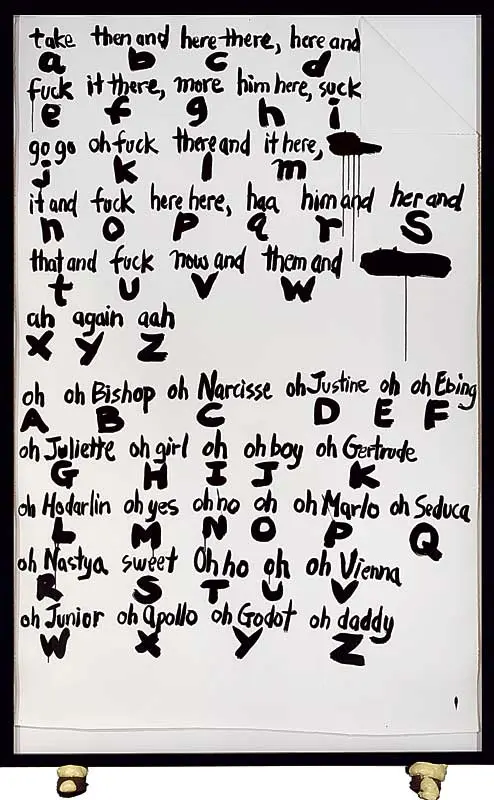
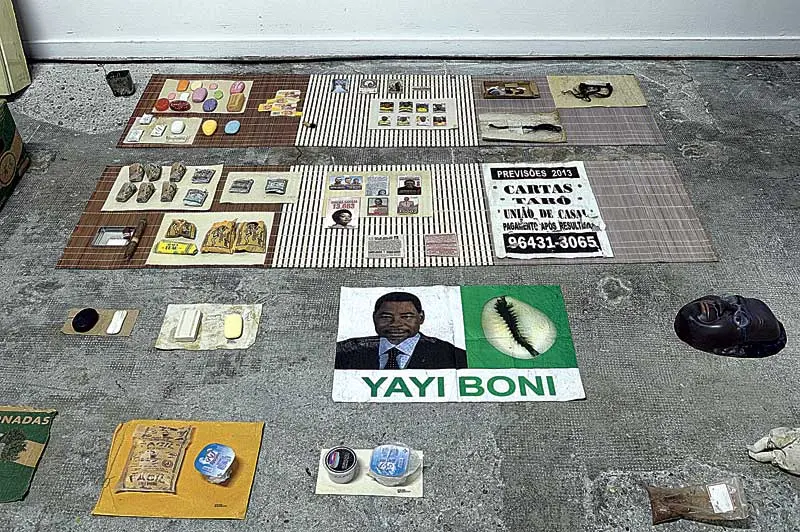
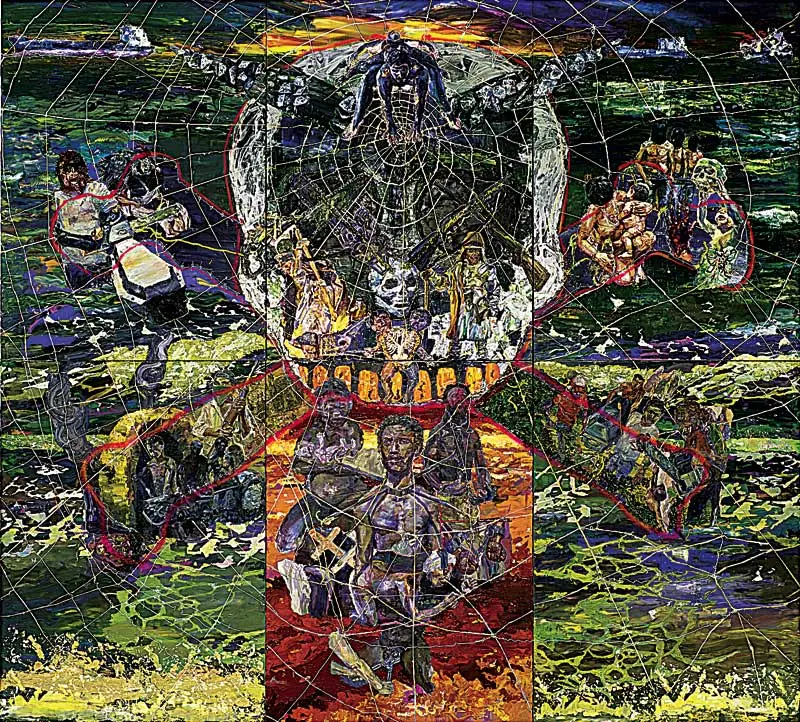
In turn, Chinese-American artist Paul Chan went so far in his retreat into the self as to create an installation that presented the results of his delirious investigation of the possibility of a language “that worked for him and no one else.” This ran counter to the work of Brazilian artist Paul Nazareth, who, skirting any mode of solipsism, interrogated his social condition as a mixed-race person in an installation that combined documents and varied reflections to weave his family’s legend of “a back man who one day was a white man.” Also from Brazil, Thiago Martins de Melo went even farther along the same path, with a selection of powerful and expressive large-format figurative paintings. The largest occupied, mural-like, a good portion of the façade of La Sucrière, an old sugar refinery and another site for the Biennial. The remaining paintings were on display inside the building, and like the one outside they proposed halfway humorous, halfway sarcastic interpretations of life and history in a country that today is globalized and yesterday was colonized.
The pride of place given in this biennial to the narrative element relates, in ways that are difficult to overlook, to the important role played by stories today among the resources and means for an effective exercise of power. For a decade or more, it has been common to hear image counselors, political advisors, and political scientists expound on the absolute necessity of creating and deploying narratives for public opinion to imbibe and interpret favorably the strategies of political power. Yet such admonishments tend to overlook the fact that the birth and consolidation of the modern state-run parallel to the construction and rise of national stories, as Benedict Anderson so convincingly demonstrated. These are stories which, while shoring up the Rousseaunian foundational myth of the “sovereign people,” attempted to satisfy the demand posited both by Michelet and Von Ranke to “reconstruct the past as it really was.” In the essay mentioned above, Raspail reflects on the relationship between history and narrative from a perspective that is heavily indebted to Jean François Lyotard, according to which the postmodern era is characterized by a crisis of les grand récits, the Grand Narratives. And among them, evidently, is History with a capital “H” (to underscore its pretensions to the status of unquestioned Truth).
Such History has come to be seen as just one more narrative, one that like any other combines reality and fiction, or one that subjects reality to the rules of fiction. Given such declaration of principles on the part of Raspail, evidently shared by Kvaran, the biennial gave ample space to highly personal and imaginative versions of historical events. The paintings by De Melo mentioned before are part of this option. But so is Czech artist Václav Magid’s work, deeply historical in the classical sense, From the Aesthetic Education Secret Files, which superimposes a TV series from the 1970s about a Soviet spy infiltrated in the Nazi elite towards the end of WWII on a 1974 gathering that brought together Goethe, Schiller, and Hölderlin, three legendary poets, to present the quest for “arts privileged space” as “a spy novel.” Or the work of American artist Glenn Kaino, which revisits and reinterprets the night of October 16th, 1968, when in the midst of the Olympic Games held that year in Mexico City, the black athletes Tommie Smith and John Carlos raised their black-gloved fists on the winner’s podium to show solidarity with the defiant African-American movement of the era.
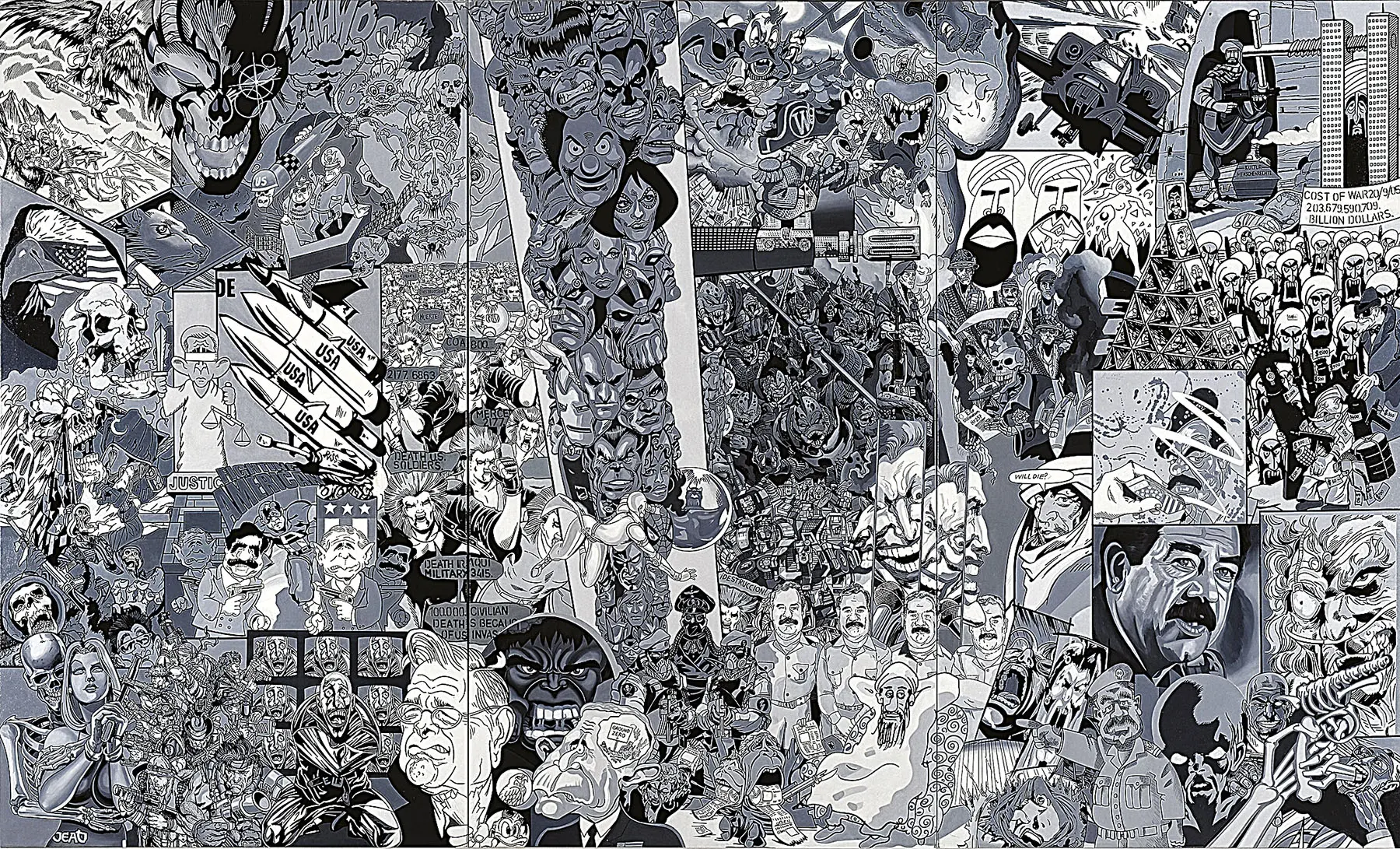
The whole of Icelandic artist Erró’s work is inseparable from the political agitation of the same period, marked by the fire of the May protests in France and by movements in opposition to the Vietnam War. The biennial included two of Erró’s most notable works. The first, from 1993, is titled For Pol Pot, and the second, from 2005, God Bless Baghdad.
The veteran Icelandic artist (born in 1931) engages these important historical events in the same sarcastic vein and with the same intention of freely appropriating the rhetorical and expressive resources of comic-book art of a Richard Crumb or, closer to our own age, a Raymond Pettibon. But Erró, instead of articulating history on the basis of sequences broken down in vignettes, composes large-format paintings where characters and situations accumulate with the very effective grammar of collage.
Even the disquieting sarcasm of Erró’s work, however, paled in comparison to the subversive intensity of the humor and irony in another notable work on exhibit at this biennial: the book The Great Art History, by Brazilian artist Gustavo Spiridao, which offered a history of art as bold as it is provocative. A story composed on the basis of photographs, erasures, and manuscript texts that combine, for example, a cowboy with a Toulouse-Lautrec, the Bauhaus with the image of an armless boy trying to write on a school notebook using his prosthesis, or Angelina Jolie with the photograph of an anonymous militia member patrolling a Twentieth Century central European city reduced to ruin by aerial bombardment or street combat. Among the “advantages” of this singular history, Spiridao cites: “1. This art history book is able to explain the history of art in itself. 2. Being art, it can be more successful in the attempt to discuss art in the context in which it takes place. 3. The book can become the caricature of an art catalog and a comic-book version of Theory.” And among its “disadvantages,” he cites: “1. The book cannot explain the history of art and there is a risk that it is not considered art. 2. There is a risk that it is an Art History book. 3. It is long.”
It can be added that the comic book, as a source of inspiration and resources, played an important role in other works present at the biennial, besides the ones mentioned above. Petra Cortright (US) exhibited a computer-animation film titled Vicky Deep in Spring Valley, which the artist herself explained as “the story of an overweight nurse with a credit card in the red.” Her compatriot Dan Colen presented Silhouette Wall Cuts (working title), which recovers and interrogates the eternal duel between the Coyote and the Road Runner, connecting and contrasting it with the misadventures of two great comic-book characters: Roger Rabbit and Kool-Aid Man.
Harald Szeemann’s innovative modalities of art presented in the fifth edition of Documenta Kassel (1972)—which he curated—included “personal mythologies.” This biennial suffered no dearth of attempt to mythologize the artist’s own biography, like New York-based Xavier Cha did in his installation Disembodied Selfie, or France’s Lili Reynaud Dewar with I’m Intact And I Don’t Care, Britain’s Patricia Lennox-Boyd with One Thing After Another And Another, or Spain’s Laida Lertxundi with The Rom Called heaven. But also on display were works that can be deemed personal versions of a myth, like the formidable Maybe New Friends, a video by British artist Ed Forniels dedicated to Britney Rivers, the protagonist of the FOX TV series New Girl.
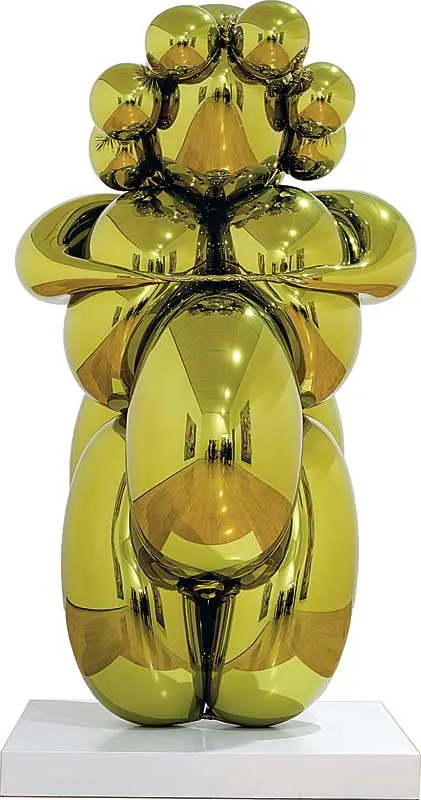
The most surprising example of this kind of mythology was offered, however, by Jeff Koons, who composed an installation that moved away from his usual line of work, so Pop, and explored classical mythology. It was on exhibit at the Museum of Contemporary At and included Antiquity 2 (Dots), a large format painting based n a photograph of actress Gretchen Mol—who played the mesmerizing Bettie Page in the film The Notorious Betty Page—riding a dolphin and holding an inflatable monkey, in a highly erotic attitude. Behind her and against a typographic screen background, there were photographs of sculptures of three classical gods: Pan and his powerful erect phallus, Aphrodite, and Eros. And over this composition, very graphic in its style, Koons made a schematic drawing hat can be interpreted as an inversion of Courbet’s celebrated photograph The Origin of the World or as a sailboat crossing the ocean under a benign sun. Koons accompanied this battery of historical quotations with a text, included in the catalog, that revisits the theory of the biological origins of beauty and aesthetic pleasure exposed and defended by Edmund Burke in his A Philosophical Enquiry Into the Origins of Our Ideas of the Sublime and the Beautiful. The second work in this set was Balloon Venus (Yellow), a sculpture made from iron sheets with their colored and shiny surfaces, much in their author’s style, based on the Venus of Willendorf, probably the best-known pre-historical sculpture.
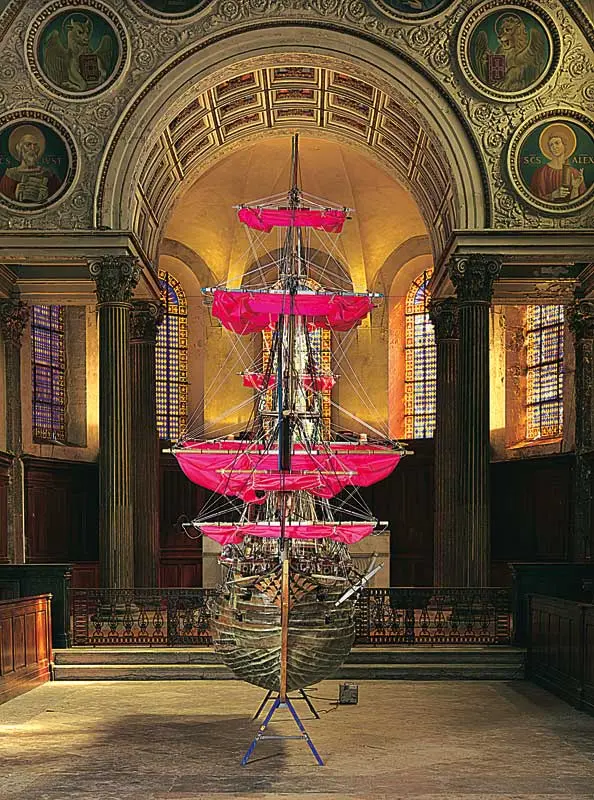
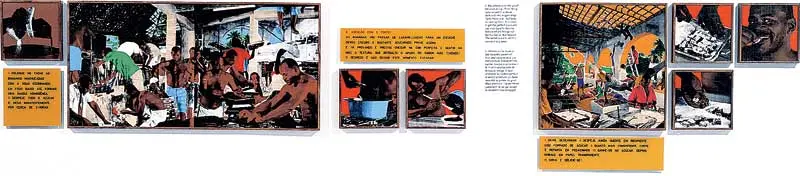
In closing, let’s mention 40 black candies is R$1.00, a varied and colorful installation by Brazilian artist Jonathan de Andrade, a traditional bon-bon candy that is very popular in the Brazilian Northeast, and Barbie Slave Ship, an installation by American artist Tom Sachs, a large-scale model of an Eighteenth-Century slave ship placed at the center of an abandoned Gothic-style church, where instead of the hundreds of chained slaves in their rank, claustrophobic confinement, we saw hundreds of replicas of Barbie. Simple, but no less unsettling because of it.
CARLOS JIMÉNEZ
Essayist and art critic. Lives and works in Madrid.