
Seen from a distance, Vortex—an
installation commissioned to Marcela Armas to close the cycle of the curatorial
program For the Love of Dissent at
the Museo de Arte Contemporáneo of the Universidad Nacional Autónoma de México—is
an elongated and slender figure suspended at the center of the room, formed by
homogeneous rotating bodies that move slowly in a spiral, and supported by
three pillars that seem to surround an invisible or imagined central body. But
that central void around which those bodies rotate implies a symbolic body that
is effectively absent, supported by jaded machinery that keeps it almost
alive.
As we approach the work we begin to (un)configure its parts. The circular figures turn out to be geared equivalent in size and thickness. The perfectly cut teeth rotate as they mesh in a vertical spiral trapped in and by its own mechanism. The gears maintain a lethargic pace of forced mobility self-powered by impotence since the pieces do not move or activate anything other than their own rotation, as they float in the air declaring the incoherence of their existence. And yet, their constant and appeased floating also evidence that they are not stopped by no one or anything, so the “engaged” cycle is offered as infinite and imperturbable.
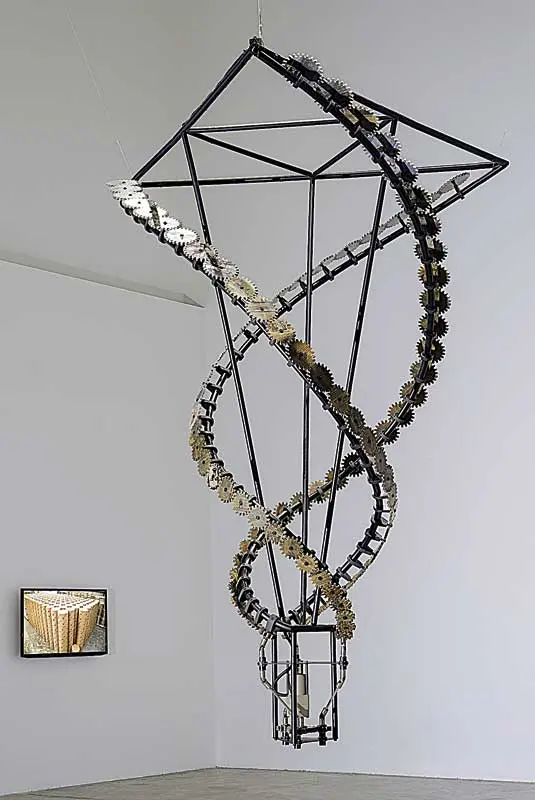
Careful observation makes it possible to distinguish the material with which these tireless-futile gears in Vortex were made. They were constructed with matt green-gray board paper, each gear assembled through the condensation of hundreds of very thin layers (similar to tectonic plates), as the body is added to the volume. It is then that the work reveals the—literal and symbolic—composition of a mechanism made with interconnected stories. These are narratives that over time—and by the decision of the state—have fluctuated through imposition as official speeches and/or have been avoided, but that ultimately have been turned into scrap; in such a way that the original material of the gears do not de facto retain or share the source-destination path dictated by its content, as it does it only symbolically.
Vortex is presented at the mercy of the story of its own manufacturing process and of the intertwined images of the video that silently accompanies it. The video shows reflexive shots in several locations—between which the “conversion” of obligations dictated on paper occur—as if they lacked a strict narrative order. However, as a group, they configure fragments-in-evidence of different processes of the production, storage, degradation, and/or mass recycling of the paper that feed and degrade the spheres of politics and public education in the country. Thus, we understand that the process referenced in Armas’s work begins with the accumulation of outdated archives in government institutions that are then turned into raw material for the mass production of textbooks for the elementary and secondary levels in “public education” schools. There are among the scenes recorded some facts and figures that help gauge the cycle of ‘consumption’ of textbooks printed annually and distributed to all public schools in the country. For example, we were informed that 218 million free textbooks were produced in 2013, and we give an account of their origins in hundreds of thousands of archives vanquished by time and collected to turn their oblivion—causal or involuntary—into tons of paper usable for reoccurrence. Public and/or private fragments of bureaucratic political life are thus shown conglomerating like dead bodies that are only good to be crushed and reinvented for the second time of use.
While the production of free books could well be regarded as a ‘respectable’ act in the face of the squalid national decrees for the promotion of public education at the national level, the work by Marcela Armas questions the relevance and responsibilities—whether attended or discarded—that feed its origins and continued existence. Thus, seeking to replicate the order and corporeality of its germination, the artist convened a group of volunteers—mainly students of UNAM—to build a small maquiladora that would allow her to emulate the processes that transform the bureaucratic paperwork into textbooks.
Vortex assumes itself—and is deployed as—an exercise of “mechanical visibility” with respect to a process that should be of a vital order, but that occurs almost by inertia and carries a heavy legacy—even as it is seemingly invisible. This happens in the body of the gears that make up the ascending—and by logic, or destiny perhaps, descending—spiral, as they are products of automatic production; having been created from recycled paper by the artist and his team of volunteers in their own maquiladora—congregating paper blocks bonded with resins and cut along their perimeter—to enable the chance for his fatuous action. Thus, Vortex not only symbolically and conceptually implies the nodal stages of a translation-by-erasure process between old and new knowledge, but it is also composed of the same inert mass that in turn feeds a mechanism—scaled and in parallel—equally questionable with respect to its purposes and results.
MARCELA QUIROZ