
Time and space were protagonists in the Diagram project presented by Marcius Galan at
the Fundación NC-Arte. Lines, circles, triangles, volumes, areas, curved lines,
among others, were the concepts and shapes with which the Brazilian artist
built facilities that put into question our relationship with the environment
and the way human beings appropriate an idea of reality as the unchanging
truth.
Painting, installation, drawing, and sculpture were the languages that Marcius Galan used to bring into play his theoretical premises. The study of the connections between body and space and the relational functioning of the mind has provided him with key information for conceiving proposals that present paradoxical situations where viewers are confronted with elements that dismantle notions that before were regarded as infallible certainties. Diagram then discards conventions and, although it plays with visually recognizable codes, the manner in which it uses them removes the significant ideas contained in them.
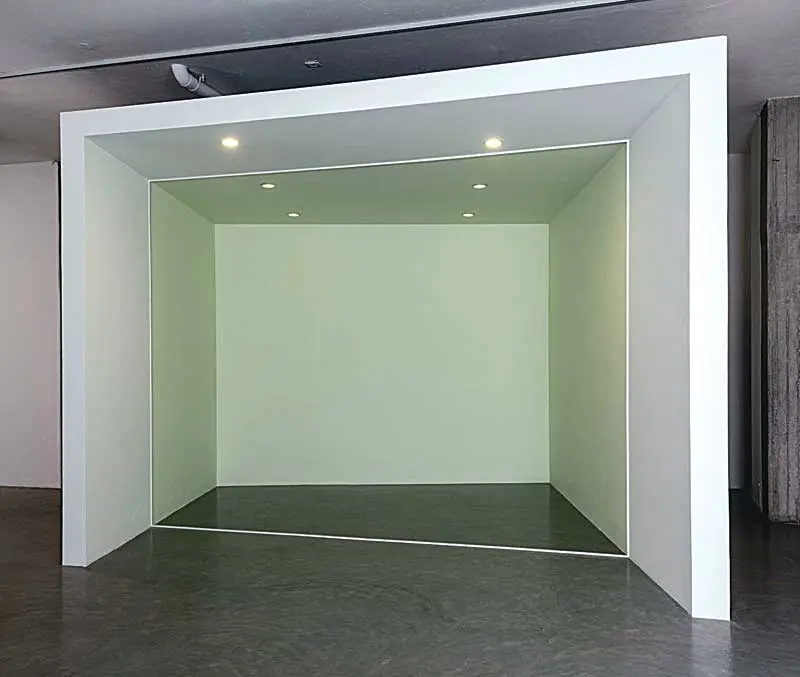
Sección Diagonal (Diagonal Section, 2008) is an installation that disengages viewers, leaving them out of it. The illusion—based on a trick that relies on color, the outlines of a specific area, and the perfect construction of what appears to be the glass frame—generated by Marcius Galan of a glass that is actually not there, highlights the level of deception that our senses can be subjected to. Dibujo de Planta y Alzado (Diagrama de Circulación) Floor Plan and Elevation Drawing [Flow Diagram], 2013), another imposing piece, is a maze that disorients viewers upon entering the room. As one walks through it other works are revealed that reinforce the idea of “time” as an abstraction that has been conceptualized to favor practical matters that help human existence.
The piece Sobre la Impresición I y II (About Imprecision I and II, 2013) negates the principle of time reading we apply to tell time. Galan brilliantly inserts the mechanism of an intervened clock into one of the walls of the fictional labyrinth and on one of the concrete walls of the room. A wire—that supports in its visible extreme a graphite stick and chalk—protrudes from each of the surfaces. In both cases, the wire leaves a circular mark created by the motion that propels the mechanism. The registry of each of the pieces is disconcerting because of the rhythm and direction of the dynamic; visually they are two creations that impact because the wire literally shakes as the chalk and graphite hesitate in each of their movements and never draw the same circle. The parts simulate an autonomous compass in full action.
The geometric narrative of this proposal embodies a metaphor for life itself. Each idea-matter powers a reflection on the ungraspable objects that we categorize as real and of course, on their practical qualities and the apprehension they cause us.
How do we experience the world and understand its behavior? Or, what is the origin of the established precepts that grant a dynamic to the context in which we exist? These could be two of the questions that arise as the viewer walks through Diagrama. The appropriation of “everything” that the project condenses requires a viewer with keen observation, one who is willing to stay in each piece and even make immediate flashbacks to the physical tethering abstract issues that are staged.
“The forms that reality adopts must change when their opportunity or function are exhausted, as they give way to different moments on the line drawn with the narrative that we know as history. However, the fact is that the ideological or formal replacements do not occur easily or consensually but emerge as the result of strong debates and contradictions since the trend is for practical mechanisms to be petrified until familiarity settles in them.” This is a fragment of the text in which Mary Iovino, curator of the exhibition, relates some of the ideas that are central to the proposal of Marcius Galan. It is a critical reading of time and space variables, an opening to the reinterpretation of the phenomena that change the course of life, not solely in a physical sense but also on a transcendental one; where the boundaries are flexible and perception is energized through sophisticated visual experiments.
The labyrinth Marcius Galan erected at NC-arte at some point evokes the principles Christopher Nolan applies in his film Inception (2009) to go beyond the concept of “real” space. The projections of dreams allow the film’s characters to inhabit spaces that are only possible while the unconscious is active. The visual and perceptive game that Nolan proposes leaves aside a naïve vision of reality and unleashes interesting discussions about the essence of what we think of as the material world. All proportions aside, the comparison is appropriate insofar as art is understood as a field of thought and creation where the value of the “target” moves and where certainties are deconstructed.
ERIKA MARTÍNEZ CUERVO