The work of Pablo Rasgado (Zapopan, 1984) takes scientific research as its starting point and proposes reflections centered on concepts such as time in connection with the erosion of durability of his materials. Rasgado’s work includes sculpture, video, and photography. This is a young artist in ascent and with an already considerable body of work. He proposes a consideration of architecture, exhibition spaces, and their transformations. This interest is presented in several of his series. For example, in Arquitectura desdoblada, Rasgado uses fragments of museum walls which he reassembles to build new pictorial planes. Those works comment on the relationship between the work of art and the space of its exhibition. At the same time, they reflect on permanence, the architectural reconstruction of space, and the generation of detritus in all such activities. Rasgado’s work processes posit the construction of a relic based on what is discarded. While the exhibition Ojo por diente is not part of that series, it does contain conceptual coincidences and concerns sustained throughout the artist’s investigation. Thus Rasgado reflects on ruins and vestiges, as well as the processes of erosion and deterioration of various materials. The show is arranged in three galleries where Rasgado molds materials already present in the site, which was in the midst of a renovation. Far from having been caused by the passage of time, mistreatment, or carelessness, these transformations are the result of a rebuilding process in the exhibition space. Thus we find walls with large holes in them, which, on the basis of gestures, reveal the changes in the site. Also, sand sculptures without agglutinating material, which render them into unstable forms that shift over time by erosion as the show takes place. These materials have all been taken from the space’s own walls; Rasgado provides them with a second life, yet they are made volatile again and disappear in the air. In this way, the show reflects on life and death cycles, erosion, and the transformations that we are all subject to by the passage of time. Nothing and no one is exempt from them; decay transforms everything. The figures produced by the artist are human limbs, pyramids, buildings, walls, and mounds. For Rasgado, even ancient civilizations and their monuments have been transformed, made into ruins whose immanence remains only as a distant desire.
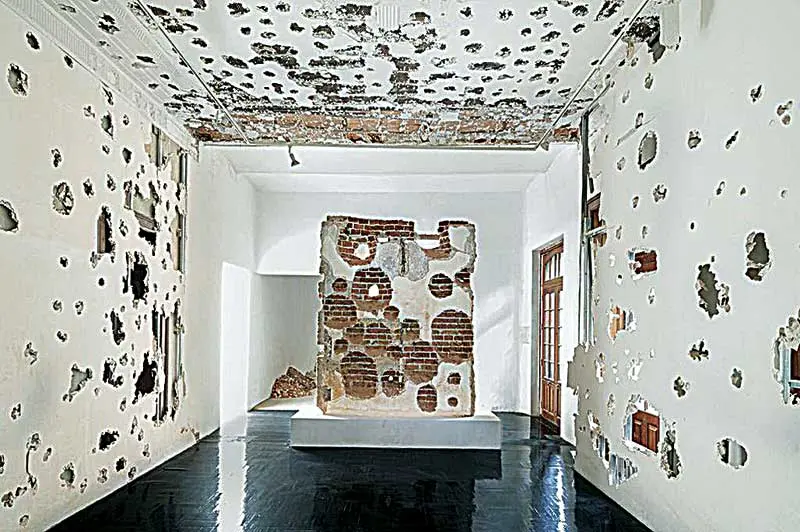
Conceived as an exhibition in shift, with objects that change as time goes by and impacts them, the Ojo por diente posits the challenge of careful observation and requires repeated visits for the full apprehension of the shifting object and a fluid relationship with the exhibit. This exhibition involves an interaction that demands critical, probing readings and an understanding of its character as a process on the part of its viewers, who are asked to transcend the formalist standpoint implied in the exhibition of any object.
The notion of ruin is not only a conceptual framework but also a living exercise to which the objects are subjected. In this show, Rasgado’s first collaboration with OMR, the notion of ruin is a conceptual axis that organizes the entire exhibit. Willy Kautz’s extensive curatorial text presents this theme as central but also brings forth more complex philosophical notions that are implicit in the work. The old Marxian dictum that “All that is solid melts in the air” is used as an axis for the curator to posit a reinterpretation of the concept.” “All that is solid here comes from the air, and, as such, melts without leaving a trace on nature; at the same time, the natural appearance of the sculptures becomes a temporal archive of forms in continued re-symbolization.”
JOSEFA ORTEGA