
Patrick Hamilton (1974) is among the Chilean artists with the greatest international presence. Connected with relevant curators and artists beyond his nation’s borders, he has situated himself in fairs and biennials that are key in the contemporary scene, such as the Armory Show (NY), Art Basel Miami, the São Paulo Biennial, or, more recently, the Venice Biennale (Zone of Urgency). It had been nine years since his last solo show in Chile, and Progreso, an exhibition held last October and November at the Museo de Arte Contemporáneo in Santiago signaled his return.
There we encounter the operations that have gained him broad recognition, in which he has been working for fifteen years: his work with everyday-use objects—generally, construction tools with an aggressive connotation, such as saws, machetes, knives, or elements connected to the architecture and urban planning, such as protective fences—that he subjects to cosmetic and camouflage strategies to achieve a visual product of great pulchritude, an aesthetic with post-minimalist undertones featuring repetition and seriality, where objects are no longer visible in their original function, with their full charge given their contexts, but as “mere” decorative items that continue, nevertheless, to be aggressive. Hamilton subverts their use with ironic reflections, based on what lies beneath those simulations and torsions.
In Patria y libertad, for example, the sharp edges of protective fences are enameled metal rods organized graphically on the wall to form the symbol of the Patria y Libertad Nationalist Front, an extreme-right paramilitary group formed in the early 1970s to fight the socialist policies of the Salvador Allende government. In Chuzo, Hamilton bends these hard objects into shapes resembling snakes that crawl up the wall. In Construcción con machetes, 120 of the same tools—with the inscription “made in Colombia” on their edges—have been carefully bending and arranged on the floor so that they look like shining worms moving towards the middle of a concentric circle. Beauty and aggression combine in these works, in a game that unveils what has previously been hidden: the violence of an organic system and a beauty that is primed for deception.
The same process is found in other images. In the series Equilibrio, Hamilton uses advertising aesthetics to hang on the wall, like chained ornaments, tools, and covering materials attached to which are postcards with references to the local context. In the photographs-within-photographs we see a Mapuche lonco (tribal chief), the US embassy in Chile, a ruca (Mapuche lodging), or a view of Chuquicamata, the largest-ever copper strip-mining site in the world, now closed. Placed as if in passing in that chain of construction instruments, they are documents or signs that represent the tensions of the country’s recent history.
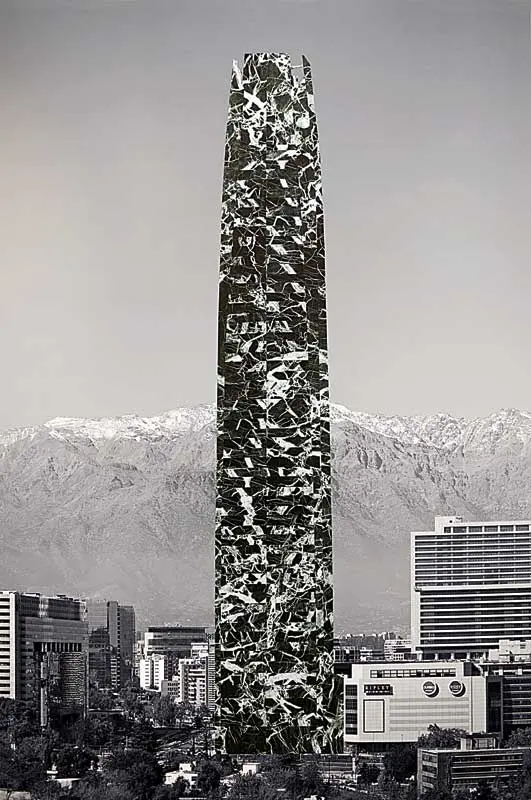
Another photographic work features Santiago’s tallest building, the Costanera Center, hotly debated for its invasive and ostentatious architecture. But it is not a simple photograph: the image appears cut and covered by a faux-marble material used in architectural surfaces. The icon of Chile’s economic splendor, thus sheathed, repeats Hamilton’s camouflage strategy, with decoration once again working to disguise and reveal, in this case, the aggressiveness of the system installed by a military dictatorship in the 1970s and 80s. Hamilton questions the “neoliberal revolution” that democratic governments of the 1990s continued to carry forward, a process currently in crisis in a country marked by deep social inequality.
In this narrative, Esqueleto could be the mark of a more recent process, situating us in the context of the social mobilizations that arose in the past few years: it presents the enameled-metal structure of a public-transport vehicle bench, as the remnant of a burning or street protest.
As I verify the strategies and themes that have marked Hamilton’s career from a post-dictatorship context—in the 1990s—to this day, I wonder how much is there of opportunism in this record, as I believe that those international art spaces frequented by the artists are rather welcoming to this kind of statement. In the context of globalization, what is the expectation for Latin American art? What it has of difference, perhaps? Social and political realities, the way in which consumerism has impacted our societies? Hamilton’s way of dealing with these subjects is even more suspicious, with his sheathing and camouflage operations that tend to transform certain symbolic objects into consumer items, a sense of irony that turns his work—correct and predictable—against itself, and makes it, in the end, resemble that which it critiques: a consumer object. In large art fairs and biennials, of course.
CAROLINA LARA B.