
The first chapter of Giulio Carlo Argan’s Modern Art, originally published in 1970, refers in its very title
to an issue that comes up often not only in art history but in Western art’s
image production in general: “Classical and Romantic.” With two sub-chapters
about artistic production in the Nineteenth Century, one on neo-classicism and
one on romanticism, this way of looking at the supposed starting point of
modern art echo other art-history writings that bring to the fore, in
different ways, a kind of pendulum-like swaying between classical and an anticlassical
language. Already in 1929, in his “Key Concepts in Art History,” Heinrich
Wölfflin proposed a critical look—and a positive balance—at the production of
the “European baroque,” formally opposed to the art of the Renaissance, in his
words. Before these two authors, of course, the indirect discussion of
linearity in contrast to curvature, or to the Italianate as a response and an
alternative to the Nordic (to mention just a couple of examples), appeared in
many writers in archaeology that could perhaps be traced back all the way to
one of the fathers of art history, Giorgio Vasari.
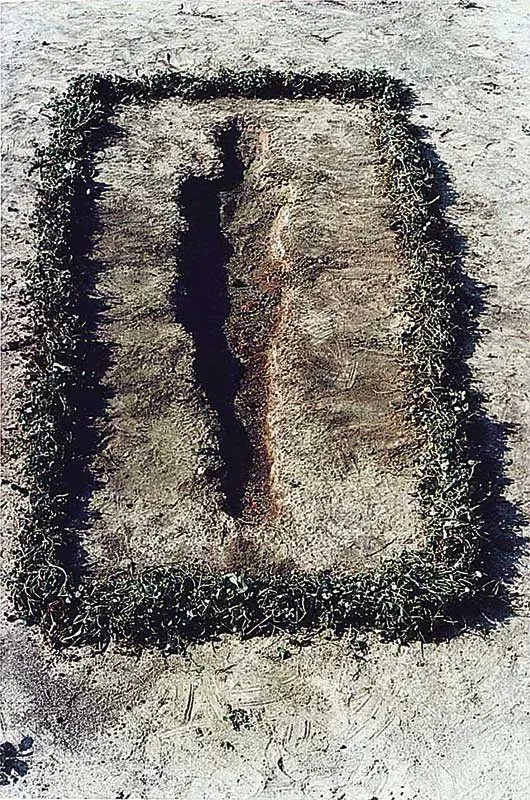
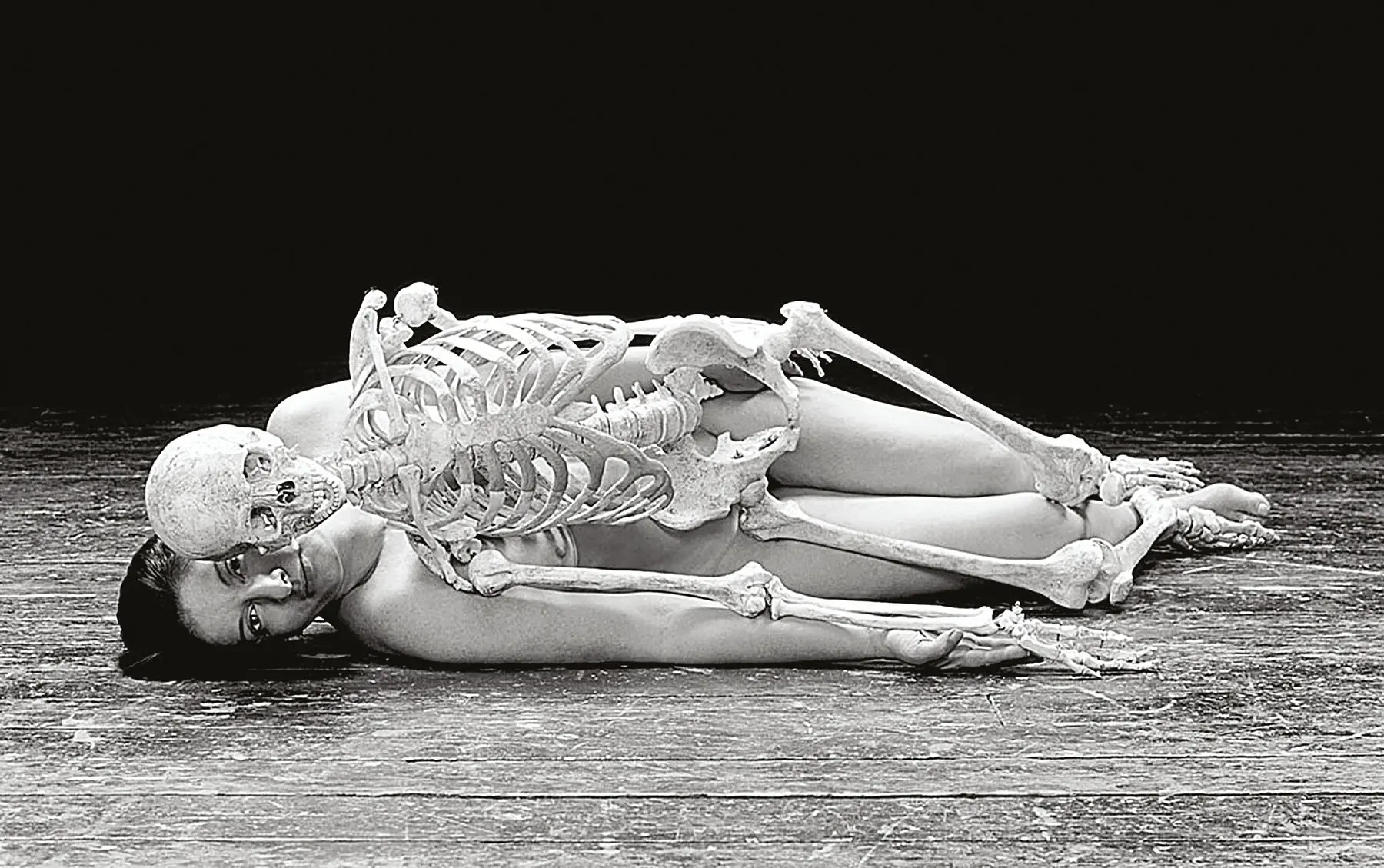
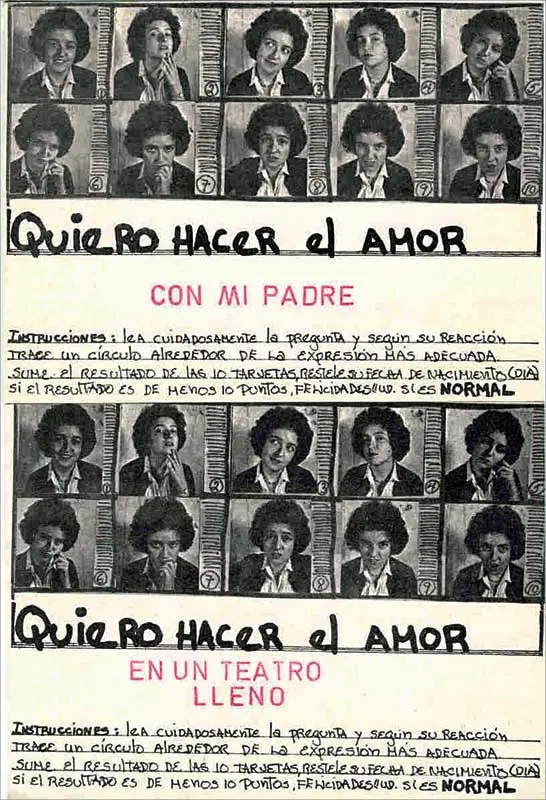
These historiographical notes are prompted by my visit to the exhibition Pulso alterado, at the Museo Universitario de Arte Contemporáneo (MUAC), in Mexico City, which surprised me upon entering with the anticlassical drive of the images selected and, why not say it, the force of the curatorship’s pathos. As the texts by curators Miguel A. López and Sol Henaro put it, the exhibition’s initial proposal was to take a specific look at the museum’s collection, which, it is important to note, is highly impressive for a university-based institution. As a Brazilian observer, and from what I know in my country, it seems to me that an equally young museum whose collection potentially resembles MUAC’s is the Museu de Arte Contemporanea at USP (MAC-USP). As in the Brazilian case, the collection comprises not only Mexican artists; for example, arranged in the exhibition space one could find works by Mónica Mayer, Ana Mendieta, and Marina Abramovic.
To quote the curators, “this selection of works is intended to show how human experiences of overcoming the normal (in an emotional, sensorial, visual, and performative sense) take place, and how they can be represented. In the same way, we approach the idea of delirium, albeit not in its traditional clinical meaning.” It is, this, a selection of works rather than interrogating the shape of the anticlassical body from a historical perspective, reflecting on the contemporary place of the detour, the excess, a certain escape from the common sense normality and of that which is socially rejected or accepted. The images on display here were produced by, following different lines of poetic investigation, artists with an “altered pulse;” this is to say, tachycardia is the driving force behind these proposals.
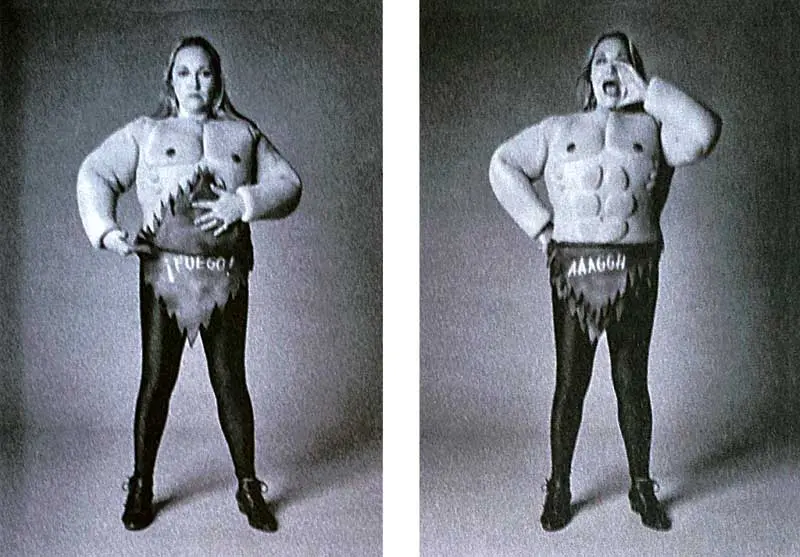
But, what are, in images, these alterations of pulse? With Armando Cristeto, for example, the audience could see semi-nude male, socially authorized bodies set side by side and butterflies. Apolos urbanos (1980-89), the series of works that start there makes a sharper gaze possible, and even the body of a small person, rather not Apollonian in Vasari’s classical sense, rises to that status. Yo Tarzán, tú América, a 1992 work by Maris Bustamante defined by self-representations, also occupies the zone of representations of an idealized male body. The artist situates herself Tarzan's primitivist and patriarchal position and, as well as reflecting on the little remarked-upon role of women as an active force in narratives of exploration of savage territories, reinforces a debate about the unilateral, imperialistic construction of the concept of the Americas. What does the name refer to? Might it be that, from a US perspective, “Latin American cannibals” will one day be capable of articulating words beyond Tarzan’s puerile speech?
Nevertheless, Pulso alterado is not a curatorial project that appropriates only discourses about the body, exclusion, or gender; many more of the selected works dialog here with a recurrent reading of Latin American art through political lenses. Immediately at the entrances was Concepto especial (2004), a work by Luis Miguel Suro. A diptych comprised of an asbestos sculpture in the shape of a cupola resembling San Pedro Cathedral’s projected by Michelangelo, and a video. Several gunshots traverse the same structure placed on a house garden. Another classical element became, meanwhile, an anti-monument; that historical datum that refers to the Golden Age of Western art, thus quoted, becomes a cupola protecting and enhancing nothing. Its shape still flows towards the heavens, but, to which Christian God are we to clamor when those same bullets traverse the non-sacred homes of civilians in wars with a quickly internationalized media projection? While Lucio Fontana cut his canvases of the same title, Spatial concept (1959), as a way of reflecting on the planimetry of painting, Luis Miguel Suro makes it possible for us to reflect, by means of the juxtaposition of languages provided by contemporary art, on the fact that the planimetry of life is closer to our own homes than to the hospital-like walls of a white cube.
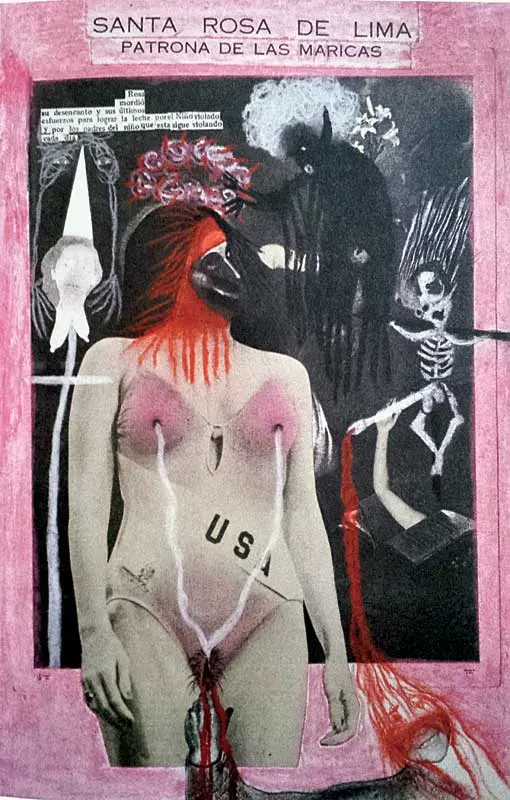
Besides photography, video, and various installation-based works in the MUAC’s large galleries, visitors will also find more traditional languages such as drawing, painting, and sculpture, in formal investigations that generally border on the grotesque, the strange, the ugly, in sum, all that is alien to the pasteurized visuality of today’s advertising. Sergio Zevallos uses the figure of Santa Rosa de Lima, the first Latin American saint recognized by the Vatican. In Estampas, Lima (1982), the image composed using photocopied images receives, like a medieval icon, layers of intervention in charcoal, color pencils, and pigments. On top of this, one of the sentences that underscore the viewer’s estrangement: “patron saint of faggots.” And on that basis, the association of “faggots” with sainthood, we are made to remember that those forceful images next to what is now barely a shadow of the saint also belong to Christian iconography: there we find demons, skulls, blood, and other elements. The blood flowing from the saint’s genitals is the same female blood that for centuries flowed from the hands of Mary Magdalene, who, embracing the Christ, lamented his death. More than inventing a way of critiquing Christianity, the artist uses what is already established to bring us into a renewed encounter with the history of art.
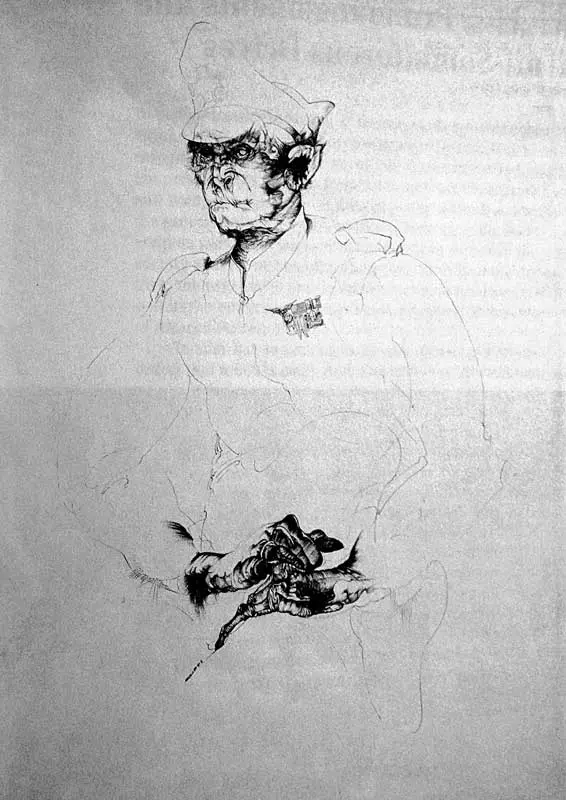
That very revision of a tradition of images brings this work closest to Melecio Galván’s drawings. In his series Militarismo y repression (1980), Galván’s realistic drawings encourage a second look. More calmly, the viewer perceives that the figure sketched there is not a tank, but a slave bending down in front of the viewer’s eyes. Between fable and imitation, between portraiture and surrealism, Galván puts on display the inscrutability of the human bodies put in the service of militarism. This body is concerned not only with repressing the bodies of others but also with suffocating its own motion, confined to a sheet of paper. The meals are set out against a white field that is at the same time figure and background of a man whose posture harks back to a tradition of portrayals of state power rooted in the Renaissance. The name is no longer of interest, only the hands, responsible for raising a weapon, and the defeated, tired face deformed by the frenzy of territorial domination.
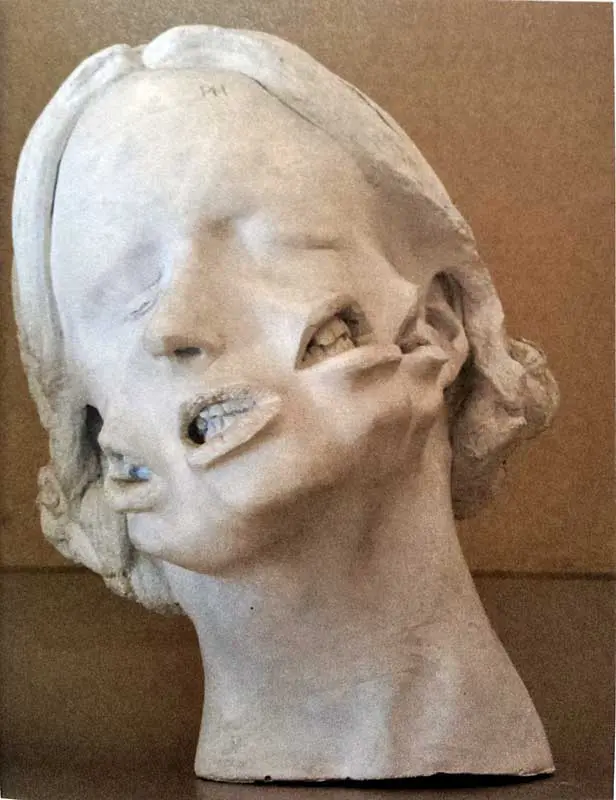
In the same way that Rachel Lachowicz presents the many mouths of
his female figures, sculpted in remedial materials, many trajectories and
discourses can be elaborated on the basis of this curatorship. Such
multiplicity seems to be one of the high marks in an exhibition that, rather
than forcing a series of items into a given category, enhances their potential
as open works and inspires in the viewer the same tachycardia that defines the
selection. At a time in the art system when moldings, objects, and artworks pay
almost cosmetic tributes to love and life (some times with faux-naïve touches),
it is at least interesting to see a project that peeks into the darker, more
uncontrolled, and more instinctual side of the human. Kudos to the lack of a
compass, to the tragic fables, and to the force of that which once was (and
still is) called anticlassical, brought to life here.
RAPHAEL FONSECA