On December 5th of last year, the program of the 35th International Festival of New Latin American Cinema announced the projection of Diago: A Maroon Artist at a darkroom in Havana. The synopsis of the 27-minute long audiovisual, directed by Juanamaría Laces-Cook, featured Juan Roberto Diago (Havana, 1971) as “a multimedia artist who has understood the creative possibilities of recycling and DIY, and who creates his images through the juxtaposition of graffiti with racially motivated non-conformist intentions.”
Raw canvases, dark woods with added textures, and metal plates with scattered color accents gathered on the same day at the Centro de Arte Contemporáneo Wifredo Lam to assemble an exhibition by Diago that was not included in the official program of the film event. Curator Marilyn Sampera wrote on the exhibition postcard the following: “From a perspective much closer to abstraction, Diago ignores textual, figurative and anecdotic elements in these works.”
Without any previous agreement, two works by Diago were shown, two supposedly opposing realities supported by a parallel montage developed by David Griffith for the seventh art. However, the audiovisual proposal evolved into a sort of flashback. A retrospective, documentary, look at a creator then more identified with a contextual aesthetic and the interaction with the public.
It tacitly involved the Diago that, among other actions, had sought that the precarious and marginal habitat represented by mockups of slums would invade the immediate access to the exhibition halls of the Centro Wifredo Lam, with his modus operandi of the squatter. The Diago, during the inauguration of the exhibition titled Dying Must Be Avoided Here (2003), gave away warm tamales from wheelbarrows originally meant for the transportation of building materials.
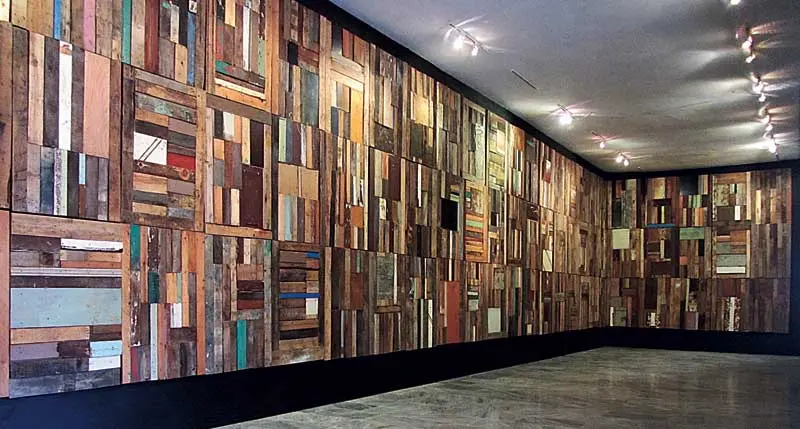
A decade later and in the same place, Diago became more intimist, introspective, he delved into black painted interior spaces... very much in tune with the title of the show: The Power of Your Soul. Without betraying the orientation of his poetic—committed to Afro-Cubans ethnocultural processes, and the socio-artistic anthropological perspective—he decided to base his discourse on communicative potential of the material employed, that which cannot be found in art stores. He recycled it again but not so much as a sign of arte povera and economic poverty, nor solely as a pragmatic solution to Third World technological shortcomings.
This time, his works boasted an aesthetic delight, a retinal effect that complemented the conceptual subtlety of the works. A promoter of art workshops for children, Diago could have very well assumed the moral teachings of that children’s song by Cuban songwriter Teresita Fernández that goes: “If you put a bit of love into ugly things you’ll see that your sadness will begin to change color.”
Anyone who saw the white canvas fragments on canvas of the same color was able to evoke Malevich’s pictorial Suprematism. Anyone who saw his wood assemblages was reminded of architectural brutalism or sculptural minimalism. Anyone who saw the welded metal surfaces with traces of color could easily make a connection with visual abstraction...
All the elements aforementioned and more were contributions of Diago’s proposal: a suprematist sensitivity search, a brutalist display of components, minimalist volumes structured with basic geometric shapes and primary materials, abstract thinking to compose and synthesize thoughts... Like in a melting pot, the art-historical references are mixed together with allusions (single or gregarious) to a transplanted culture that found in syncretism a record for survival.
Diago emphasized the construction of monumental works subjected to the idea of the continuum. He assembled each in segments (textiles, metal, or wood) that alluded, not so much to the mosaic Julia Kristeva prescribed for the postmodern artwork, but rather to the fragmentation and recomposition of African rooted ethnic-religious discourse manipulated by the artistic subject.
With the eventual support of a working title or a quote from an author, the materials are chosen by Diago become vehicles for symbolically-charged meaning. Metal becomes an attribute from Ogún, the warrior Orisha of Santeria. Burr welds and braided textile keloids turn into reminiscences of rituals from African culture and traces of scars on black skin. The whitish colors are seen as evocations of Obatalá, an Afro-Cuban deity, owner of heads, wisdom, and peace...
Viewers could obviate these connotations and appreciate only compositional variations of abstract and geometric appearance, textures, and reliefs distributed without horror vacui in an exhibition where the artist wanted to enhance his training as a sculptor. He confessed that intention to me after I told him that his quest for purity, insight, and his discourse on black based on materials, reminded me of a sculpture—well-known by Diago—that Teodoro Ramos-Blanco carved in 1934: ahead with Negroid features and eyes closed, carved in white marble and (symptomatically) named Vida Interior (Internal Life).
ISRAEL CASTELLANOS LEÓN