
There is a literary intent behind Tania Candiani’s latest
exhibition. The promise is clear from the title she has given her show: La Magdalena y otros trabajos de campo,
which would not be out of place on a book’s spine. Such a book, the promised
object, doesn’t exist, strictly speaking, but in its possibility Candiani
catalogs a story of pillage, in the terms in which since the Sixteenth Century
the words have meant to move one place to another, stone by stone, in order to
assert it in its destitution: the owners of the present are the owners of the
past. In that spirit of appropriation, or better yet, in its paradox, Candiani
embodies the spirit of the modern; she imitates it, to the inevitable degree in
which it is a culturally learned inertia, yet she also invents it (or, rather,
re-invents it) in the evidence of her own passage through a remote place. What
Candiani brings back from her journey, her physical and spiritual baggage comes dangerously close to tourism, but nevertheless, like a new Vasco Da Gama,
she seduces us in the ruse of discovery with a phantasmagoria that updates a
Nineteenth-Century imaginary.
In the original project, Expedición botánica, Candiani’s intention was to investigate the figure and the imagination of the scientific explorer, while residing in the town of Honda, Colombia, invited to the artist-in-residence program helmed by Colombian curator José Roca, founder of the independent space Flora ars+natura. Candiani was to focus on the scientific traveler’s notes, commentaries, herbariums, drawings, and other “fieldwork”. She was interested in connecting this with the earliest botanical investigations in the Americas: the new names and classifications that took the place of the old ones. Between her fieldwork, her social work, and her art, and confronted with the social conditions of the population in Honda, Candiani wondered above all about the knowledge that was lost. Honda was an important river port in Colombia; today, its inhabitants live off fishing, trade, and tourism.
The question Candiani posed for herself was, “How was that, coming from the Old World, the scientific explorer named a New World and displaced local knowledge?” The spirit of the scientist and the spirit of the conqueror are one and the same. Their goal is the same: plunder. Their a posterior justification is the rescue of a different culture. Candiani does not deceive herself in that regard, she knows that the plunder is emotional. It is an exotic experience at the edges of a continent that has not ceased being exotic. She knows that this site is at the margins of a Latin American that has been globalized and could leave her behind. She also knows that such remoteness is an illusion. It is the savage in the mirror. Candiani jumps from the scientific catalog to the magic ritual. Hence, perhaps, the landscape with a yellow bridge painted on a rock, gives weight to a fleeting image. Hence, perhaps, the herbolaria in kaleidoscopes, transformed by the projector’s light into a delirious game of shapes.
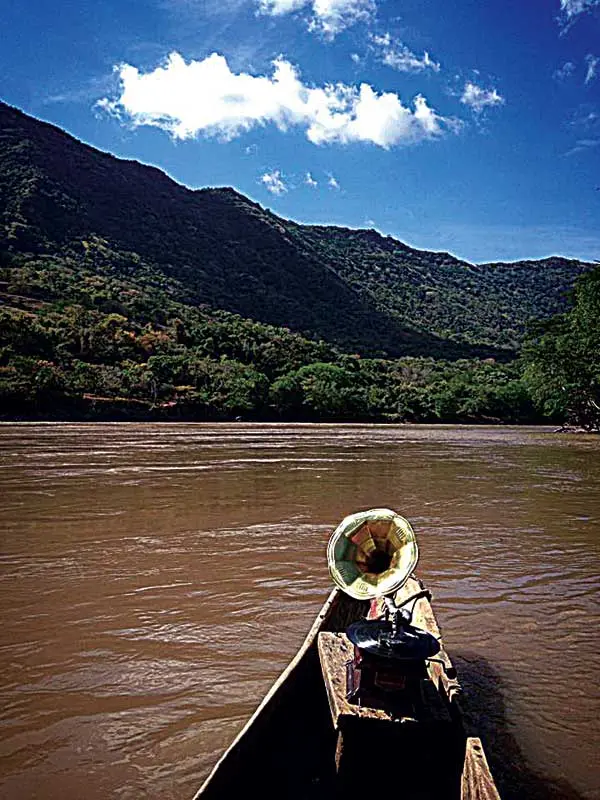
The cornerstone of this exhibition is La Magdalena, a canoe carrying a gramophone on the Magdalena river. Candiani later broke it in two for another work, with the gramophone and the river on a video monitor. These are clear allusions to Fitzcarraldo, a film by Werner Herzog about a man who set out to build a theater in the Amazon rainforest. This is how she declares it, at least, for those who do not have the reference of that civilizing spirit. Candiani creates a poetic object by superimposing such objects of opposite use; a formula she inherited from the avant-garde, which in itself is an extreme version of a formula inherited from the Romantics. The canoe with the gramophone and the river landscape are leitmotifs in the exhibition: the delirium of civilization confronted with the exuberance of nature. The weight of the old is that it was new at some point. At some point, a gramophone replaced an entire orchestra. The video monitor replaces river journeys. The vehicles of the simulacra of the modern become fetishes. According to Candiani, Fitzcarraldo’s passion is like the passion of the fishermen: “It is a gesture, a tribute to the dream of a man that does the impossible to bring it into reality. It has to do with the situation of the people in that city, their daily struggle for survival, but with all the respect they have for their passion.” For Roca (who also curated the exhibition), “the boat, the device, the music, and even the river itself, in their manifest anachronism, are all symbols of a truncated process.”
In other works, based on grids, Candiani frames the river, which flows within the frame like a continuum that is as present as it is ungraspable. The video images (which could very well function in a documentary or in advertising) are captured and made into paintings, subject for a moment to whoever carries the frame. The frames and the grids—at once objects, metaphors, and criteria—are transformed into a network of meanings and correspondences. The works that comprise Candiani’s exhibition build a narrative of discovery, and updating of remoteness, an expedition but also an invasion, a booty to put on display.
RICARDO POHLENZ