
Waltercio
Caldas was about thirteen years old when in 1959 Ferreira Gullar published the
“Neo-concrete manifesto” in the Jornal do
Brasil. Needless to say, Caldas was not among the artists who participated
in that first neo-concrete exhibition for which the manifesto was written.
Nevertheless, when Caldas began studying art under Ivan Serpa in 1964, the
polemic between concrete and neo-concrete Brazilian artists had painted the
background into which other influences began to appear. By the time the young Caldas
created Condutores de percepção (Conductors of perception, 1969), a
great many things had occurred in Brazilian art: Lygia Clark had produced her Bichos, Hélio Oiticia had assembled his Parangolés, and Lygia Pape had staged
her Divisor. The atmosphere of
openness into which Caldas walked in was spelled out by Pape when she stated,
“There was total freedom; nothing was dogmatic. Everybody was willing to
invent, and not to work within conventional categories.” Caldas has made use of
that freedom throughout his artistic career.

The Nearest Air: A Survey of Works by Waltercio Caldas at the Blanton Museum of Art in Austin amounts to a small retrospective of the artist’s oeuvre. It is the first solo show in the United States of an artist whose oeuvre has been described as “unclassifiable.”* Curated by Gabriel Pérez-Barreiro, the exhibit is comprised of 75 works, many on loan from private collections, some hitherto unseen publicly. In a year in which some countries are voicing disapproval of the idea of loaning their national treasures for exhibits abroad, the Blanton Museum of Art and the Fundação Iberê Camargo have successfully collaborated to organize this exhibition whose first two venues were in Brazil; at the Fundação Iberê Camargo in Porto Alegre, and at the Pinacoteca do Estado de São Paulo. For the current showing, The University of Texas Press has published an impeccable book catalog titled Waltercio Caldas, featuring essays by critics Richard Shiff, Robert Storr, and the exhibition curator, Gabriel Pérez-Barreiro.
Two works in the exhibit we already mentioned deserve comments because they evidence the aesthetic diversity in the show. Condutores de percepção (1969) is a velvet-covered black case containing two glass rods capped with silver tips. It has the ingredients of a Duchampian readymade: a found object altered for the purpose of art. Guy Brett, a critic quoted in the chronology of the catalog describes the work thus: “The two conductors lie in their velvet box like the instruments of some fastidious science. They invite touch, they imply investigation, measurement, meaning, and yet they are transparent and void...” Robert Storr, one of the essayists of the book, offers an interpretation that does not differ greatly from Brett’s: “Thus we are left with pseudoscientific or perhaps magical devices that seem to promise exceptional receptivity yet withhold access to it.”
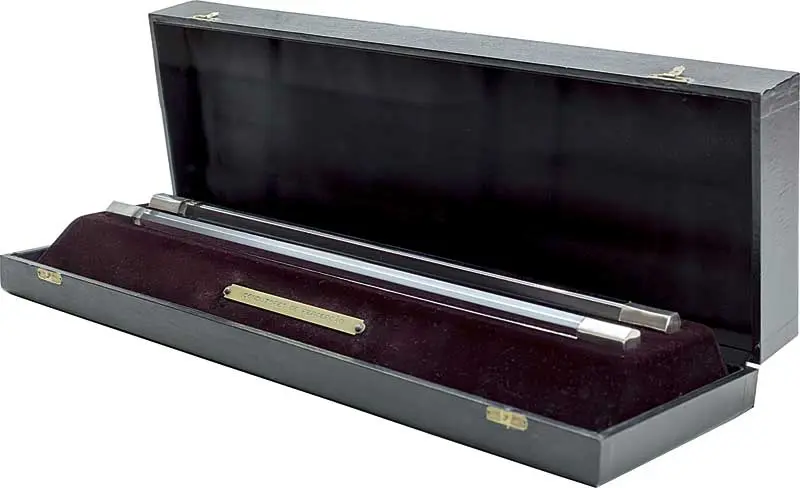
Obviously, both writers have taken condutores to be light or electrical conductors, and have not heeded the obvious: that these rods are the batons of hypothetical orchestra conductors. Music and perception, after all, are important leitmotifs in Caldas’ oeuvre. In fact, in the last dozen years or so, Caldas has created works whose sonority is part of their aesthetic offering. Indeed, the two glass wands are not only batons for an imaginary conductor, but themselves potentially contain a sound if one were only to risk hitting them as if they were musical claves.
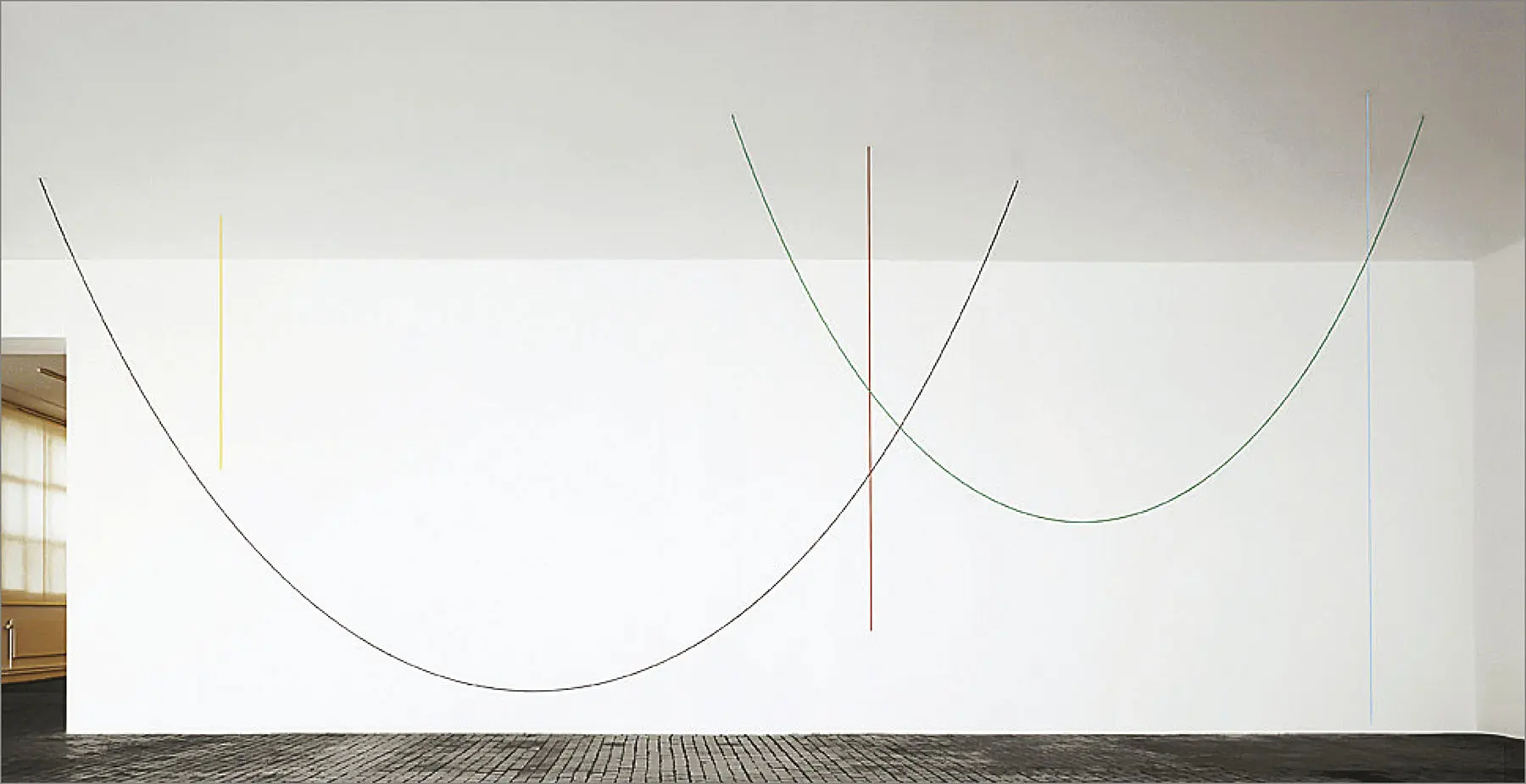
The second Caldas work we have already mentioned, albeit unwittingly, is the one that gives its name to the exhibit: The Nearest Air (1991). Pérez-Barreiro writes, “Consisting of little more than colored yarn, these works are among Caldas’s largest and most impressive. In them, Caldas uses yarn to carve up space, dividing the air into fractional elements that the audience (sic) must negotiate.” Space is indeed a major concern of Caldas. In a recent interview, he expressed, “I think negative space is the biggest space. What we don’t see is great material. A big material.” So for Caldas, the nearest air is not a metaphor, it is the material where his works begin. “I deal with the environment as if it were a sculpture,” he once said. The minimalism of The Nearest Air becomes a maximally occupying presence whose accidental borders are the colored yarn.
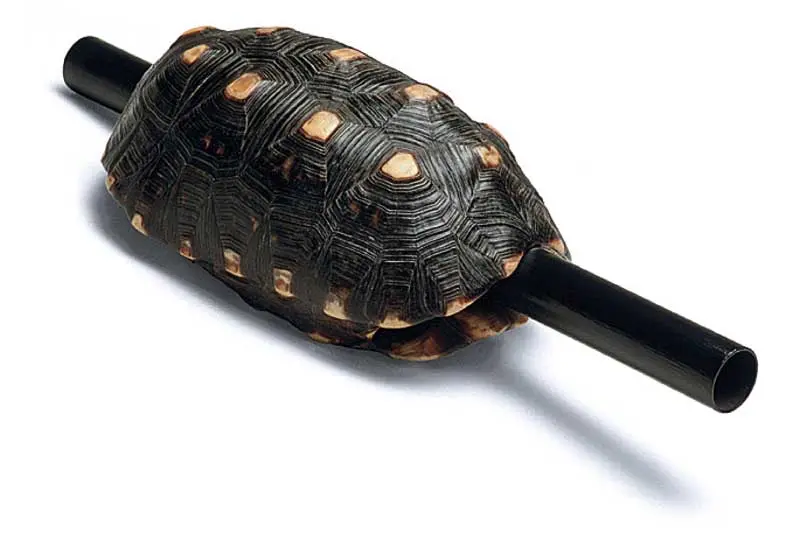
Caldas’ lecture at the Blanton showed him to be close to what his works are: inquisitive, philosophical, humorous, and ironic. Indeed, the image in the invitation to the lecture was Invitation to reasoning (1978), a readymade in which a turtle’s empty carapace is penetrated by an iron rod—perhaps alluding to Goya’s famous phrase (“The dream of reason creates monsters”).
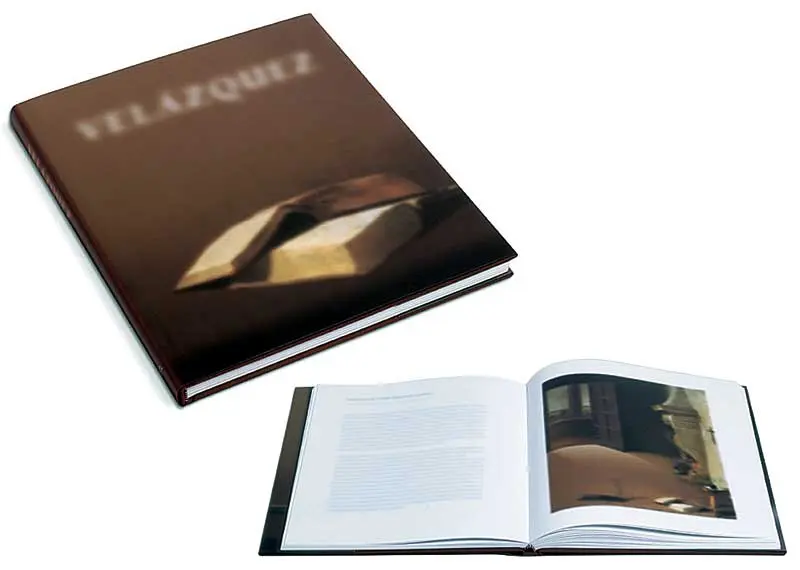
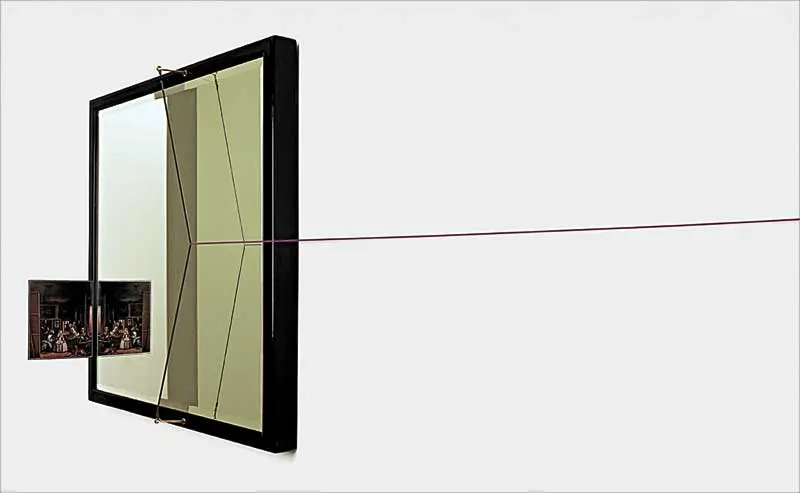
Although some of his works like Jazz Mirror (2002) and Painted Iron Rod (1978) might fit seamlessly in an exhibit of concrete art, in many of Caldas’s works figurative representation is indispensable. In fact, Caldas has made Velásquez, painter of painters, the common denominator of his many-sided meditations about the printed artwork, perception, and art-viewing. The Velázquez Book (1996) is an actual book done in offset lithography where the printed paintings are out of focus; which curiously enough, was a strategy pictorialist photographers employed to make their pictures more “painterly.” Mirror for Velásquez (2000) places a small reproduction of Las Meninas in front of a mirror in order to underline and take out of the picture plane the mirror complicit in that famous painting. In Los Velásquez (1994), Caldas removes all the characters in Las Meninas in order to focus solely on the space of the chamber.
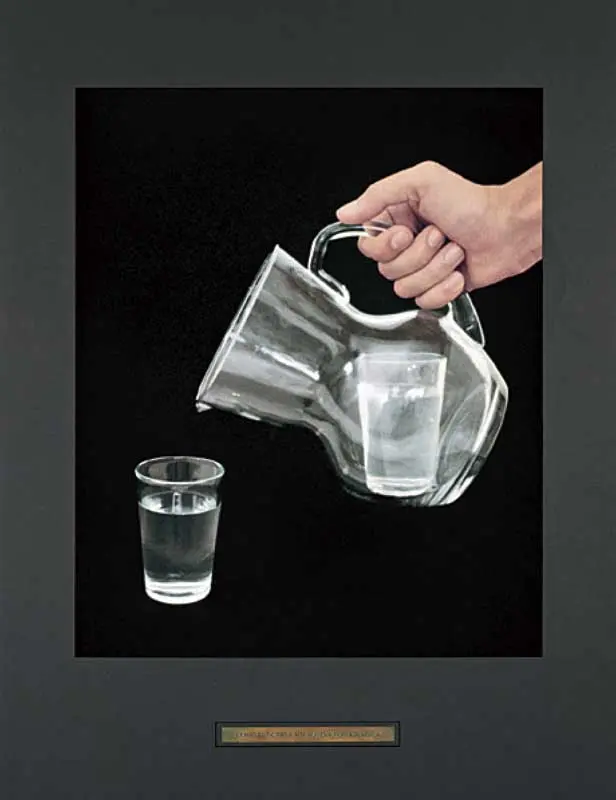
Caldas’s How does a photographic camera work? (1977) echoes René Magritte’s The Treachery of Images (1928) whose famous phrase “Ceci n’est pas une pipe” (this is not a pipe) has been one of the most quoted phrases in art since the 1968 Michel Foucault book. In Caldas’ photographic image glass of water inside a pitcher has poured its contents into the glass of water outside, thus reversing the outside-inside sequence of the photographic process. The pitcher is not a photographic camera. However, if the pitcher is a model for an idealist’s conception of the mind, it is indeed that chamber that pours out the world. Caldas often reflects on idealism. Plato (1996), two circles and one circumference of polished steel and chrome draw an analogy to the third man problem of the platonic ontology. Namely, if a circle (or man) is a circle insofar as it partakes of the ideal form of a circle; so the ideal circle is such insofar as it partakes of a third, more ideal, form of a circle; and so on, ad infinitum.
No matter how prone to idealism he might be philosophical, Caldas eloquently speaks about the materiality of his works. His artistic practice seldom fits in traditional categories, isms, or media; and his work does not project itself towards just one, but many visions of art.
* From November 9, 2013, to January 4, 2014, an exhibition of new drawings and sculptures by the artist was presented at Christopher Grimes Gallery.
FERNANDO CASTRO
Critic and artist.