
Emotional Objects is Cuban artist Yoan Capote’s first exhibition in London. The show includes a selection of Capote’s work since 2006, emphasizing his most recent production and two installations commissioned for the occasion.
Capote is part of a generation of Cuban artists who critique the island’s political regime and means of an artistic practice based on direct experiences, having grown up and received their education under the Castro government. Capote’s work engages issues such as political repression and freedom of speech, which, although constant in Cuban art, have recently transcended the boundaries of the island to become global concerns. The title of the works featured in this exhibition describes specific aspects of Cuba’s political history: Isla, Doctrina, Migrantes, Paranoia, Secreto, Abstinencia, Romance, and Voluntad de Poder.
The particular seal of Capote’s work and that of his contemporaries, artists such as Arles del Río, Adonis Flores, and Alexandre Arrechea—all highlighted at the most recent Havana Biennial in 2012—is the use of paradoxes and meaning games, with cross-breedings and juxtapositions of different languages, primarily writing, painting, and sculpture. A clear example of this kind of practice is the series titled Abstinencia, in which sequences of hands (as photographs or sculptures) make different sign-language words that can only be deciphered using a special code: they spell the words Democracia and Política.
This exhibition offers an opportunity for an international audience to encounter a kind of art I believe is representative of and essential to the contemporary Latin American scene. Capote’s work is able to establish connections at several levels with different publics, particularly thanks to a unique sense of black humor and the presence of the absurd in his vision. The entrance to the gallery allows for a general overview of the exhibit, with works like Migrantes (2013) and Voluntad de poder (2013) dominating the scene. Both are clear examples of the influence of Surrealism on Capote, to my mind echoes of Magritte’s Red Model (1937) and Man Ray’s The Gift (1921). Although almost a century separates them from Capote’s most recent work, the resonance is unmistakable.
The Isla series is comprised of three works, titled La Espera (2012), La Otra Orilla (2013) and Mi Orilla (2013). They are images of the sea and remind me of the view from the Havana promenade. Seen from a distance they look like generic images, a faraway horizon and a becalmed ocean, but as one comes closer their message and their meaning shift completely. The ocean waves are formed by hundreds of fishing tackles, all sharp and pointing towards the viewer. As in Man Ray’s Gift, the meaning of the image is negated by its materiality: this is not an ocean at rest, but an enclosed field.
Migrantes is perhaps the main work in the gallery. Two trees, laying down side to side, their branches desiccated and leafless. The trunks are more than four meters long, which gives the work a powerful presence. As in Isla, coming closer to the work activates a new meaning. The roots of these trees are transformed into what seems like two legs, clad in pants and a pair of tennis shoes. This shift changes the message and prods new readings. Pondering the title, Migrantes, the idea of an uprooted tree, transplanted and in constant transit, is a painful echo of an ever-present condition in a situation of political conflict around the world.
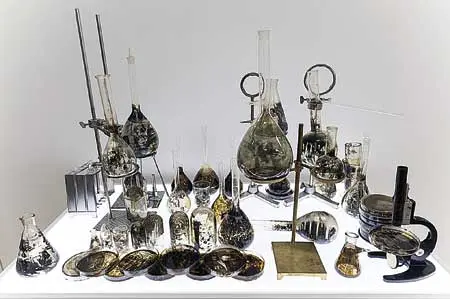
My particular attraction for photographic images and their inevitable association with notions of memory and identity prompt me to mention one last work, Laboratorio (2011-2013). A light table functions as a kind of stage, on which rests an installation of various lab devices—jars, flasks, and pipettes—that seem to have undergone several tests and then been abandoned. Looking at the installation in detail, we discover the nature of the experiment. Archival images, mostly of popular rallies and celebrations of the revolution, are printed on the delicate glass surfaces. This carefully constructed work, which brings photography to a sculptural terrain, speaks of Cuba as a laboratory and of its Revolution as an experiment, rather unfortunate it seems.
To complement our reading of the works, the gallery published a catalog with an essay by Nelson Herrera, titled Psychological, Physical, and Sensorial, along with a conversation with Capote. It is worth highlighting from the latter a sentence about the motivation behind his work: “An unconscious struggle for balance between reason and emotion takes place inside all human beings. As an artist I simply try to convert this into something conscious and premeditated, that’s the basis of my work.”
RODRIGO ORRANTÍA