
Light and motion were among the most recursive elements in the
varied visual games developed by artistic movements in the second half of the
Twentieth Century, as was evident in ZERO,
an exhibition at the Museu Oscar Niemeyer (MON) in Curitiba, Brazil. The show,
curated by Heike van der Valentyn, presents the visual experiments carried out
by the Zero group, established in Germany in the 1950s, with Otto Piene, Heinz
Mack, and Günter Uecker as its most prominent participants.
Besides the work of this group, the exhibition also explores connections between European artists like Yves Klein and Hans Haacke, and their South American colleagues like Lucio Fontana, Almir Mavignier, and Jesús Rafael Soto. The historical dialog is further expanded with the presence of Brazilian artists Hércules Barsotti, Lygia Clark, and Abraham Palatnik. Thus, it was possible to contextualize the group’s emergence during a period when kinetic art was gaining a greater audience around the world, with South America as a seedbed for pioneering artists. After its stay at the MON, the show will travel to the Iberê Camargo Foundation, in Porto Alegre (December 2013 – March 2014) and to the Pinacoteca do Estado de São Paulo (April – June 2014).
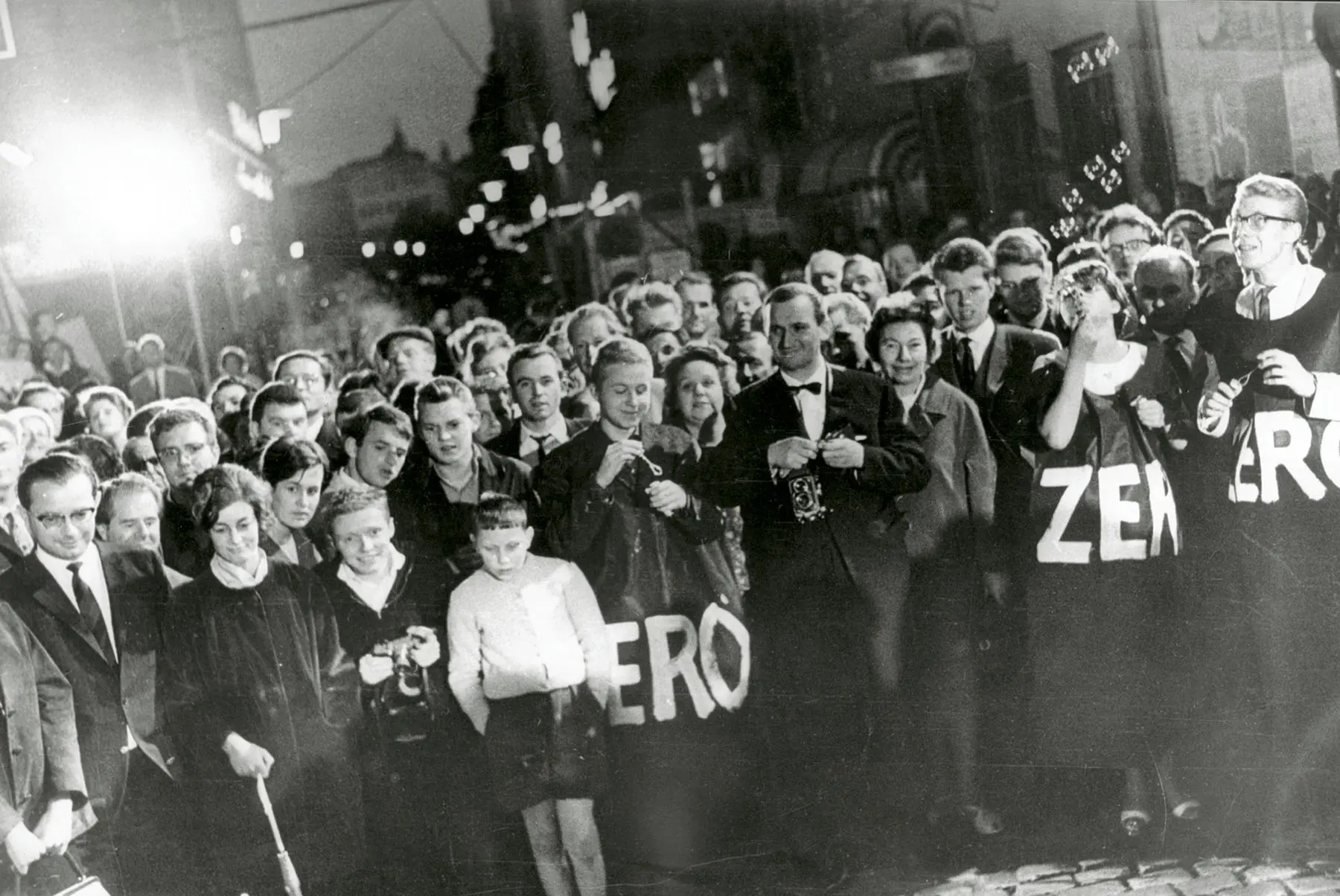
The Zero group was founded in 1957, when Otto Piene and Heinz Mack, two young artists in Düsseldorf, launched the idea of art characterized, above all, by experimentations with light. Afterward, Günter Uecker and other artists joined the group, which remained active for almost ten years. In that period, three editions of the journal ZERO were published, devoted to the group and to similar-minded European artists like Yves Klein (a representative of Parisian New Realism), Lucio Fontana (Milan), and the artists grouped in NUL (The Netherlands).
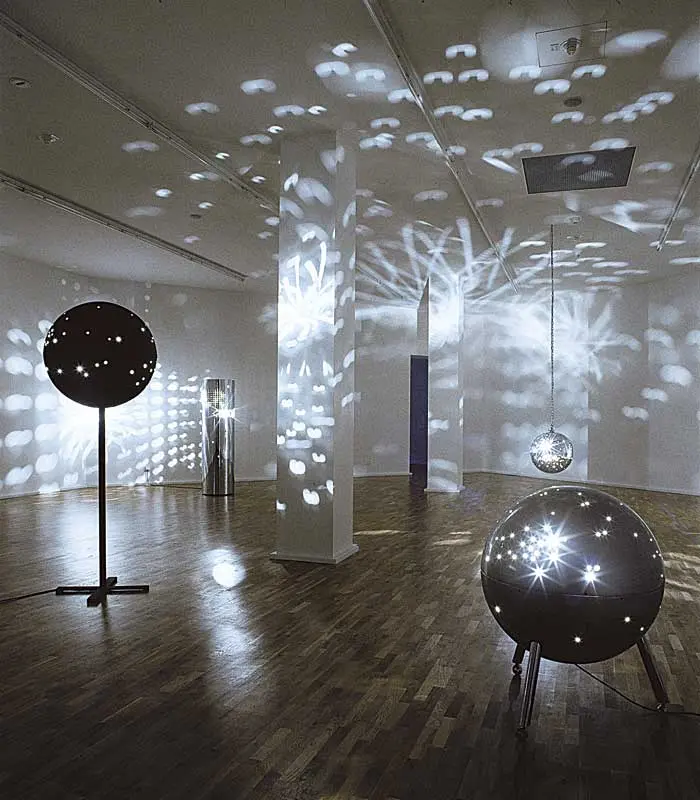
At first, exhibitions were held at night, with installations and two-dimensional works in which light and motion marked a break with the static condition of the painting and of the viewer’s gaze. Using elements such as light, vibration, and monochromes, the group developed daring, creative experiments accompanied by spectacular performances and environments. These works produced shifting effects, especially as a function of light, as in Otto Piene’s Lichtballett, one of the movement’s most significant expressions.
One important event in the history of the movement was their participation in Dokumenta III, in Kassel, in 1964. In the attic of the fair’s main exhibition site, the Fredericianum, Zero artists presented a tribute o Lucio Fontana, in a space composed using rotating objects. Another important moment was the group’s official dissolution at a party for 1,000 people in which a burning automobile was sunk into the Rhine.
The group’s ideas had an impact on the art world. According to data provided by the Goethe Institute’s Brazilian office, before its dissolution Zero held nearly 55 exhibitions in Europe and the United States. The Zero Foundation was established in Düsseldorf in 2008, the result of a collaboration between artists Heinz Mack, Otto Piene, and Günter Uecker with the KunstPalast Museum and the local municipality. The artists donated forty works as well as their archives, which include important records such as photographs, correspondence, invitations to shows, and texts.
It is worth emphasizing that during the group’s long years of activity, other artists and collectives across the world also experimented with kinetics in art; for example, in Italy, with Grupo T (Milan) and Grupo N (Padua), and in the United States, where MoMA of New York presented the exhibition The Responsive Eye in 1965, which marked an arrival for optic and kinetic art. In Brazil, several artists included optical experiments in their work: Lothar Charoux, Almir Mavignier, Ivan Serpa, Abraham Palatnik. Already in the 1950s, Luiz Sacilotto’s paintings anticipated themes that would be later developed by international Op Art.
The works featured in this exhibition show the artists in search of a pure condensation by means of the neatness of pure color and of light vibrating in space. To emphasize these elements, the curators installed light-and-mirrors environments to divide thematic areas, enjoined as individual chapters: white as the color of light; Yves Klein’s idea of purification, manifest in blue-colored objects; objects in motion inscribed in the concept of the Dynamo; the phenomenon of vibration and the insertion of natural elements that fuse the realm of art with the realm of nature.
Etymologically, the term “kinetic” is connected to the idea of movement, and it became effective in the vocabulary of the arts in 1955, with the exhibition Le Mouvement at the Denise René gallery in Paris, which featured works by artists from several generations: Marcel Duchamp, Alexander Calder, Vasarely, Yaacov Agam, Jean Tinguely, Pol Bury, among others. The specificity of kinetic art is that its motion is the structural principle. In the case of the Zero group, one can speak of a “light-based kinetic art,” materialized in the form of disks, spheres, and light-filled spaces, as can be seen in Geschichte des Feuers, an installation by Otto Piene (1968-1971).
Besides real motion, kinetic art involves optical movement and, in that sense, connects with the optical art of Venezuela’s Jesús Rafael Soto. Soto’s importance in the visual experiences inscribed in this artistic language is a clear example of the pioneering role played by South American artists in the international scene. Between 1950 and 1953, Soto created works in which elements arranged in space produced effects of virtual motion and optical vibration. In 1955, as the first exhibition was being held in Europe, Soto was more directly involved in kinetic investigations, based on perceptual shifts that resulted from the viewer’s position relative to the work and the use of suspended elements vibrating against a background.
The pioneering quality of South American artists can also be appreciated in experiments by Abraham Palatnik, who after painting some constructivists canvases, began in 1949 to project machines in which color moves. On the basis of these experiments, he created boxes of canvases with lamps that move thanks to motor-activated mechanisms. His work was also pioneering in the use of electric light. Mario Pedrosa has called those inventions “Kino-Chromatic Devices”; they were shown for the first time in 1951, at the 1st International São Paulo Biennial.
As a member of Rio de Janeiro’s Frente group, one of the most important in concretism, Palatnik adapted the ideas of concrete art to the three-dimensional, with works in which small objects placed inside closed boxes moved, thanks to electromagnetic fields. In the exhibition under review, Palatnik’s Sequência Vertical S-30, from 1965, shows the way in which the artist explored the aesthetic possibilities of light, establishing a play of symmetries and asymmetries in extended, silent movements.
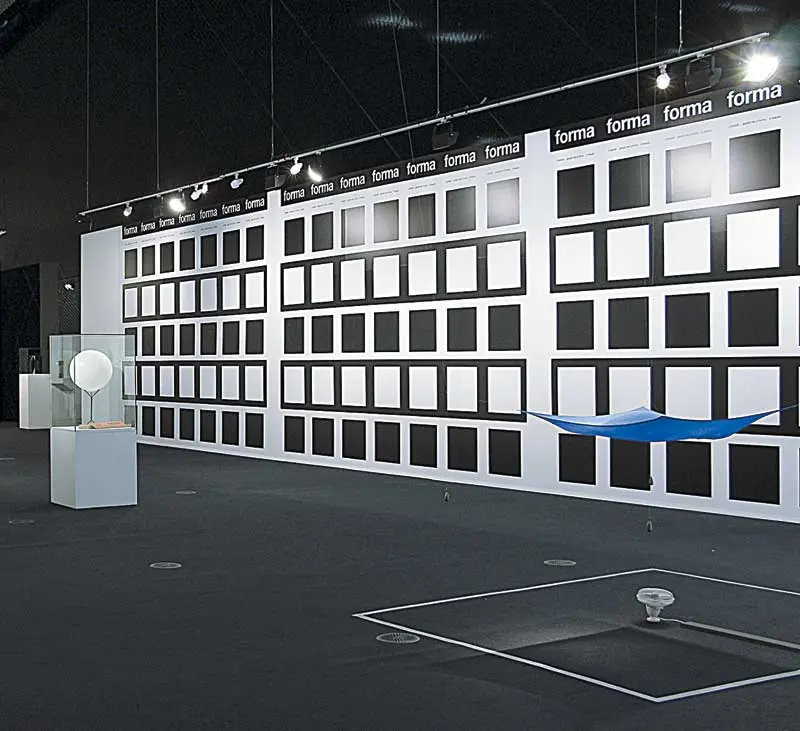
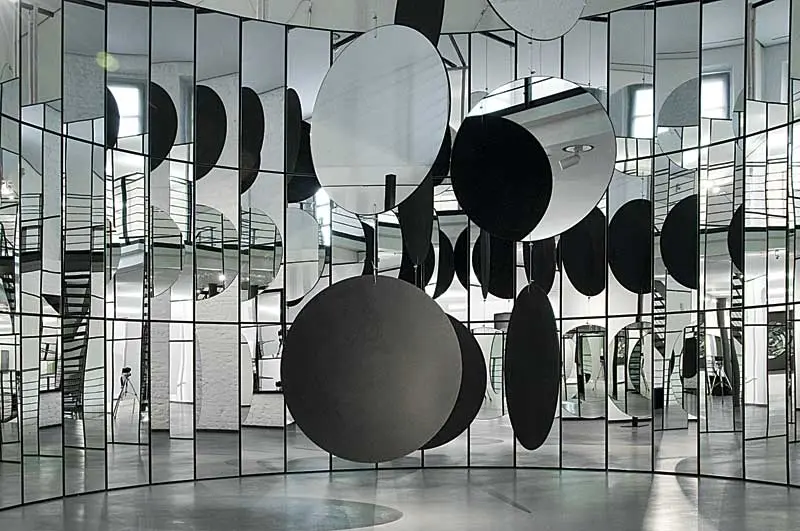
Another significant work is Spiegelwand und Mobile (1963), by Christian Megert, a Swiss artist and a member of Zero. Known for his abstract-geometric structures and his environments using mirrors and the main element, Megert incorporates wood, lights, and motors into his projects in order to generate a sensation of disorientation as viewers walk through his built environments. In Spiegelwand und Mobile we see his attempt to create an infinite space, “without beginning or end, static and fluid at once.
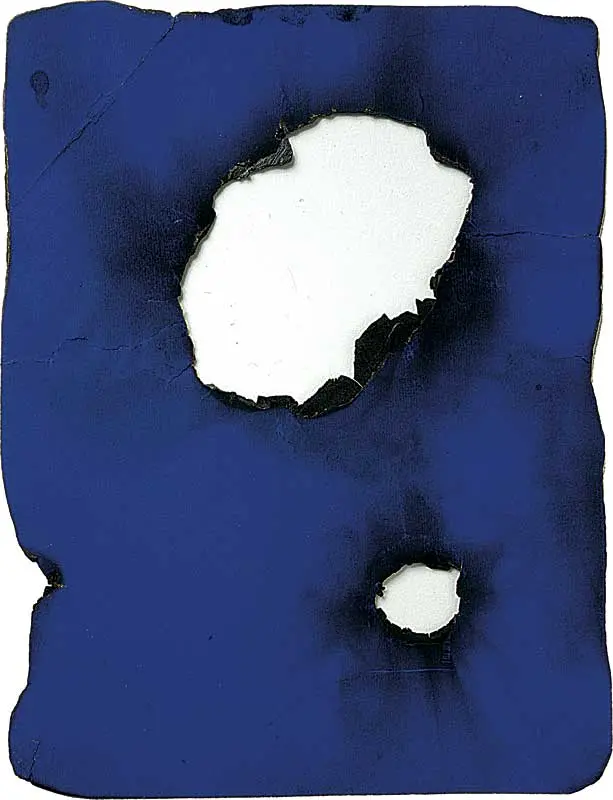
The show also includes installations and reliefs by Yves Klein, all using the lively blue pigment of the artist’s own invention. Klein was one of the main figures in the group’s networking efforts since his own aesthetic investigations coincided with those of several members of Zero, especially with regards to their study of the monochrome. In this case, the possibility of using only one color was not connected to the exploration of an empty, neutral, or passive space, but to the search for a continuous space-time, traversed by force fields that expand and connect with one another via the maximum of color saturation. These characteristics are reinforced in the exhibition by the continuity of the color blue in several works on display inside the same room, as Klein himself proposed in other shows.
Fontana is another artist for whom these ideas are pertinent. Contrary to the conception of modern art as a representation of space, he uses light as a technical manifesto of his ideals. Fontana’s concept of spatialism is based on the principle that matter can be transformed into energy, invading space in a dynamic way, and that which, moreover, can be achieved by means of technology. As a counterpoint, in the materiality of his works Fontana sought to make evident, with severe gestures, matter’s potential for breakage, as in his perforations and slashes of the pictorial surface.
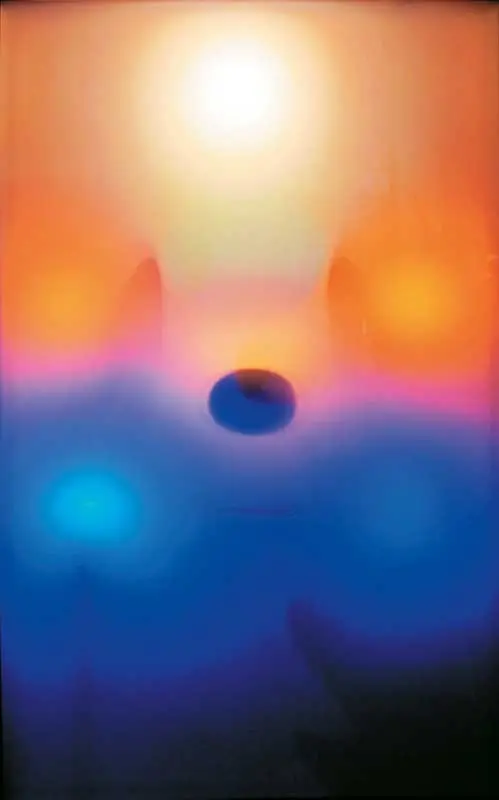
Pure color, light, and movement became a synthesis for the Zero group, whose artistic desires sought the liberation of individuals. In the group’s vision, new technological achievements were to contribute to their goal of opening new horizons and requiring the investigation of differentiated materials. More than in intellectual activity and reflection, the movement believed in action. Thus, it transformed theory into reality. Zero established a kind of symbiosis between art and science as an attempt to dismantle the old concept of representation of artistic forms as mimesis, this is to say, as the imitation of the objective world. In order to emphasize the creative experience and the power of thought, the group’s members created a “language of motion” and brought it to bear in works that evince the possibility of transformation, be it thanks to the position of the viewer or the manipulation of the work itself. The work is never closed but is forged at every moment.
ALESSANDRA SIMÕES