
Fourteen alabaster, marble, and resin sculptures, plus eleven
drawings by Peruvian artist Alicia Ehni were exhibited in her first solo
exhibition in New York from October 17, 2013, through the end of January of
this year at the Frederico Sève Gallery. Through the juxtaposition of geometric
forms derived from cubes, cylinders, pyramids, and spheres, Alicia Ehni—who
graduated from the Pratt Institute in 1999, after studying six years at the Pontificia
Universidad Católica in Peru—generates abstract objects that range from smaller
ones that measure 8 x 8 x 2 in. to bigger ones of 11 x 11 x 32.5 in. The
results are sculptures that, in representing geometric abstractions, are
reminiscent of both the ceramic and textile works from pre-Hispanic Peru. In
this manner, by operating from the “abstract” component as a point of departure
because of its analogy with the local cultural and visual history of Peru, Ehni
develops a binary language that, on the one hand, refers to the visual heritage
of the region and, on the other, to her memories pertaining to the Peruvian
landscape.
Curated by Petterson Smith and titled Mapping Stone, the exhibition consists of three series, each involving a different material: alabaster, marble, and resin. Although the three series formally coincide in their geometric abstraction and in the white of their surfaces, each demonstrates a reference for a different object; a unique aspect of the Peruvian landscape. In this manner, the moon, the rocks, and the mountains constitute the sculptural imaginary that Alicia Ehni exhibits as a kind of inventory.
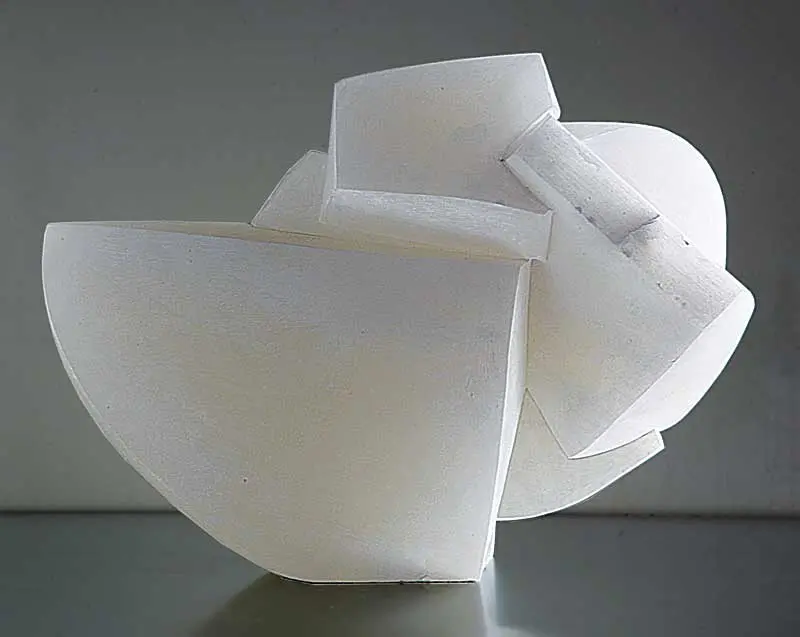
Pan-American Highway is the name of the series created with alabaster. It consists of five small sculptures that represent stones that one may find, eventually and/or symbolically, on the Pan-American Highway. Being a road 25,800 kilometers long that links ten countries of the American continent, the distance between one point and another is measured differently in each country. Ehni, who since 1998 resides in New York, recalls that during her childhood the Peruvian section was full of rocks and the stones were inscribed with white markings that signaled the specific distance in kilometers between that point on the road and Lima. In Enhi’s memories, the distances between one point and another did not indicate any informational spatial reference with regards to Lima—a matter that would reaffirm the centralization of power—but rather the different landscapes that appeared along the road, thus indicating the value and wealth of the geographical diversity in Peru. From the desert to the mountains, and from the forest to the sea, Alicia Enhi uses the landscape that surrounds a specific kilometer of the Panamericana as a referent to create hybrid forms between rocks and landscapes. At the same time, the combination between specific information (kilometers) and the variety of rocks along the road (the organic) moves the artist to analyze the relationship between landscape and geopolitics, as she reflects on the relationships between distance, landscape, and cartography.
In the series of marble sculptures titled Turning Stones seven sculptures of various sizes represent a cycle and its various stages of development. To Ehni, these works are “based on the idea that when you see the moon, even if not in its complete form it does not mean that the rest does not exist. Something can be complete despite not having all of its parts.” Thus, Ehni generates negative space that becomes visible through the continuity of the sculptural lines, prompting in the viewer’s gaze the desire to continue the cycle. To Ehni, this series is associated with the Paracas Desert, whose surface resembles the lunar surface. Finally, two vertical sculptures—the largest in the exhibition—are made of resin. Unlike Pan-American Highway and Turning Stones, these sculptures are not rocks or objects that resemble the desert floor, but mountains, small vertical fragments that seem like modern architectures of fluid white cuts. Alongside the sculptures, eleven drawings, mounted diagonally on thin white shelves, accompany the three series, signaling the process of creation of some of the sculptures.
Despite the materials and referential differences between the three series, both the play of light and shadows and the geometric abstraction in each of the sculptures make the pieces unify into a whole in a story that explores the artist’s memories associated with the physical and mental landscape of Peru. Ehni, through her white geometric compositions, invites visitors to explore mountains, rocks, and lunar phases on the surface of the desert, as she opens her memory to a direct and sensitive dialogue with the viewer.
FLORENCIA SAN MARTÍN