
The existential nomadism that for many years has characterized the life of Alicia Paz (Mexico, 1967) finds its equivalent in a type of painting that could be defined as “iconic nomadism.” A graduate of U.C. Berkeley (US) and the Royal College of Art in London (UK), Paz lived for a short time in Paris and Germany and eventually settled in London, where she now lives and works. Her aesthetic imaginary could indeed be regarded as a form of travel through time and across several universes, as compiling, supposing, and establishing dialogues among images has become with the passing of time her modus vivendi. Through her approach to reality and past memories, Paz creates unexpected, incongruent, and singular collages that are nonetheless always subtle. They construct a fiction, an original gaze focused on her relationship with the world and the history of art that proposes a confrontational inquiry. In several important exhibitions organized in 1997, 2000, and 2005, Paz immerses images from the history of painting—by Velázquez and Goya specifically—into a chimeric and amusing everyday context—very similar to the exquisite Eighteenth-Century porcelain figurines from Saxe—or creates characters that combine pop art with science fiction, as she showcases her ludic and uncomplicated ability to approach the overlapping nature of time through the complicit absurdity of her juxtapositions.
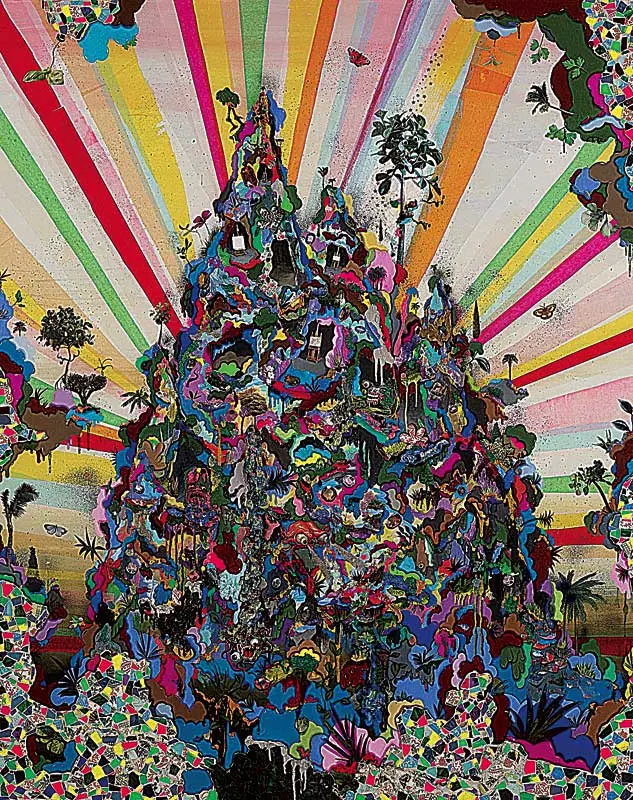
The construction of her hybrid and narrative imaginary will only become more amplified and visually complex with the passing of time. Centered on figurative representation, Paz’s aesthetic will spread as the increasingly more fractioned image will gradually disintegrate into a multitude of heteroclite fragments—canvas, paper, buttons, miniature plastic objects, ribbons, pompons, photographs from periodicals, sponges, etc.—that will constitute the essence of the sensitive and tactile narrative of her current work, often structured around photographs of faces and eyes taken from women’s magazines. Sponsored by Champagne Nicolas Feuillatte—the company that elected Paz as its Artist of the Year—the exhibition presented at the Instituto de México and at the Galerie Dunkan—6 paintings on canvas, 24 works on paper, and 6 cut kinds of wood from 2008-2013—proposes the best-achieved expression so far of that sense of controlled proliferation confined inside incandescent and magical universes that captivate the astonished gaze. The art collection owned by Champagne Nicolas Feuillatte includes works by artists like Nils Udo, Tony Soulié, and Philippe Favier. Alicia Paz is the fifteenth artist that has received the support of this prestigious institution.
I will focus on the exhibition at the Instituto de México since the one at Galerie Dukan uses some of the pieces from that exhibition. There, Alicia Paz presents two new series. Titled Artists, the first series consists of three-dimensional works that depict female figures fashioned in wood and dressed in sumptuous clothes whose exuberance, iridescence, and fantasy does not contravene a previous production—although the chance is not altogether absent from the original design. Measuring 180 x 110 x 2.5 cm, the piece—selected and awarded by Champagne Nicolas Feuillatte—titled Amaranth (wood, mixed media, collage, 2012) is the first of these three-dimensional experiences. Here front and back were worked in a different manner. The second series consists of large drawings that are characterized by predominant bustling materiality. It is a pleasure to imagine, on one hand, the creative delirium of Venetian masks and, on the other, a totally different inspiration associated with the magical space of Chinese mountains and Japanese landscapes, without making any references to its spiritual dimension in favor of evoking its poetic and spatial levity.
Within this group of works so rich in pictorial and aesthetic surprises, the works on paper are, in my opinion, the ones that create the more dynamic and innovative spaces. Conversely, the three-dimensional figures offer in my view a more “anecdotic” version of the imaginarily and visually infinite two-dimensional concept. Thus, I will not address here the three-dimensional pieces. Several works attracted my attention for the way in which each shows unique visual and spatial horizons. They are characterized by their Japanized aspect present in the cherry blossoms in Medusa Islands (mixed media on canvas, 200 x 160 cm, 2013); in the “tree” of Yellow Frost (mixed media on cardboard, 190 x 153 cm, 2013); or in Guardians of the Secret (mixed media on canvas, 200 x 160 cm, 2011), in which the sunrays over the mountain increase the mystery of the material’s depth. There is real jubilation in this phobia to emptiness manifested in Alicia Paz’s works-collages. The aquatic universe—collages and paintings with predominant blues—that serves as a background in Run Deep (mixed media on cardboard, 190 x 150 cm, 2013), attest to the artist’s overflowing baroque approach. A work that stands out from the group is Sombras (Shadows, mixed media on canvas, 200 x 160 cm, 2011), a tree of life and death that is the sole black and white work with a few touches of blue. None of these works allow us to forget that Alicia Paz is first and foremost a painter, as the sovereign, amassed and ground pictorial matter—with her controlled drips—constitute a fundamental and palpable body of the oneiric and literary universe of her work, a true material of memories that weave the threads of a thousand stories.
CHRISTINE FRÈROT