
The exhibition of Amelia Pelaez, which opened as one of the inaugural exhibits at the Perez Art Museum Miami, is a welcome opportunity to see some of the best works of the great Cuban Modernist that is not yet as well known in the US as she should be, given her importance in the development of the modern language in Cuban painting and even though MoMA has been at the forefront of changing that perception by recently showing some of her paintings within the context of the permanent collection, hanging alongside the great masters of Modernism she so admired.
The MoMA works by Amelia were acquired by Alfred Barr, that visionary curator who really put the museum at the forefront of collecting Modern Art that was then Contemporary. Amelia was a true pioneer for Modernism and at the very center of adapting its stylistic forms in Cuban painting. The quality of her works and her importance in the development of the modernist language in Cuban and Latin American art has been slow to gather attention as she was always a very independent artist who worked in virtual isolation after her return to Cuba from Paris in 1934, where she had been since 1927, incorporating the elements of the international modern vocabulary within the structure of her uniquely Cuban artistic expression. While in Paris, she was particularly influenced by the work of the great Russian Suprematist and Cubo-Futurist artist, Alexandra Ekster, who was her teacher and mentor. Amelia was particularly sensitive to the artistic ideas of Ekster, who was, like herself, a woman pursuing an artistic career at a time when that professional profile was still exceptional, and a pioneer of the avant-garde coming from the periphery to Paris, being a Russian artist in the then undisputed center and capital city of the modern movements.
Amelia Pelaez was an active participant in the vanguard (1927-38) and the later and more classical (1938-51) phase of Cuban modernism. After her arrival from France, she concentrated on drawing more than painting, as Amelia always considered drawing the foundation of good painting and maintained a discipline of working daily on her drawing until the end of her life. In this period after her return to Cuba, she was working out her assimilation of European modern art and formulating a new subject matter based on her revaluation of the light and shadows of her native Cuba. The exhibition includes some great drawings from this period, such as The Seamstress (La Costurera) from 1936, which benefits from the exhibit nearby of an original Singer sewing machine from the period. This detail was an outstanding curatorial insight for Amelia. Like all Modernists who considered the machines around them to be important references for the making of their art, the contributions from contemporary design inform their work, whether in Picasso’s still lifes or Leger’s renditions of contemporary modern urban life. Leger in his writings acknowledged the good taste of industrial design and color, while Marinetti in his Futurist manifestos praised the machines and the newfound velocity of the age, which were of paramount importance in his formulation of the movement’s ideals. Considering that Alexandra Ekster was very close to the Italian Futurists and exhibited her works alongside theirs in Rome during this period, it was only natural for Amelia to include these ideas into her work as well.
Two significant works on paper from the ‘40s; her fascinating Self-portrait from 1946, which already introduces the theme of a woman viewed in profile which she was to develop and explore further in the next decade, and the elaborately baroque The Fortune Teller (La Adivinadora) from 1944, particularly illustrate Amelia’s deeply rooted aesthetic within the historical context of traditional Cuban art and design; both these drawings have the visual impact of a pattern of lace mounted like a painting. This exhibition included an installation of furniture that suggests a traditional Cuban interior; it consisted of an elaborate rocking chair, table, and tablecloth, in which the placing of the colonial chair was particularly illuminating because it created a pattern of shadows as elaborate as the original furniture piece, a factor that Amelia incorporated into her construction of paintings with great care, as these background shadows and patterns in her Cuban interiors are very important components of the compositions. In fact, it can be argued that the “dark” part of her paintings, whether expressed in the shadowed areas of her interiors or in the elaborate framework depicting metalwork, is what creates a balance for her compositions, and supports her strong colored palette.
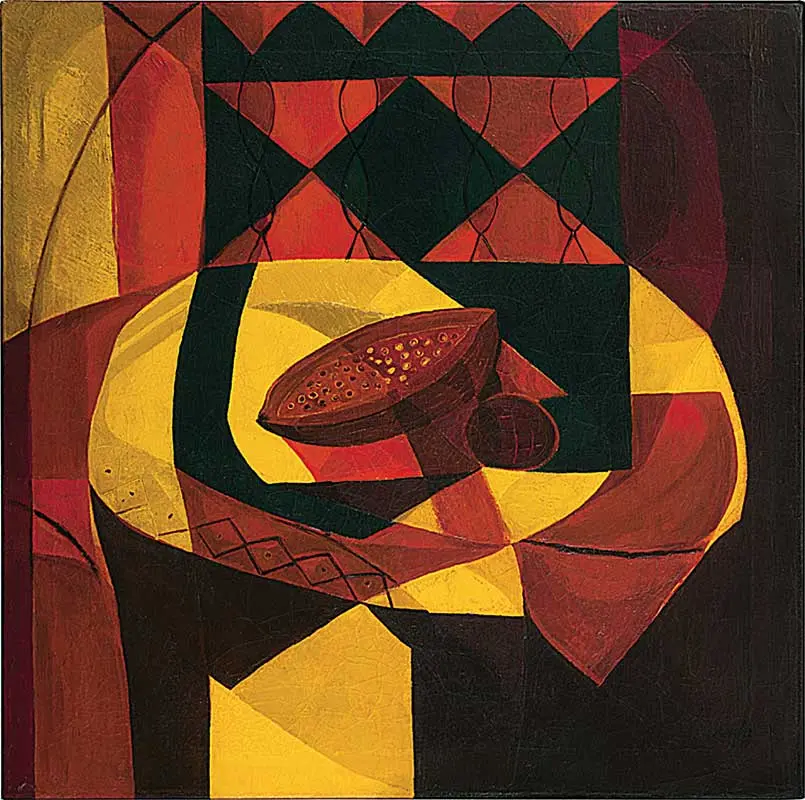
A self-portrait on paper from 1935 shows Amelia arranging a still life on the table in front of her. This is a rare combination in her work of both the still life and the figure and was donated to the museum from the Perez collection as part of the gift for the museum’s inauguration. It is one of her best drawings from the period, showing the elements of her mature style of the ‘40s. The theme of still life was a major one in the artist’s production, and the exhibition provided a great selection of her Still Life paintings. Following the development of this genre through the decades, an early example from 1929, Untitled, is a rare work that has not been exhibited in more than 40 years. She incorporated elements of Cuba’s flora in her assimilations of modernism, depicting a “mariposa,” the Cuban natural flower, painted in a pointillist technique that clearly references Kandinsky’s works. The linear planes of the composition also recall Matisse, an influence that is more apparent in a work from 1931, Still Life (Naturaleza Muerta), another painting that has not been seen in public in several generations, and which depict a fruit bowl in a very similar pictorial context as Matisse’s Rose Marble Table from 1916, (in MoMA’s collection since 1956). There are two other still life paintings from the ‘30s that are equally striking in their modern style, Still Life in Red (Naturaleza Muerta en Rojo) from 1938, which entered MoMa’s collection in 1942, and The Pineapple (la Piña) from 1939, on loan from a private collection which highlights Amelia’s masterful use of dark colors and shadows that create volume and define the architectural space. Papaya from 1940 and Still Life with Fruit from 1935 are excellent examples of opposite color schemes of the same theme, the Papaya being a color-saturated canvas of reds and oranges displayed as a veritable feast of tropical splendor, while the Still Life with Fruit has an austere treatment of the subject which is framed by a white tablecloth, recalling in its severity of line the paintings of le Corbusier in the simplicity of his signature Purism style.
In the next decade, she developed her style by enriching her modernist vocabulary with arabesques, bright colors, and elaborate compositions derived from the baroque Spanish tradition and nineteenth-century Cuban architectural decoration and furniture design. The exhibition incorporates a couple of pieces of furniture and textile to emphasize this point, which is very helpful to comprehend the influence of her immediate environment in her work, her home, garden, and neighborhood, an old-style quarter of Havana, La Vibora, which had fortunately remained behind the times. Its old-fashioned colonial style became, for her, a new source of artistic inspiration and cultural expression. She integrated elements of colonial architecture in her work where often we see the colored puntales (door arches), windows, the patterns of the iron gates and balconies, lace tablecloths, and expanded on the nineteenth-century tradition of the use of tropical fruits and flowers for the same purpose.
In the exhibit we can appreciate these developments in a series of works Amelia dedicated to the theme of two women, always designated as sisters (hermanas), which is a major part of her oeuvre. Sisters in the Balcony from 1942 is an important gouache that shows both women in profile, facing in opposite directions, their faces in a classical style, the background and foreground enclose them in the elaborate architectural detail that formulates the effect of a display case or exquisite cage. The Sisters from 1943 is a color-filled composition highlighting the women surrounded by architectural elements in a balcony, a Grecian column, and the perspective she uses to augment their height, as well as the mask-like treatment of the faces, makes them more like ancient deities than contemporary women on a balcony. One of them even holds a flower in defiance, as if it were an attribute. This work was a highlight of the 1944 Cuban art exhibit Modern Cuban Painters, at MoMA, where it appeared illustrated in color in the catalog. This painting was thought lost until its recent appearance at the auction where it achieved a world record for the artist; it was a pleasant surprise to see it in the exhibition next to the Reading Sisters (Las Hermanas Lectoras) from 1944, another development of the theme, this time with darker colors and shades in blue tonalities, one of her most interesting compositions in the darker, shadowed palette.
The ceramics that Amelia took an interest in producing in the ‘50s and ‘60s are well displayed in cabinets which also included archival material that documented her ceramic tile project for the decoration of the Havana Hilton in 1958, as well as a number of photographs and letters that add useful information to her artistic trajectory. The thoroughness of the exhibition makes it the most important showing of Amelia’s work since the 1988 retrospective organized at the Cuban Art Museum in Miami by Giulio Blanc and an absolute must-see exhibit in Miami.
ALBERTO BARRAL