
Continuing his artistic explorations in geometric abstraction, Tucuman artist Andrés Sobrino (1967) presented his latest production in the halls of the Galería Del Infinito Arte. He exhibited a series of paintings made with synthetic enamel on multi-laminated wood where he developed a—more intuitive than mathematical— the study of the properties of geometric figures on a flat surface. Sobrino used diagonals, horizontals, verticals, and, above all, triangles to explore their formal value, both as shapes within the compositions and as structures from the trimmed frame. The work was enriched by the insightful selection of enamel to create the paintings, which provided a flat, shiny, and industrial-looking surface. Unlike previous works—such as those made with ribbons, in which the construction and the results are related and interjected as a deconstructive strategy—in this series the element of construction is not evident. Nonetheless, the material importance of the finishing of the synthetic enamel must be underscored.
Based on the combination of basic geometric shapes and on the order, simplicity, and industrial look of the piece, this work revives and updates the investigations carried out by Minimalism. But this is not the only analogy to modern art, it is virtually impossible to observe Sobrino’s work—consisting of a grid of black lines on white—without being reminded of Piet Mondrian (1872), an artist repeatedly mentioned in the Argentinean artist’s production. In the same manner that the reference to the tradition of abstract art from Argentina becomes evident in his explorations surrounding the cut frame.
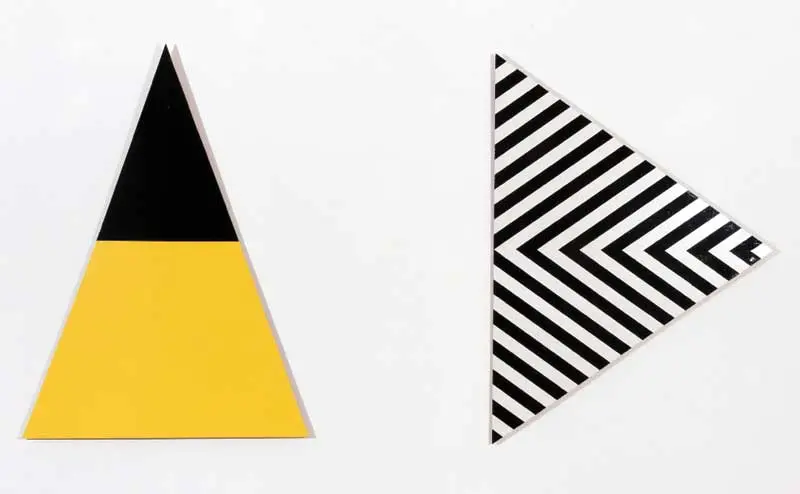
Sobrino’s production is in a continuous dialogue and is constructed through the exchange of references, not solely because of its reinterpretation of the central currents of Twentieth Century abstract art, but also as a result of the relationship it establishes among his own works throughout the exhibition space. The intelligence displayed in the way of arranging the works in the exhibition room is nothing short of admirable. This ability allows Sobrino to leverage the strength of each of the works based on the dialogue. A piece interferes with the reading of another as even the gallery wall functions as a support for the geometric figures on display. The transformation of the exhibition space suggests the entire exhibition as a great visual installation where color planes are released and function as sculptural objects. This implies a topological registration of the work, suggests a sensitivity for the surrounding space and exploration at the context level, for the assembly requires a selection, order, and the continuity of the works across the space. In connection to this, it is interesting to recall the proposal by David Hume in “On the Standard of Taste” (1757), in which the Scottish philosopher stresses that a critical viewer must be able to understand each of the parts of a work and compare them in order to perceive them as a unit. While the Eighteenth Century author gives central importance to the ability to capture the smallest details, he also notes the need to understand the entire work. In that sense, in Sobrino’s exhibition, we could emphasize the importance of observing the works as a group.
In addition to modern art, there are other relationships that enrich Sobrino’s reinterpretation of the abstract language, such as proximity to graphic design or the references of some shapes and colors to urban transit signals. It is not a proximity-based on content, but rather on the visual code that those signals use. The “signs” by Sobrino rearrange the space of the room not by any rational decoding but through a more intuitive communication with the viewer.
Reduced to their essentials and stripped of any ornaments, we can conclude that few are the elements chosen by Sobrino for the construction of works that, beyond their mathematical rigor, would appear to be the result of intense reflection and careful observation. Sobrino chooses production strategies based on an exploration of the minimum, which emphasizes the resolution of form and color in his work. The economy of resources becomes the product strategy that allows him to strengthen those two elements so each plays a fundamental role.
AYELÉN VÁZQUEZ