It would seem that only gods exist in contemporary art, the gods of the market, and under them a whole hierarchy of celestial beings: Thrones, Cherubims, Seraphims, Virtues, Dominions, and Authorities. Only after them come the Angels, Archangels, and Principalities. In such a world of Grace, filled with theories not all that different from those that filled Byzantium, the devil is necessary. In fact, they exist and are legion. And among them is Antonio Dias. From the start, in the 1960s, his devil asserted himself and has continued to do so in recent works.
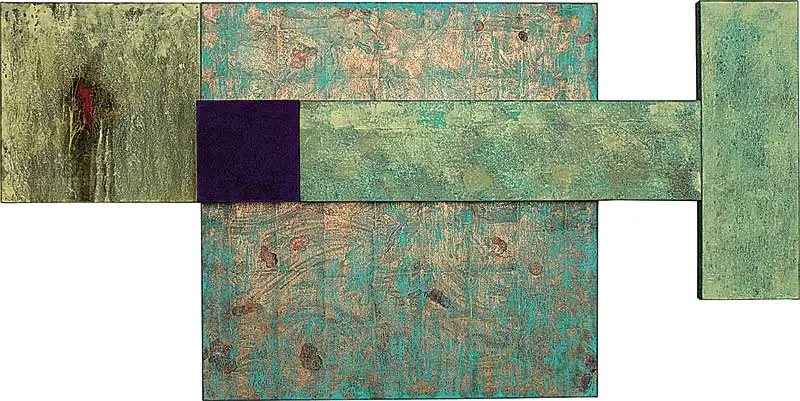
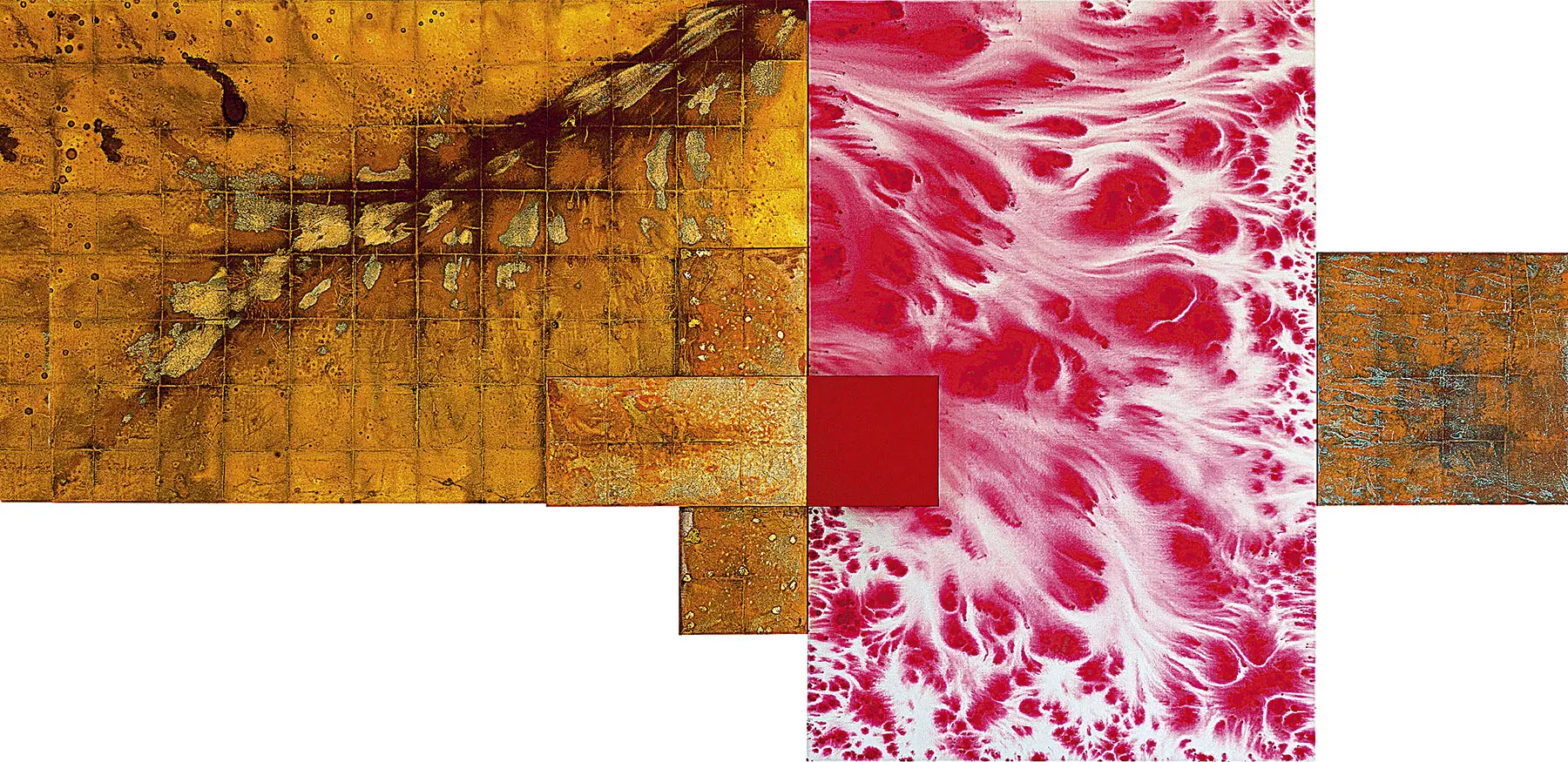
This devil is Dias’ poetic power. A great potency that is nevertheless extremely controlled. There is in him an austere rigor that contains every possible excess. Constructive reason is the sentinel of excess, and excess is numberless. It goes in every direction. Painting is one, and there are many in each. Constrained, it rises with powerful visual violence and spreads horizontally. It possesses visual energy whose intensity—always forceful—varies slightly between one plane and another yet remains always diverse. There are no modules in the sense of design or architecture; these would be the best measuring units for the generation of a set from which the entire composition derives. They can’t be called polyptychs, either: traditionally, polyptychs repeat the same module. These are planes, in a dual sense. Paintings that aspire, each one of them, as elements of totality, to independence, preserving their formidable autonomy in relation to the whole to which they belong, pictorial planes that sparkle with their strong colors, at times invented and at times well known; even when they seem to vanish into a quasi-green, quasi-white, they surprise us on the rough surface where color is discontinuous, varying inch by inch from white to light green. Why add confusion to such a confounding world? Each plane a painting, and next to the painting a formidable metonymy, as linguists would say back in the day when Roman Jakobson was still required reading.
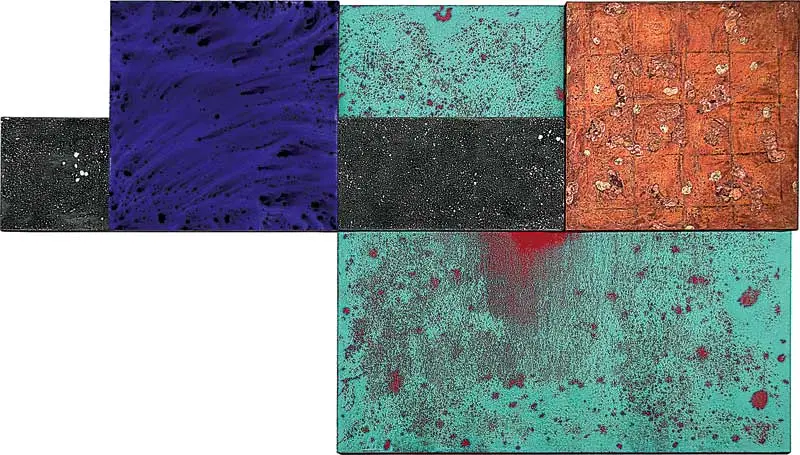
They are also stage planes for the theater of color in a drama determined by meaning: what is present is not only his mastery of the painterly craft but the praise of labor that, like no other, seeks to assert itself on the basis of its excellence. The artist’s labor. All of this seems outdated and even conservative at a time when the art circus is all setup and the word business substitutes for work labor. According to the verb of the era, planes “negotiate” between themselves, as though they were in a medieval market purchasing tapestries. Planes “negotiate” nothing: they relate to each other in a calculated tension that maintains their independence. Between them, in their dialog and dispute, they begin to announce what will happen once they are immersed in the world, in the finished work. They could never exist in a completely independent state, they will always have a level of impurity and will find themselves contaminated by the world and by the contagion that the work of art needs in order to escape the harness of formal schemata and distant meaning, which threatens to render it into nothing more than a lab rat. That is precisely the contamination we find in the surfaces on which no pure color takes hold. The uncertainties of green, of copper, of gold, already foreshadow the inevitable fate of any and all work of art. It is there in the world, where everything is, where the power will be measured. There we will find out whether it remains thanks to its poetic power, or solely because of the scandal of an action transformed into a spectacle.
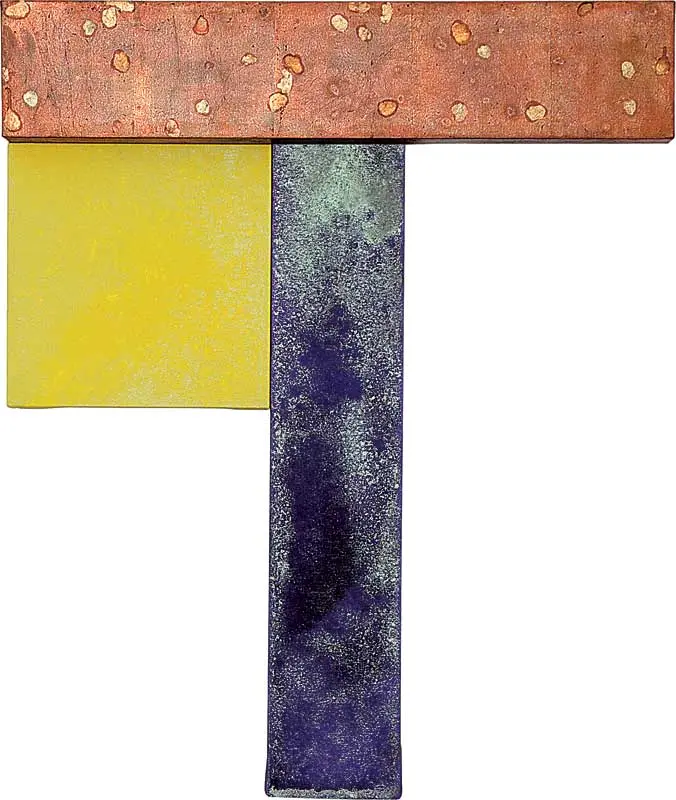
But see: juxtaposed, superimposed on one another, these are planes that move towards three-dimensionality; they don’t content themselves with the wall but must push forward and forward, assuming volume (yet, as always, without outbursts of any kind): the rigor of the construction doesn’t allow for “postmodern” extravagance; rather, it generates a structured totality. Volume is contained in an abstraction whose geometry is found in the perimeters of the parts (the planes/paintings) that comprise it. They are paintings and sculptures on the wall. Let’s examine one of them, which is, in an organic sense, the same as many.
First is the fullness of color. Each flat, complete, and integral. The sole pure color is red, the rest are all complemented by contamination of variability: copper, gold, and even the scarce malachite are found in Dias’ paintings. Perhaps even red itself dissolves in white. They are not pure colors but are segmented into portions of the painting. The chromatic adventure never ends.
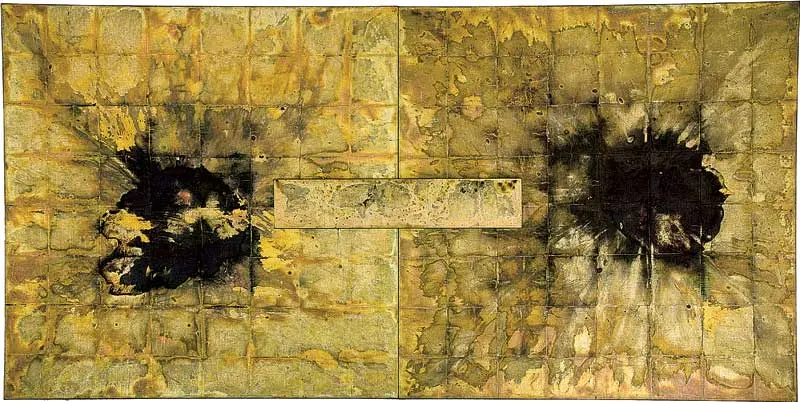
This is related to film editing, but not as it is carried out today, in digital islands, but with the montage techniques of the past. Using scissors, Eisenstein will forever remain in the memory of the Twentieth Century. The sequence is dramatic not only because of its content but because of the intensity of the montage. There is no fusion. General shots alternate with close-ups and details. All with dry cuts. Glauber Rocha reconstructs it in the Monte Santo Massacre perpetrated by Antonio das Mortes in his film Deus e o Diabo na Terra do Sol (released in English as Black God, White Devil). Brian de Palma makes it a theme—the baby carriage falling in a train station—in a forceful, suspenseful sequence in The Untouchables. Film provides a vector that is absent in painting: time. In film, the artist determines the time of each shot. In Battleship Potemkin (1925), the year was 1905: from the staircase, the crowd cheers the sailors in rebellion, who are on board the battleship. The Tsar’s troops advance in close formation against the unarmed people and the mother, hit in the abdomen by a bullet, drops the carriage with her baby inside; the carriage wobbles, the carriage falls down the stairs, and the crowd runs. The drama must be told in segments, but there is nothing more complete in the world. Antonio das Mortes, the killer of cangaçeiros, as sung by Sergio Ricardo, reloads his Winchester and shoots; each shot is a terror and the terrible Odessa massacre is relived in the Monte Sacro stairs: the hunter of cangaçeiros, the hunter of outlaws, shoots against the people. What is the lesson in this painting? Mimesis? Never.
If it all is done in segments, why would the painting be whole? This is the question that resonates behind each moment of color in the paintings before us. The “deconstruction of totality”—as fashionable theoreticians have it—and its reconstruction after the disaster, in the interior of which we live: the encounter of art with the larger entertainment industry. But that is the dynamic of the form: it is alive, it moves with time and in space. Form, dynamic in its process, is the site of art. Only the blind would not see its complex genealogy, its interactions. They live the separation of form and content.
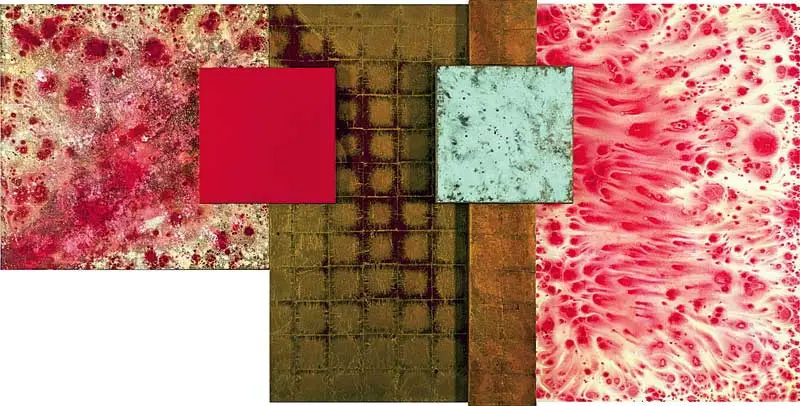
The reflective demand imposed by Dias’ poetic rigor is right there in the work, in its complex form. How much will this demand be imposed on inside a crowded gallery? But, as we witness such dissemination of consumption, is it what we were after? Do we vindicate the democratization of art? It is not too late to say no, now that the business is successful. Millions of people pass in front of works of art every year. In the western part of the Northern Hemisphere, art is “democratized” thanks to the big private corporations that sponsor it and to still rich European countries. Even in the midst of the crisis, they are still very rich, especially if we keep in mind the Human Development Index (HDI). There, it is not a matter of blockbuster exhibitions, but of entire blockbuster institutions. The regime of enjoyment is altered. We are not about to return to the tale of aesthetic enjoyment. It suffices to think of a very recent past, in pioneering contemporary oeuvres such as Lygia Clark’s (1920-1988), Eva Hesse’s (1936-1970), Hélio Oiticica’s (1937-1980), and Dennis Oppenheim’s (1938-2011), and remember the conditions in which they emerged. The impediments, the resistance, and the opposition of institutions and the public were still factors. When they appeared, their works (like many others) caused dismay and paralysis, one didn’t know what to say, no one just walked by them with a cellphone camera in hand. You stood before these works to reject them or to ponder. For a moment, all certainty was suspended and the unknown emerged. Can it be that this past no longer exists? It doesn’t, and it cannot return. Now comes the dilemma: the work of art is launched into the inevitable, absurd, spectacular, circus-like present, or insists on a remote, archaic past, situated much closer to the modern when the experience of art was not disciplined by anesthetics. Such is the potential of art outside the contemporary circus, and the restoration of this existence, still impossible, must pass through the mediation of bringing into the present the remainders of modernity’s lessons when the illusion of the autonomy of the arts was fully realized in the imaginary and the symbolic realms of a triumphant Western culture.
The bridge between the present and the past is present in innumerable works of art, and it is also found in Antonio Dias’ paintings. Our art is broken into pieces—exploded by consumption—and this is his transit towards art made of fragments: montage. Deconstruction and reconstruction. But the reconstruction is the conclusion of truth. Let’s not oil the truth up in order to make it slick and relative. Truth is what allows us to have at the same time the work of art seen in passing, in the light enjoyment of large centers, and the restoration of the cognitive that should be present in any aesthetic enjoyment. The loss of the old paradigmatic unity of painting on canvas, already present in the artist’s youthful works, is enhanced. The pleasure here is the knowledge of where we are, standing before the work, in our own time, in unavoidable contact with the here and now, with the contemporary.
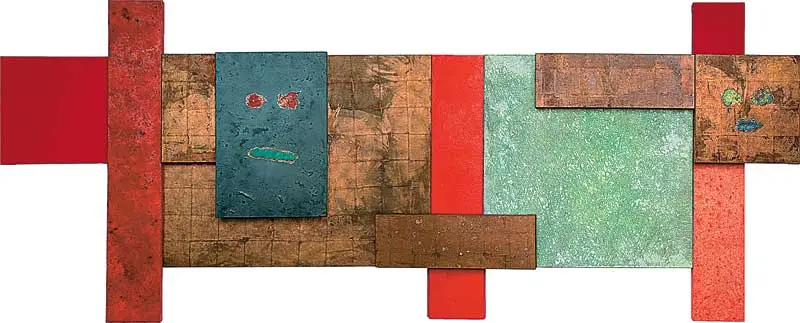
This is the problem posed by Antonio Dias’ art when we confront it: it was never reduced to relativism. We are in front of a true, and truly affirmative, work of art. It is not that the artist eschewed the inevitable sense of humor and irony in specific works. On the contrary, that remainder of irony and humor traverses his entire oeuvre, and at times it is exacerbated.
In film, as in music, we have time. In painting, we have all the planes in simultaneity. Time does not belong to the work of art as it does to music, drama, or film. Time belongs to the reflective subject in the act of contemplation, it determines our gaze on the whole and the parts. That synchrony built by juxtaposition, by forward-and-backward motion, by chromatic contrasts and inventions, sets the stage: the pictorial as a montage. What we may have here is the pure and simple syntax: it seems like the essence of the thing. Red in its radiant purity and the green hue of malachite and copper, impure, all sparkle. There is motion all over, determined by the rhythm of construction. The drama may be purely visual, pictorial. But the phrase remains suspended, its meaning hangs in the air like the painting on the wall. This fluctuation of meaning has to do with shadow areas, where colors are blurred. The internal tension between dissimilar elements such as planes, volumes, and colors, which moves in different directions in space and time (why not bring forth the revolutionary historical memory of the color red?) is where the form is generated in front of our eyes. To conclude, we have beauty, the discarded virtue of the contemporary world—form—present when the truth is expressed in art: everything is available at the same time, for each person’s perceptual time, but it all depends on history. And the demons are who make history, not the gods and the angelic court.
PAULO SERGIO DUARTE
Art critic and History professor at Candido Mendes University, Rio de Janeiro.