When one thinks of erotic-feminist art in Puerto Rico, with an
original Pop-Postmodern discourse, the name that immediately comes to mind as
it is greatest and best practitioner is the young painter/photographer Cacheila
Soto.
Although the lesser of the Antilles has seen important precursors of erotic art with women as its subject (and art that invites feminist readings)—María Penne, Luisina Ordóñez, Domingo García, Rolando López Dirube, Myrna Báez, Marimater O’Neill, Zilia Sanchez, and later younger artists like Toña Ordóñez, Sofía Maldonado, Cristina Córdova, and Monica Félix—it is Cacheila who, with her photographs and paintings, made us (as she does once again) reevaluate our provincial gaze on erotic art, feminism, and the unmentionable secrets/pleasures of women.
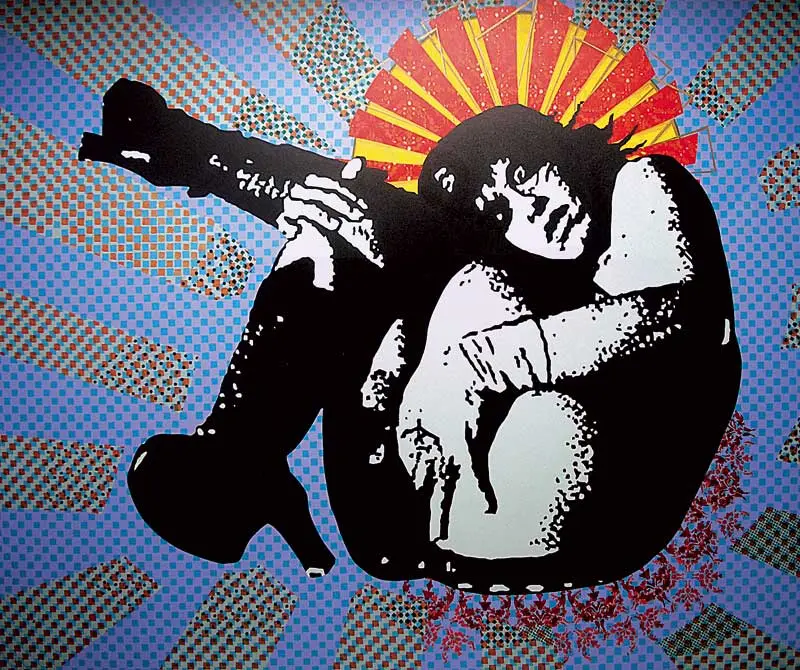
Since her earliest exhibitions, with both photographs and paintings framed within a Pop-Pomo very much her own—minimalistic and greatly provocative—Cacheila takes impressive liberties in the expression of women’s feelings. The audience’s first reaction, as well as that of some critics and art-world connoisseurs, was one of shock and puzzlement. How does a young artist dare to present such a controversial discourse in Puerto Rico, forever conservative when it comes to nudity, eroticism, and sex? The answer is in Cacheila’s philosophy of life: her honest conviction that women have every right to equality, every right to be women, every right to happiness and to enjoy sensuality, eroticism, and sexuality (something similar to what Sappho proposed in classical Greece and what, in the Nineteenth Century, Flaubert reminded us with his Madame Bovary).
This can be clearly seen in the development and evolution of Cacheila’s art. She has moved forward, inch by inch, in the construction of a discourse that is difficult—let’s look at what has happened with videos by Shakira and Beyoncé—from both an aesthetic and an ethical point of view.
Cacheila Soto was born in Mayagüez, Puerto Rico, in 1979, and graduated from the Escuela de Arte de Puerto Rico in 2003 with a Bachelor’s Degree in painting and with great recognition from her peers, local art critics, collectors, and art lovers in general. She holds a Master’s Degree in Museum Studies from Caribbean University (2012) and is currently studying towards a Doctorate at the Centro de Estudio Avanzado in Puerto Rico.
The young artist, whose career includes nine solo exhibitions both in Puerto Rico and abroad as well as participation in many collective projects, began to use the human figure at the age of 17; specifically, she began using the female figure, within a realistic, sensual, and erotic aesthetics.
Cacheila Soto was my student at the Escuela de Artes Plastics de Puerto Rico. I accompanied her and other students on a trip to ARCO and the Guggenheim Bilbao. During that trip and afterward we have shared plenty; I have seen her grow and I have celebrated her success. I have written extensively about her work, praising her professionalism, originality, and courage in creating metaphors for the essence of life: survival, beauty, sex, fertility, and happiness. Why then write again about her and her paintings? For a simple reason: in her latest exhibition, Morfopsicoanalogía, Cacheila Soto has decided to bring forth what is private, what is forbidden (as Michel Foucault would say), what is not spoken of self-pleasure, female masturbation.
As Balthus and later Eric Fischl did, Cacheila Soto creates in the best works on exhibit here pure poetry of ecstasy, of pleasure, of the sweet pleasure that tastes of honey and swords. Some of her compositions bring to my mind the facial and bodily contortions of Michelangelo’s slaves—where the great Master is able to combine, in sublimated orgasm, happiness and pain, the greatest totality of the human and the most terrifying emptiness—those “small deaths” that clarify our life.
In Morfopsicoanalogía, which remained open to the public from late 2013 through February 21, 2014, Cacheila Soto undresses and opens for us doors both to everyday life—rendered magical and mysterious—and to the greatest sexual intimacy: sexual self-pleasure and masturbation. Works of the caliber of Adoración, Fusión, Sublime, Converger, Manifestación, Paralelismo, Expansión, and Reminiscencia demonstrate clearly the great leap forward taken by this artist in her career and her personal life. I believe she has immensely helped her contemporaries—male and female—and the general public reconcile with their bodies, their sexual and spiritual needs/appetites/preferences, because, as Cacheila and her companion, the renowned Puerto Rican artist MERO know, we are all red-hot inhabitants of the skin and its desires.
MANUEL ÁLVAREZ LEZAMA