As stated in one of the curatorial texts, the exhibition by Frida Baranek on display between the end of 2013 and early 2014 on the third floor of the Museu de Arte Moderna in Rio de Janeiro was not intended as a retrospective. However, bearing in mind that some of the works included articulated her artistic trajectory from the 1980s, it was inevitable that the public would learn about the objects according to the artistic survey. Of course in Baranek’s case, this refers mainly to the exploration of the sculptural potential.
At the entrance of the museum, viewers are welcomed by a piece that immediately reminds them of the closeness of the cultural institution with one of the airports in Rio de Janeiro. An amalgam of unused aircraft parts, added to stainless steel, created a circular line of force that caused a break with the museum’s modernist architecture full of openings. While the gaps between the pillars allow the public to enjoy the urban landscape of Rio de Janeiro—generally interrupted by the departures and arrivals of airplanes—the circular structure reminds us of the concrete nature of the building, its height, and its inevitable relationship with the floor. Nonetheless, far from the sky, we have that stuffed plane that suggests a swirl that goes from nowhere to somewhere—a means of transportation that generally does not provide a slower traveling experience because of the boarding and disembarking race—and that by being placed at eye level, it invites viewers to regard it as part of the structure.
Within the exhibition space, the public can make their own route through the various works as they find the three-dimensional answers in Frida‘s proposals. A recent piece from 2013 titled Armadilha (Trap) welcomes the public beside one of her most iconic images, Untitled (1985). A red inflatable rests on the floor as a stone that hangs from the exhibition room ceilings threatens it. There is an interesting intersection between elements from classical sculpture and proposals that could likely belong to the generation that followed Marcel Duchamp’s experiments.
We are able to encircle this “sculptural group” by turning its form with our bodies. The verticality of this image and its monumental nature are also notable. Not surprisingly, the narrative that permeates this work also occurs in a top-down direction that highlights its dramatic force, like the sculpture by Laocoon, possibly the biggest icon of the classic narrative in marble, which has a central human face and, at the top of the sculptural group, its climax. Added to the complexity of the work there is the use of mundane materials that underscore the weight tensions here proposed: a stone and inflated balloon, a piece of the natural landscape, and an example of industrial manufacturing. Aside from the formal relationships that to me are very clear in this aesthetic proposal and in others by Baranek, could we try to interpret them from a semantic perspective that perhaps problematizes the industrial and the handmade?
In Diosa Imperial (Imperial Goddess, 1999), the artist shapes sisal thread in a cabinet made of steel and bronze. Here again, we could contrast the nobility of materials already established with the aridity and precariousness of sisal. That visual composition is reminiscent—because of the banal use of the furniture—to the work by Doris Salcedo, but at the same time, it is very different from Salcedos’ more political works. Perhaps, in an effort to expand Baranek’s semantic field, we could imagine her next to a Brazilian artist linked to surrealism like Maria Martins (1894-1973). Knowing Martins’ interest in the nationalist representations of indigenous mythology and in iron-based weight and volume configurations, it would indeed be an enriching experience to see both artists side by side. Instead of a reading that insists on emphasizing the connections to the 1980s in Brazil and its “young” and experimental art during the so-called return to painting and sculpture, it would be interesting to conceive Baranek’s production through a more intense temporal arch time that would also open the possibilities of international encounters such as the production of Louise Bourgeois.
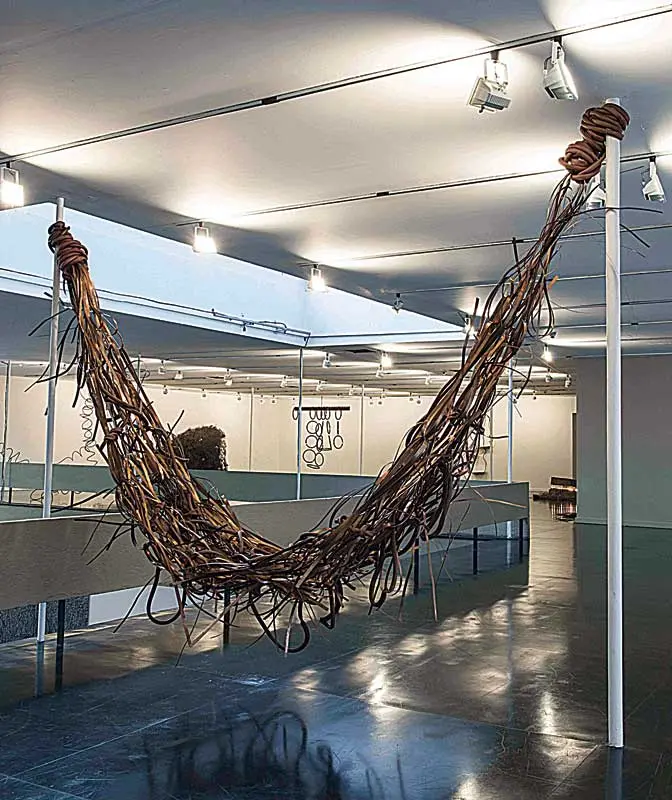
The red balloon and sisal threads make poetic pairs with other elements exploited by the artist in several works: in Grand Titre (1995), a structure reminiscent of a chrysalis that is full of lank balloons; Ma Mémoire (My Memory, 1998) brings back the sisal, but flattened, dripped on the floor; marble dust rehearses its fall in Balance 03 (2004). The banality of the materials is re-articulated through formal games that generally oppose such banality to the works with steel, stone, and iron. An example of this relationship is Tenor, Sentimental, Music, Gala, Fatal, Veto, Original, Moral, Brutal (2000), where a hammock is reconstructed with latex and bronze. Perhaps the most symbolic and inviting element in Brazilian culture, relaxation, is transformed into something in which the idea of rest is far from the viewer’s leeway for interpretation; the hammock becomes a bed of nails and a wild celebration, a supposed Brazilian take of the space, again becomes an image of discomfort.
This last word seems interesting as a tool to enter into a dialogue with Frida Baranek’s work. More than mere experiments, these are sculptures that appropriate elements associated with the public’s visual culture and recodify them into structures that are uncomfortable in the best sense of the word. That which is domestic becomes sculptural and so, gradually, Frida Baranek domesticates sculpture as she reveals its oxides and uncomfortable materiality.
RAPHAEL FONSECA