
São Paulo’s Berenice Alvani Gallery presented, between November
and December of 2013, the largest-ever retrospective of the prolific
German-born Brazilian artist Gisela Eichbaum’s six-decade career. The show was
curated by Carlos Suster Abdalla. The show was also an opportunity for the
launch of Canções sem Palavras / Songs
Without Words, a bilingual book edited by Abdalla, featuring an unpublished
text by Alvaro Machado and reproduction of critical texts by a variety of world
art figures, among them Maria Bardi and Mario Schenberg. The publication also
features, alongside the 55 works included in the exhibition, over 100 other
works by artists from different periods. The title harks back to a small
book published by the artist in 1986, inspired by Felix Mendelssohn’s piano
piece of the same title. The exhibition covers all the periods of Eichbaum’s work, from her first exercises, heavily influenced by expressionism,
to the abstractions that made her name.
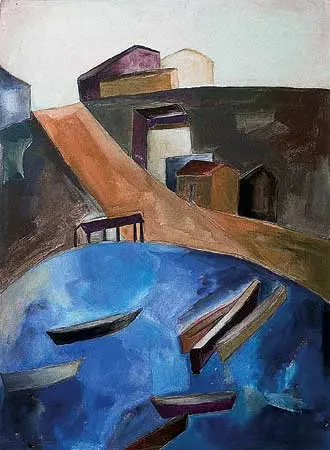
Eichbaum’s connection with music was lifelong. Born in Manheim in 1920, she immigrated to Brazil in 1935 with her parents, both musicians who made their living teaching their art. Eichbaum herself learned the piano and often demonstrated her skill in parties organized at her home with the presence of many internationally renowned artists. As a career, however, she chose to transform the rhythms and melodies that interested her into brushstrokes and graphic elements. The development of her oeuvre displays a careful effort towards abstraction, achieved step by step, with discipline and drive, as though the artist moved on to the next phase only when she was satisfied with the results of the previous one and pushed forward driven by the search for new challenges. Nothing is abrupt. On the contrary, Eichbaum’s transitions are fluid and retain always an essential core: in her case, draftsmanship. Her earliest works, from the 1940s, evince the influence of Expressionism, a forceful movement in Europe during the first decades of the Twentieth Century. In Terra Brasilia, Eichbaum connects with artists who had a similar language, such as Karl Plattner, Lasar Segall, and Yolanda Mohalyi, the latter a close friend with whom Eichbaum collaborated closely in several projects.
In the artist’s trajectory, some elements remained constant across a variety of techniques and themes. Mainly, the tracing of drawing lines, which are present throughout her entire oeuvre. Initially, they were there to structure the composition, as in Desperation or Girl with doll, two watercolors from 1944, or The Adoration of the Magi, a gouache from 1957. In later abstract works, the line gains autonomy and status as a protagonist, in strong monochrome graphics that exert different rhythms and intensities. Always, her traces are omnipresent from watercolors to gouaches to experiments that combine colors, China inks, and ball-points. Paper was her preferred support, despite having also worked with oil on canvas. The formats of her works are discreet, in a scale that is welcoming for the viewer, who can relate to them in a closer and more human, perhaps more empathetic, way.
Gisela Eichbaum’s colors go through a gradual intensification; at first, her palette is softened, dominated by discreet combinations of pastel hues, some earthen tones, that refer to the colors of her native Germany. As the tropical landscape is assimilated, the artist added colors that are bolder, saturated, and contrasting with each other. Yet even when she uses a more intense palette, Eichbaum’s paintings display a certain melancholy, a colorful melancholy present in her portraits and figurative works with unsmiling or faceless characters, cityscapes, and titles like Keep silent or The Empty Table. Already in her abstract works, we find an element that cannot be fully apprehended, as though those “fantasy landscapes” belonged to the realm of dreams and appeared to our eyes half-diaphanous, half-ethereal, clearly utopian.
Young Gisela, the daughter of Hans and Lene Bruch, two master pianists, came with her father to São Paulo in 1935 to join Lene, who was Jewish and had fled a political situation where “mixed marriages” were prosecuted and which was on the verge of turning murderous. She frequented Yolanda Mohaly’s studio—the two became close friends—and the São Paulo Abstraction Atelier, founded by Samson Flexor. Throughout a career spanning almost six decades, Eichbaum received several awards, participated in three São Paulo biennials and many salons and group exhibitions in Brazil and abroad, and more than 25 solo shows. She died in São Paulo in 1996. Her legacy is that of a road followed with persistence, moving away from figurative not under the pressures of the fashionable but by the natural maturation of her own expressive language.
SYLVIA WERNECK