
EXIT, the anthological exhibition curated by
Walo Araujo, could be defined as an oblique biography of his brother Gustavo
Araujo (1965-2008) and a multifaceted tribute to the artist and the man.
Evidence of this is the emphasis on self-portraits and portraits of friends and
family, the flawless deployment of some of his notebooks, an album of childhood
photos, and revealing comments from the artist.
The show also included a selection of four major groups: the laconic black-and-white photographs taken at the beginning of his career in New York and Panama (1996-1999), his lightboxes and digital animations (2000-2002), his street photography (filled with fascinating moments and details: Gustavo was one of the artists who most keenly portrayed Panama City’s extravagant idiosyncrasies) and the oils painted in his last years of life.
Of his works, the lightboxes and photo-animations have received the most critical recognition. Wind and dreams—both “magical” forces that burst into reality—are frequent protagonists of his large lightboxes, whose medium belongs to the field of advertising and industrial design. People and things are portrayed from different angles and juxtaposed in grids of interrupted sequences. The passage of time, central to these works, is unusual in photography. But the moving picture cannot give us this: a narrative both disjointed and simultaneous. His grids motivate the eye to jump from one image to another, trying to construct a personal interpretation, always different from the previous one. Each of the images exists in a different, unique time, yet coexists with every instant of the fragmented work.
His very first images already evidence a certain rejection of stasis that will soon become a rejection of the exclusively photographic. People are captured in full motion, blurred or with ambivalent gestures, the various angles disturb the image, and the photographic gaze is elliptical. All photographs—he seems to suggest—are too literal. In order to dislocate the image, to see through it, and be able to discover something that intimately defines it, one has to stop looking and thinking only photographically.
The core of that search may come from the artist’s fascination with happy childhood memories, summarized in family trips to the beach. Several of his photographs are attempt to reproduce the atmosphere of those days and his notebooks are full of allusions to the subject. In fact, the ocean and the beach run through all the work and life of this artist, who was also a surfer.
Photo-animations such as Red Frog and Isla Grande convey a sense of loss by the slow disappearance of the figures. Something similar happens with several other pieces, such as the double billboard titled Hans and Nils: on one side two children play on the beach, and on the other, only their traces are left in the sand. Bocanadas (Mouthfuls), the lightbox with images of bubbles, is the product of submarine exhalations of a Gustavo that does not appear on camera.
Then again, interpretations of these four works could be different. The two looped animations show the gradual disappearance or distancing of people that nonetheless reappear again and again. We just have to walk to the other side of the billboard to see Nils and Hans return. Bocanadas can also be considered a self-portrait.
In these and other works, presence and absence are constantly replaced, and time and space are broken, suggesting that the past does not die so easily. Fragments call for the greater whole to which they belong, like melodies for the music piece, or the sway of the waves for the sea. The hypnotic and primal sound of that sway, which constitutes the audio of Red Frog (one of his most lyrical pieces), spread to the adjoining rooms in this exhibition, affecting our perception of the works shown there—all with the ocean theme.
Gustavo worked in advertising photography before and after he began to exhibit his art in the mid-1990s. His artistic career was short-lived and yet as I said, he showed a marked development that transcended photography. His innovative leaps were many: a media readymade, public billboards with a brief phrase, an audio piece, digital animations, and countless experimental projects that never came to fruition.
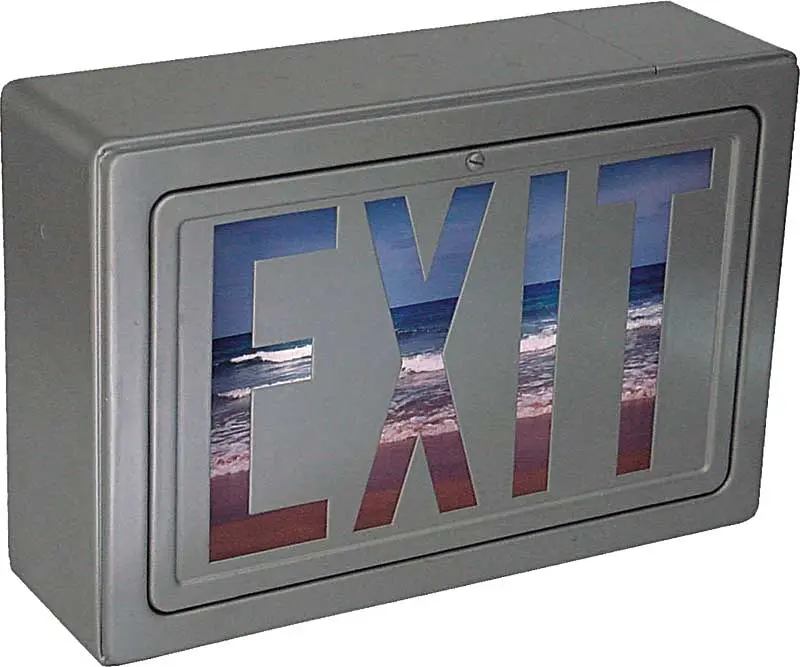
Despite the characteristic rigor and enthusiasm with which he explored painting, I think his foray into this medium was a fertile cycle that eventually would have taken another direction: a possible confluence of digital technology, painting, and urban art. Or, conversely, to ultra modest and refined proposals: perhaps something along the lines of Exit, the beautiful conceptual piece that gave this exhibition its title and that condenses Gustavo’s most intimate emotion: an aching joy for life.
NOTE
1. Johann Wolfschoon was in charge of the exhibition’s design.
ADRIENNE SAMOS