“(…) The experienced world is entirely less pacific, it is composed of a dissonant multiplicity marked by strong contradictions and tensions”
—Athanasius Kircher
One thing that defines any project by Colombian artist Ícaro Zorbar is the dramatic character he gives to the spaces in which he works. The installative nature of his art colonizes the site with disarticulated devices that seem to come back to life. Each proposal brings to mind the fascination generated throughout history by machines that produce images or sounds. Zorbar invents other times and forms on the basis of experiments with audiovisual language, and above all with that almost child-like obsession with taking things apart to ponder, revise, and strip them of their basic functionality.
In baja definición: a
partir de este momento los días cambian, Zorbar mounted several
installations that, as he points out, “make the gallery space vanish.” This
wasn’t a predetermined goal, but each work diminished the importance of the building’s
walls, to the point that—at least at night—they were hidden from view. The
power of the “total image” generated by the exhibition came from the halo of
mysticism generated by the creation of several spaces. Light and shadows were
the basic materials for the work, which as a whole evoked both the earliest
image projectors and a science fair.
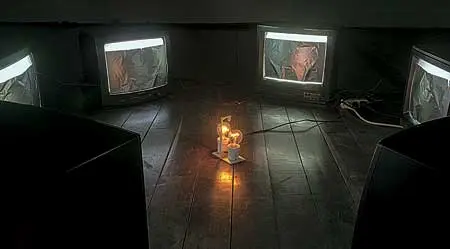
La luz que brilla con el doble de intensidad dura la mitad de tiempo (2013) was a cabinet installed in the room were the show began, a metallic piece of furniture invaded by jars interconnected through a cable. Each jar contained mineral oil and a light bulb, turned on. Zorbar used electricity as a material to give an aura of spirituality to the assembled objects, a maneuver that his installation El títere y el tiempo (2013) exacerbates to the point of shocking the viewer with the activation of a spark of electricity.1 As in a ritual, a group of TV monitors appeared in the room with their screens covered by aluminum foil, almost “looking” at each other, with light bulbs turned off at the center of the scene. The system activated the light bulbs slowly with the energy coming from the monitors, yet the power overcame their resistance and a small electrical explosion—with the usual sound—had the expected effect on the viewer.
For his installation En 97 años estaré muerto (2013), the artist built a sky dome using cardboard and light bulbs, where viewers had the sensation of dawn and dusk in a shortened time span. Zorbar was able to recreate an experience of both strangeness and familiarity in a single instant. It is impossible to describe every work with greater specificity, but it must be said that each one of them was a suggestive image that infuse the whole exhibition with an air of suspense.
It should be remembered that in the Middle Ages, students of technical events gave their research a theo-physical connotation; the so-called electrical theologians understood that “the discovery of electricity, as well as magnetism and Galvanic phenomena in nature connected with the presence of God in the world, and as a consequence of that novel idea of the divine a new understanding arose of the relationship between soul and body, between spirit and matter, between life and mass”.2 This reference alludes to one of the historical moments when vision and sound machines took a bold, definitive leap forward for future generations, an influence that hasn’t escaped Ícaro Zorbar.
“Machines have a desire for perfection that we sow in them, and
which sooner or later will fail. Humans understand perfection as an
objective—success—forgetting that only error makes advancement possible. I
think that playing with this breaking point reminds a bit of our own
fragility.” This is what Zorbar says about his gamble in baja definición: a partir de este momento los días cambian.
NOTES
1. It is worth remembering that “the audio-visual experience” of shock has played a crucial role in the theoretical study of images and audiovisual language. The classical idea—derived from the dramatic arts—that such shocks have a purifying effect on the soul comes to life in Zorbar’s installation in a playful and romantic way, and of course it evokes the notions developed by Walter Benjamin around this idea in his famous essay on the place of the work of art in the age of mechanical reproduction.
2. Zielinski, Sigfried. “El modelador mediatico de Loyola. Athanasius Kircher en el contexto de una arqueología de los medios” In Genealogías, vision escucha y comunicación.
ERIKA MARTÍNEZ CUERVO