Julio Larraz’s most recognized influences come from renowned
artists from the School of American Realism like Edward Hopper (1882-1967) and
Andrew Wyeth (1917-2009). This is not a surprise since Larraz trained as a
painter in New York, in a period in which he coexisted with several of them.
Like these artists, Larraz’s brushstrokes are contained and undoubtedly generate the illusion of absolute realism, a mirage that vanishes when we move into the
works and discover a complexity that goes far beyond the accurate representation
of his environment.
Among the most visible formal elements of Hopper’s work that influenced Larraz is the way in which the painter would solve his compositions. In the work of both artists, there is an apparent serenity that is actually disturbing. It is perhaps a certainty that there is more content in the images than the eye would lead us to believe. Supposedly the narrative of his paintings is clearly presented, however, again and again, we find ourselves trying to decipher every detail.
Larraz’s works are full of very personal symbolism. They become a kind of catharsis similar to the one that can be found in the pages of newspapers. He paints as if he was telling a story that combines biographical and fictional elements in equal parts. There is an oneiric component in many of them that make viewers wonder whether the image is the representation of a specific, real, place or has been completely imagined by the artist.
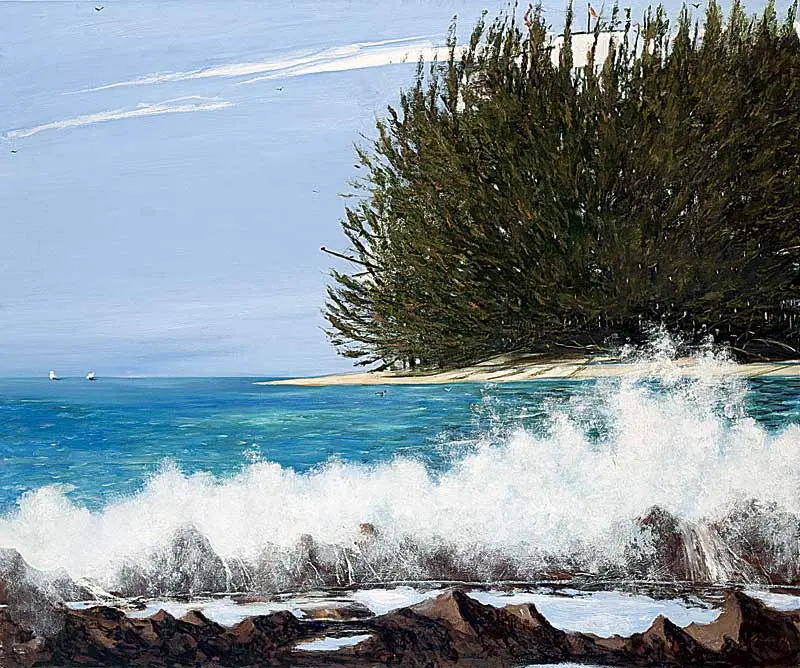
Larraz incorporates key elements in his compositions in a very subtle way, as he leaves clues in the titles. A good example is One Day in October, a representation of the arrival of Christopher Columbus in the Americas. If we do not know the title we may think that we are facing a seascape—as the sea is the undisputed star in the composition—that continually batter short waves in the foreground. Then we eventually notice the caravels, one hidden behind a bush, and the other two insinuated as small dots on the horizon.
Another interesting aspect of this piece is the theme, which may prove controversial, and the manner in which Larraz represents it. While other artists focus on the most dramatic aspects such as excerpts from the conquest and all that that entails, he has selected the time of arrival. Again, the suggestion through strategic elements opens entire series of readings and questions, with the viewer having the last word at the end.
An important part of the works in this exhibition are aerial perspectives that the artist has created with his imagination, without any other visual support. These bird’s eye views demonstrate Larraz’s mastery of perspective.
Through his works, Larraz creates a very peculiar world where anything can happen, as in The Daring Rescue of General Acapulco. The piece consists of the suggestive image of a lonely house in a forest surrounded by a coastline that occupies most of the composition. To the right, lights from torches insinuate the marching of the group going to the rescue of the general in question. The questions can be many, like the responses and stories prompted by the imagination.
Each of these pieces succeeds in inspiring a story in which the narrative can be derived from individual fantasy. And this is precisely what Larraz is after, to let each person delve into his/her thoughts and each image to provoke readings or memories according to the individual’s own experiences.
Coming Home marks an important point in Larraz’s career. It is his first personal exhibition after 25 years in Miami, the city where he currently resides. It demonstrates his versatility as a painter, palpable in the themes represented, which range from classical still lifes to scenes inspired by historical facts. It is a compendium of the issues that have been preoccupying him in recent years. His landscapes and still lifes coexist in the same space, we can see in them his life experience by discovering fragments from the various places that Julio Larraz has visited and lived in.
IRINA LEYVA