This
exhibition of works by Carlos Jacanamijoy, carefully curated by historian
Álvaro Medina, is a retrospective covering over twenty years: from 1992, when
the artist’s career began after graduating from Universidad Nacional de
Colombia, through 2013. A large-scale exhibition of Jacanamijoy’s work, long
admired by many and derided as artisanal by others, was certainly needed. As
Oscar Wilde wrote in his famous essay about art and the handicraftsman: modern
art (and contemporary art, we would add today) is intimately connected to
handcraft. This is not the place to delve into this fascinating topic, but
let’s take the opportunity to state that handcraft, seen on occasion as
something negative and connected to a kind of virtuosic display, strangely and
mistakenly negated in contemporary art, is one of Jacanamijoy’s strengths.
After visiting the exhibit, we can say that Jacanamijoy has demonstrated not only that his work is the result of a sustained and rigorous effort, but also that painting is not dead by any means, contrary to an idea that gained currency among us precisely a little over twenty years ago. In that sense, Jacanamijoy is an artist who has persisted with great tenacity in the construction of a visual language where the indigenous imagination, from his own Inga ethnic group, consolidates into an oeuvre that has reached the level of maturity needed to demonstrate that art is a matter of perseverance and sustained work, where tradition and contemporariness combine.
How is it possible for an artist from an indigenous background, educated at an art school where aesthetics is founded on Western, European values, to communicate in the elements of the work of his own culture? Álvaro Medina explains it as follows:
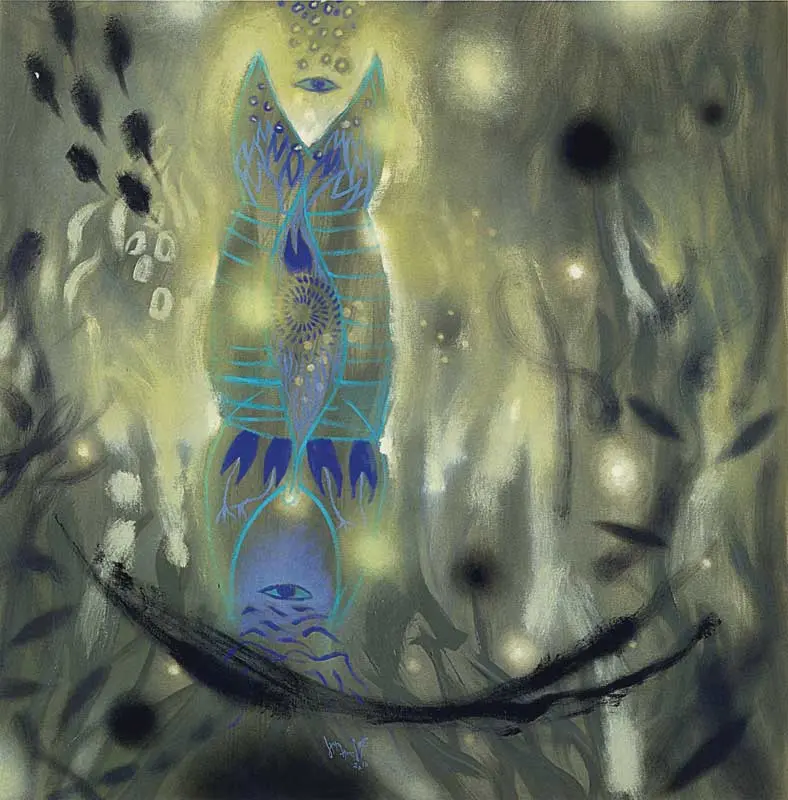
“Memory generates remembrances, which Jacanamijoy expresses through magic and color. We encounter images composed with the formal freedom that this academically-trained indigenous painter was able to take from the expressionism and abstraction of the European avant-garde. Bringing together figurativism (landscape spaces), expressionism (the combination of blotches and gestural brushstrokes), and abstraction (the landscape of compacted forms without a horizon) (…) he has been able to paint sui generis poetic atmospheres whose highly dynamic chromatic flows are connected to the ritual practice of yagé (…)”
Indeed, the chromatic explorations in Jacanamijoy’s work are difficult to situate within a pictorial genealogy. His visual universe is populated by ancestral memories updated by his connection to the contemporary. This kind of anachronism as understood by Didi-Huberman, where the past permeates the present, makes his oeuvre the site for the apparition of a series of objects that hark back to family stories, the countryside, or the forest, filled with vegetation we have never seen before and colors that suggest unknown aromas.
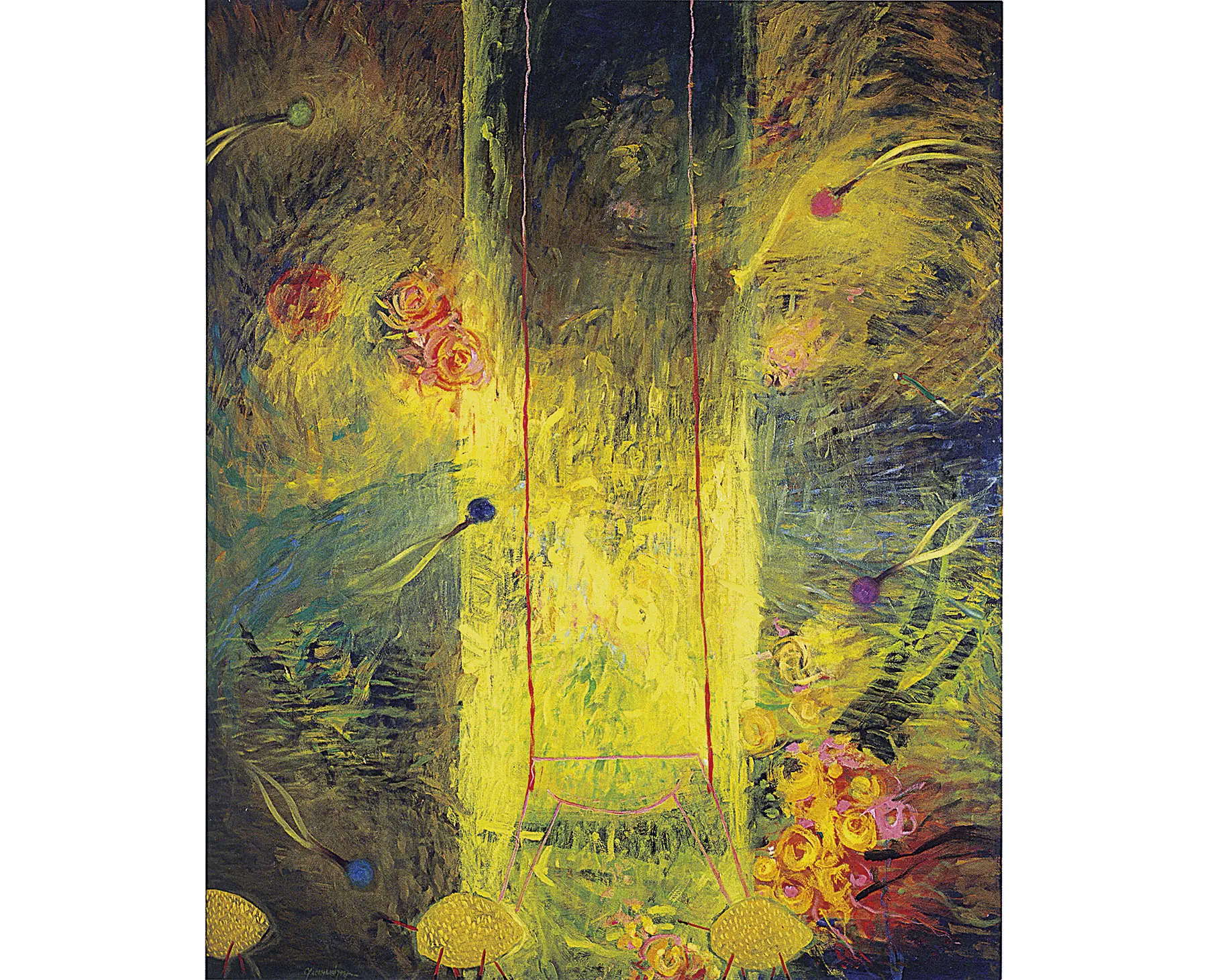
His paintings are enigmatic and possess a poetic charge that is already foreshadowed in their title. For example, his Vuelves, los tomas y los lanzas (1996) features a reminiscence of the wooden bench where the artist’s grandmother used to sit. The object is surrounded by a series of chromatic turbulences that recreate the intimate atmosphere of an Inga home. By the late 1990s and the turn of the century, Jacanamijoy’s art becomes somewhat more abstract; his colors are increasingly more forceful and luminous, contrasting with more somber atmospheres. For example, Ímpetu al amanecer (2000) materializes the sensation of an experience in his grandparent’s chagra, where nature dies and is reborn in a permanent cycle, where the cultivation and rest of the land is part of that motion of life.
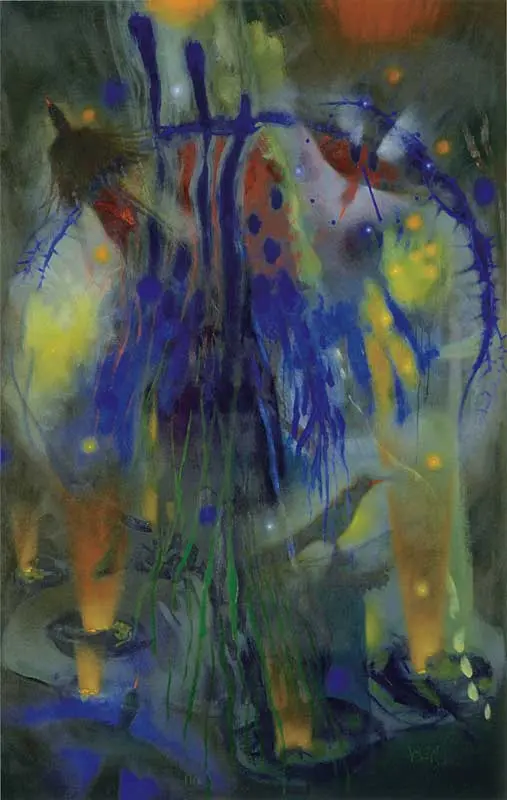
An interesting element in Jacanamijoy’s oeuvre is what Álvaro Medina relates to “free association,” where childhood memories (the grandmother’s chagra) and contemporary experiences (a New York church and its lights) intermix with sensations of bird songs here and there, now and then. The literary text serves to intercut the mixture: for instance, in 5:30 pm adora el Amarillo, su pájaro es el mirlo, su hora la noche (2013), whose title is taken directly from Julio Cortázar’s Rayuela.
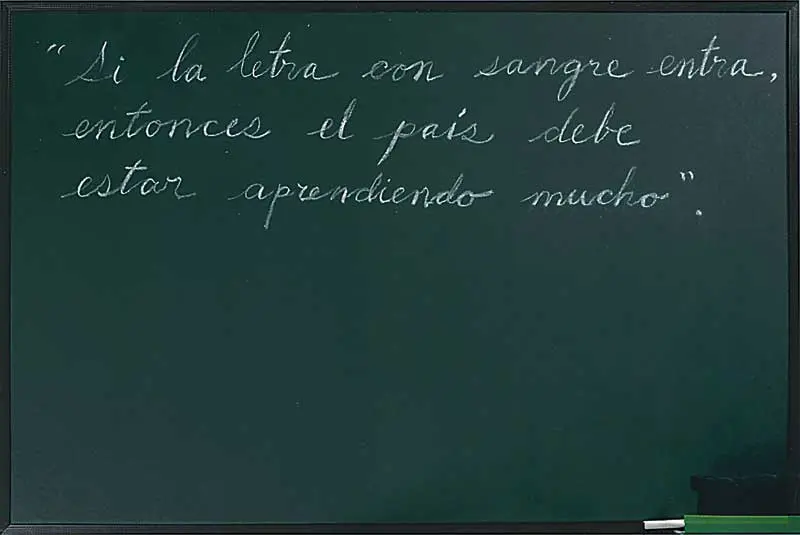
Something that did puzzle me in this exhibition: the series of Tableros or green boards created in 2013, similar to those encountered by the artist when he began attending school as a child. In them, written in white chalk, we find sentences like: “The sense of sight is the same in all human beings, but each one sees differently.” Under it, a plaster relief of an eye also painted green. In other of the boards, we read “If a letter is better taken in with blood, then our country must be learning much.” This unexpected leap into conceptualism surprised me. It is a bold exploration that breaks the myth of the “style” to which the artist was tied. But, as the song says, “Twenty years is nothing…” I believe that Carlos Jacanamijoy will continue to surprise us for a long time. This is just the beginning.
RICARDO ARCOS PALMA
Culture theorist and critic.