A mysterious architecture with airs of a sacred temple looks out
from the interior of infinite space and time marked by Displaced Areas and Other Triggers, the title of the exhibition by
Maria Elena Álvarez (Venezuela, 1964), at Galería 39. The canvas
surfaces—juxtaposed fragments, sometimes transparent in their whites, others
dark with Prussian blues or boundless blacks—are inhabited by beings, loves,
sacred places, pasts, and presents, and also by a constant concern for the act
of creation poured into the continuous work hours of the day and night. Invited
by the tranquility of her inner silences, the artist delves into the complex meandering
of art, of her own art, always supported by rigorous study and a dedication to
research in all the visual mediums that she has practiced: painting, drawing,
photography, collage, engraving.
The visual inquiries by María Elena Álvarez exist to materialize in an “I do not paint images, I paint words.” It is a declaration of thematic and aesthetic principles and aesthetic attitude in the face of a visible reality of irreducible solitude. Since her school days studying the visual arts, mainly in photographic media—University of Hartford, Connecticut, and a MA from New York University, NY—painting have been a fixed target, notwithstanding her very complex relationship with the medium: “When I focused on photography, and as I would be studying an idea, the pictorial medium would turn around to face me.” This pictorial research experience during that intuitive and energetic period, led her, upon her return to Venezuela, to establish a singular relationship between the two mediums. Photography and painting are amalgamated into “free structures,” something that could be considered as a generic title of works that are always created with acrylic on canvas. Thus photographs eventually become visual references that aid in the creation of paintings; references that offer clues in the search for the invisible.”
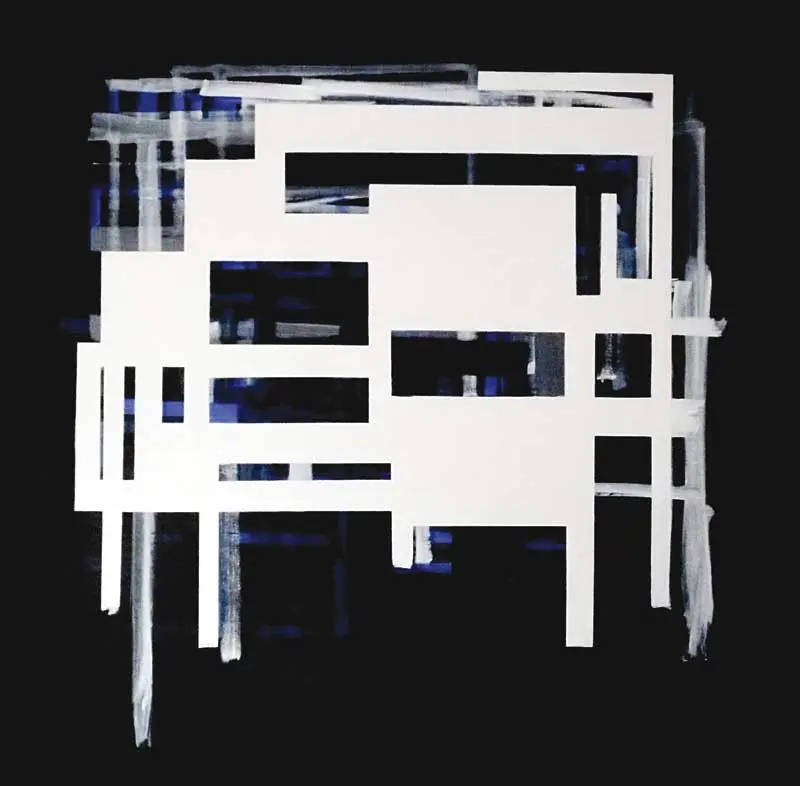
A close look into the development of Álvarez’s work since her first exhibition in 1997 shows her rejection of the pictorial representation tradition: «I›ve never been figurative.» However, there is a certain baroque style present in her artistic production from the early 2000s, something that reveals, in the small «windows» formed by the intersections of the grid, miniature figurative elements: character portraits, trees, houses, and tables.
A sort of aesthetic asceticism has led Álvarez to use the austere chromatic logic of black, white, grays, and blues that is reminiscent of her first cherished interest in photography. Her new formal experience is anchored in minimalist codes, a kind of spiritual geometry that, while it might appear a non-signification, discovering other landscapes within landscapes actually opens a communication network, a condition to turn “words” into signs, stains, empty or filled squares. It is the “representation” of an idea, not as an abstraction but as the tracks from which it speaks to concatenate the non-visible with the visible. And she succeeds.
The series of works of Displaced Areas and Other Triggers center on the pictorial itself. It consists of large white spaces that, to paraphrase the title of her 2010 exhibition “reinvent other realities,” dominate as an internal instigator. Here, the artist expresses interest in a private inquiry on the behavior of the compositional structure. There are more open spaces but contained, this is to say, more “windows” through which to approach the underlying meaning of a theme that can be a confession, a song, or a cry. Or expressive nudity of poetic whites accompanied by areas outlined by exalted blues or blacks, or other sections that hide behind brilliant overlays. Maria Elena Alvarez rejects any artificial structure in her work, from the concept to the theme to the use of formal elements. The grid, the vertical and horizontal stripes, and the color squares make up the complex compositional syntax of work of the high expressive force.
Hers is a lucid pictorial vision characterized by an “obsession for secret stories,” that offer the possibility of multiple readings. In this work, the reality is not immutable. Álvarez offers a universe without stagnant punctuations. Hers is a contained personal and artistic universe, rendered in pauses, mysterious silences, and expressive concerns. The artistic expression of María Elena Álvarez approaches the spirituality of minimalist abstraction of the great artists in the universal history of art. Could the exaltation of a secret religion be considered? Or of a metaphysical one, perhaps?
BÉLGICA RODRÍGUEZ