María José Arjona returned to Colombia in mid-year after a long stay in New York and, with the support of NC-arte, presented at the Galería Mor Charpentier the performance Pero Yo Soy el Tigre (But I Am the Tiger), curated by Eugenio Viola.
The title of the piece was taken from a text by Jorge Luis Borges titled A New Refutation of Time. This story revolves around three arguments, one based on the world of dreams, and ends this way:
Time is the substance I am made of.
Time is a river which sweeps me along, but I am the river;
It is a tiger which destroys me, but I am the tiger;
It is a fire that consumes me, but I am the fire.
Time and the body are the elements that performance is made of, as María José Arjona has demonstrated throughout her work. “I think that artists are, above all, time manufacturers.” She said a few years ago. “(...) Performance artists use the strength of their bodies more than anyone else in order to manufacture time with them. And time manufacturing based on the body is somehow that which establishes a vision (...)”
On this occasion, to “establish a vision,” she carefully chose the place for her performance. She chose a marginal place that is seldom frequented by the public that attends arts events, but one that she knows very well because it is just a few meters from the university where she studied. There, when she was still a student, she had access to other less “elegant” and quieter forms of life. It was in that place where she learned about the deep solidarity people demonstrated to each other, amid a tough, violent and neglected environment.
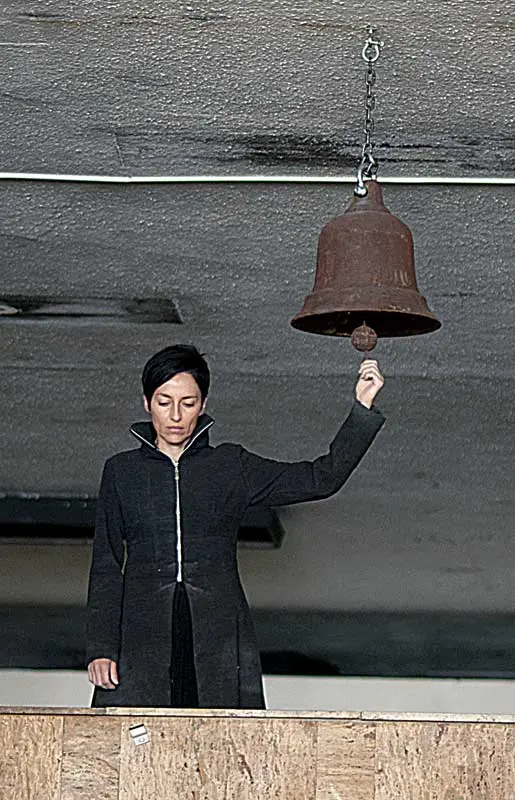
I arrived at the site where María José Arjona’s performance was to take place after having traveled through some noisy and deteriorated commercial streets where I saw hardened faces, some of them frightening. I walked through a conglomeration of motorcycles parked on the sidewalk and walked into an old warehouse that looked as if it had been abandoned a long time ago. After going through a dark alley, I entered a double-height space. At one end I saw a pile of demolition material and it was clear that a lot of debris had already been extracted. At the other end, there was a sort of carpet with lumps of various sizes perfectly ordered. In the lateral spaces, several white tables hung from steel cables; tiny stones, rubble with pieces of plastic, wire, fragments from everyday objects were arranged on the tables with the rigor of an archaeologist. In the background, behind a row of columns, a young woman tattooed on the arm of María José Arjona a number that alongside others formed rows of numbers on her skin. After nearly an hour, when the tattoo was finished, she, with her black felt coat, got up, went upstairs, and rang a bell. The sound indicated that the work for this day had ended.
I could only access that moment that was preceded by sixteen days and then went on for four more when the performer in an eight and sometimes nine hours stretch would extract from the rubble fragment that which could evoke the life going on in a family home adjacent to the recently demolished warehouse. Each of these selected remains was counted aloud during Arjona’s performance, and each number engraved on her forearm corresponded to the amount of debris that was removed during the day.
Also, the sound of her voice was recorded and reproduced through four speakers, creating a sound field that challenged the chronology, just as Borges did. The recorded sound and live voice converged simultaneously so that the past would converge with the present to create a circularity that seems foreign to the manner in which we westerners order time. By her own account, when people accessed the site she would, as she often did, lock eyes with the viewer and emphatically name the new number. This gesture at that moment would encourage the encounter of two bodies and would actively engage the viewer, as it emphasized the substance the performance is made of: time and body.
I was not present in those moments when the performer moved back and forth across the space, nor did I ever hear her voice. To write this review I have relied solely on records and a conversation I had with the artist. But having reached the place and having accessed the installation that gradually emerged during the performance, and by being present during the time of the tattoo, it turned out to be enough to have a dream a few nights later in which—as it at times occurs during our nights—times and bodies get confused. I dreamt that as I raised my arm I noticed those indelibly fixed numbers that so impressed me. Upon awakening, they were no longer there but were fixed in my mind and I know that they will forever remain in this other body that is a product of time.
MARTA RODRÍGUEZ