
The drawings of Natalia Revilla in recent years have explored different forms of representing violence. Revilla studied historic documents of the armed conflict between the Shining Path and the Peruvian government, but also everyday threatening scenes, destruction, and grief. In her previous solo exhibition titled The Future is the Next Past (2012) at the Centro Cultural Ricardo Palma, Revilla presented a series of drawings on canvas based on press photographs from the 1980s and 1990s, where the bodies and missing elements in the images allegorized the denial of social antagonism. Revilla pointed with these works to an unresolved tension in the life of postwar Peru: why have certain things been legitimized to be shown while others have not and have been deemed as unrepresentable?
This game of absences has been a constant in her work since 2010, first as an attempt to explore intimate and affective imagery, and then through a frontal observation of the social body transgressed through images that mainly relied on the cut-out as a tool for representation. The artist imagined the drawing as the record of an action. “Action is to Hurt, to Draw with Emptiness,” noted Revilla. That cut on the support can also be interpreted as an attempt to intervene in the memory of those images, noting the difficulty of telling and constructing those stories. At the same time, those sections of pure emptiness pointed not solely to a sum of missing signs, but also to the imaginary formations that build the limits of what we accept or repress at the moment of perceiving reality.
In this new solo show, The Invisible Is a Place (2013), Revilla evokes images that arise from a recent personal trip she took to the Amazon in Peru, a place that she frequently visited as a child. She was able to observe the drastic changes suffered by different landscapes and natural areas. Thus, Revilla decided to collect a series of representations of those transformations that occurred both as a result of human intervention and natural phenomena. Revilla looks at these changes as the traces of , between individual memory and the contemporary survey of those spaces that today are marked by abandonment and predation.
One of the main pieces in the exhibition is the cut-out drawing Sin Título (Untitled, 2013) that depicts a precarious-looking flag sadly placed in the middle of a road over pieces of wood and other remnants. The piece is based on a photograph taken after the incident known as the “Slaughter of Bagua,” a crackdown carried out by the government of Alan García on June 5, 2009, against Amazonian villagers who had blocked the road as an attempt to curb the privatization of their lands. The image has a sense of tragedy, ruin, and helplessness that alludes to a broken project of the nation amid a landscape that was a significant part of Revilla’s life experience.
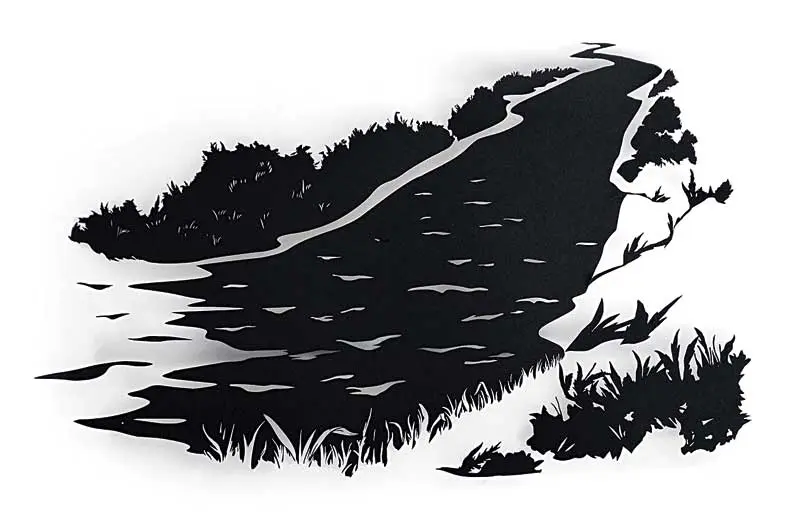
Another major piece, Río Negro (Black River, 2013) presents a three-dimensional fragment of the Marañón River cut-out in black color. The work, suspended over the ground, is like an enigmatic entity that, when we stand in front of it, we feel that something terrible has happened without knowing exactly what as we inject our own sense of grief into the object that emerges. The darkness of the river and its environment evokes the devastating effects of pollution as if it were the direct opposite of blind campaign advertising and economic celebration discourses of the country in recent years.
Another series of four hyperrealist charcoal drawings also show disturbing enigmatic representations, all based on photographs circulated in the mass media: from an image of contaminated river water, a truck carrying illegal logging, a crack that resulted from an earthquake, to the perforations produced in mountains by dynamite during road construction. In all of these cases, the works depict dysfunctional landscapes that, like many of the other pieces in the exhibition, convert the images of individual memory into the echoes of a collective disaster. These drawn territories appear to be speaking to us already from a place of loss: the scenes by Natalia Revilla are also scenographies that, somewhere between the documental and fictional, communicate with angst future flashes of a tragedy that appears irreversible.
MIGUEL A. LÓPEZ